Imagine walking into a room full of people and feeling your heart race — not just once, but every single time. For an estimated 7.1% of U.S. adults — roughly 15 million people — this is daily life with social anxiety disorder, according to the National Institute of Mental Health.
Many people with social anxiety feel profoundly isolated. They want connection but worry they’ll say the wrong thing, burden others, or face judgment. The fear keeps them from reaching out, even when they need support most.
Here’s what you’ll gain from this guide: a clear, 7-step blueprint to build and maintain a powerful support system for social anxiety. You’ll learn practical ways to assess your current network, find understanding people, ask for help without panic, and strengthen those bonds over time. Along the way, you’ll see real-world scripts, expert-backed strategies, and research-backed reasons why this matters.
A well-designed support system for social anxiety is more than just having people around — it’s having the right people who understand and help you grow. This guide draws on clinical insights and resources from the NIMH, Mayo Clinic, and APA to give you actionable steps you can start using today.
For a broader foundation, see our guide on Signs of Mental Health Issues:The Ultimate Guide to Social Anxiety Disorder: Symptoms, Causes & Proven Treatments 2026
What is a Support System for Social Anxiety? — Support System for Social Anxiety Overview
A support system for social anxiety is a network of people and resources that provide understanding, encouragement, and practical help when social situations feel overwhelming. It reduces isolation and gives you safe places to practice connection at your own pace.
What is a support system for social anxiety
Think of it in layers. The innermost circle includes one or two trusted people who know your challenges and respond with patience instead of pressure. The middle layer might include online communities or support groups where everyone shares similar experiences. The outer layer includes professionals or apps that offer structured guidance.
Each layer serves a different purpose: emotional validation, accountability, and skill-building. Together they create a safety net that makes everyday interactions less daunting.
How it differs from casual friendships — tips for building friendships with social anxiety
Casual friendships often revolve around small talk and group activities that can feel exhausting when social anxiety is involved. A true support system, by contrast, focuses on mutual understanding and low-pressure interaction. You don’t need to perform or hide parts of yourself.
Tips for building friendships with social anxiety start small: shared interest groups (book clubs, hiking meetups) where conversation has a natural focus. The difference is intentionality — these connections are chosen because they feel safe, not obligatory.
Who is most affected? — signs you need a better support system for social anxiety
Social anxiety touches people across ages, but it often hits hardest during transitions — starting college, changing jobs, or moving to a new city. If you notice yourself canceling plans more often or feeling drained after even brief interactions, your current network may need strengthening.
Expert Insight
Licensed clinical psychologists emphasize that a support system for social anxiety works best when it feels safe rather than overwhelming. The goal is steady, manageable connection — not sudden immersion.
For a broader foundation, see our guide on Signs of Mental Health Issues: Social Anxiety Medications: What Doctors Around the World Actually Prescribe in 2026
Why a Support System for Social Anxiety Matters — Signs & Importance
Strong social connections act as a buffer against the isolating effects of social anxiety. They remind you that you are not alone and give you concrete proof that safe interactions are possible.
Early signs to watch for — signs you need a better support system for social anxiety
You might notice increased withdrawal, physical symptoms before social events, or a growing sense that no one truly understands. These are signals your current support isn’t meeting your needs.
Long-term impact if ignored — how to strengthen your support system for anxiety
Without support, social anxiety can quietly limit career choices, relationships, and daily joy. Strengthening your network, even gradually, helps prevent this cycle and builds resilience over time.
Who should be most concerned?
Anyone who feels their anxiety consistently blocks meaningful connection — whether you’re a teenager navigating school, a parent managing family events, or a professional avoiding networking — can benefit. The earlier you start building, the easier it becomes.
AI Overview Snapshot
A support system for social anxiety provides emotional safety and gradual exposure to connection. Research from the American Psychological Association shows social support bolsters resilience during stressful situations, making it easier to face social challenges without spiraling.
For a broader foundation, see our guide on Signs of Mental Health Issues: How to Manage Social Anxiety Every Day Without Letting It Control Your Life
How to Identify and Assess Your Current Support Network for Social Anxiety
Start by looking honestly at who is already in your life and how they make you feel.
Steps to create a support network for social anxiety
List the people you interact with regularly. Rate each one on a simple scale: How safe do I feel being myself? How often do they respond with understanding rather than advice to “just relax”? This quick assessment reveals gaps you can fill intentionally.
How to ask for help with social anxiety from friends
Begin with low-stakes scripts: “I’ve been dealing with some social anxiety lately, and it would mean a lot if we could meet one-on-one instead of in big groups.” Most people respond with kindness once they understand.
Should I tell friends about my social anxiety?
Yes — selectively. Choose people who have shown reliability. Sharing builds deeper trust and often reduces the pressure you feel around them.
Pro Tip
Keep a private note on your phone with three names and one small request you could make to each person this month. Small actions compound faster than waiting for the “perfect” moment.
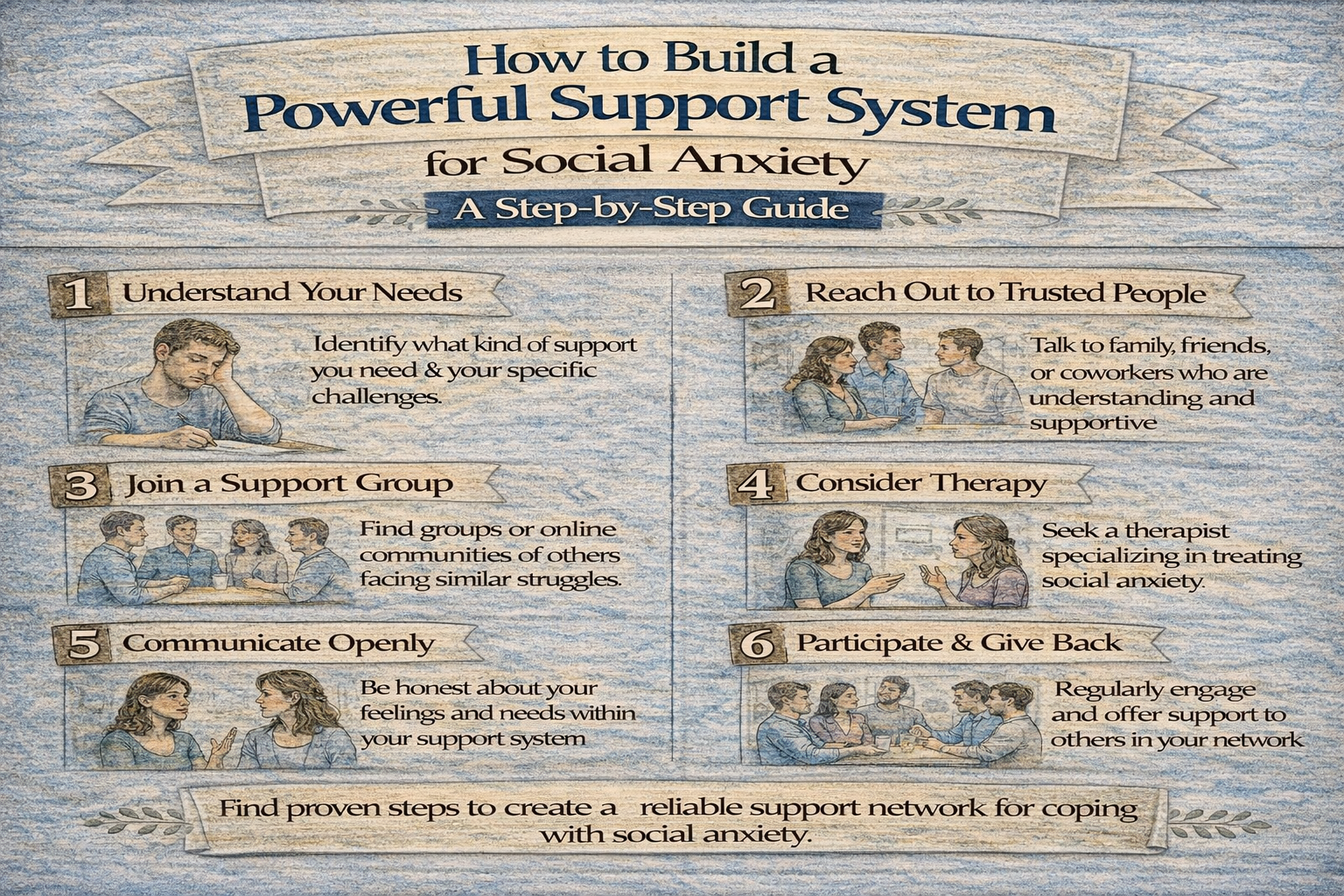
How to Build a Powerful Support System for Social Anxiety — Step-by-Step Guide
You don’t need to overhaul your life overnight. These practical steps create steady progress.
Step 1 — how to find friends when you have social anxiety
Start with low-pressure environments: online communities, hobby-based meetups, or volunteer work where the focus is the activity, not small talk. Look for groups that explicitly welcome newcomers.
Step 2 — best ways to build a support system for social anxiety
Focus on quality over quantity. Schedule short, regular check-ins with one person at a time. Use shared activities (walks, games, creative projects) to ease conversation pressure.
Step 3 — can joining a support group help with social anxiety
Absolutely for many people. Groups provide instant understanding from others who “get it.” Start online if in-person feels too much.
Disclosure reminder: This section contains affiliate links. If you purchase through these links, we may earn a small commission at no extra cost to you.
Expert Tips for Building Friendships with Social Anxiety — What Professionals Recommend
Clinical experience shows small, consistent actions create lasting change.
Tip #1 — top apps for social anxiety support network
Apps like 7 Cups or ADAA’s online communities let you practice connection on your terms. Start with text-only chats if voice feels intimidating.
Tip #2 — support groups vs online communities for social anxiety
In-person groups offer body-language cues and accountability; online communities provide accessibility and anonymity. Many people combine both for the best of both worlds. Mayo Clinic recommends reputable internet-based support groups as a practical starting point.
Tip #3 — how to strengthen your support system for anxiety
Schedule recurring low-key interactions — coffee every other week, weekly text check-ins. Consistency builds trust faster than intensity.
Research Shows
The American Psychological Association notes that emotional support improves resilience in stressful situations and helps people cope more effectively with life’s difficulties.
Scientific Evidence & Research on Support System for Social Anxiety
Clinical research consistently shows that perceived social support plays a protective role in mental health.
Key Clinical Studies
Reviews available on PubMed highlight that social support can buffer the effects of stress and reduce symptoms of anxiety and depression.
Expert Opinions
The National Institute of Mental Health and Mayo Clinic resources emphasize reaching out to friends, family, and support groups as key coping strategies.
Statistical Data
According to the NIMH, social anxiety disorder affects 7.1% of U.S. adults each year. Resources from the APA and Mayo Clinic indicate that building connections is one evidence-based way to manage its impact.
Important
These findings support gradual action — not overnight transformation. If symptoms feel severe, professional guidance remains essential.
Common Mistakes to Avoid with a Support System for Social Anxiety
Avoiding these pitfalls helps your network grow stronger instead of creating more stress.
Mistake #1 — expecting one person to meet all needs
No single friend or family member can handle every emotional load. Spread support across different people and resources.
Mistake #2 — waiting until you feel “ready”
Readiness often comes after the first small step. Starting imperfectly is more effective than waiting for perfect confidence.
Mistake #3 — ignoring online vs in-person balance
Relying only on online connection can feel limiting for some; avoiding it entirely can feel overwhelming for others. A healthy mix usually works best.
Frequently Asked Questions About Support System for Social Anxiety
Why is a support system important for social anxiety?
A support system for social anxiety reduces isolation and provides safe spaces to practice connection. Research from organizations like the APA shows social support bolsters resilience and helps manage symptoms more effectively. When you know people understand, everyday interactions become less overwhelming. Speaking with a healthcare provider can help tailor this to your situation.
How to build a support system for social anxiety?
Start by assessing current relationships, then add one new low-pressure connection each month. Use shared activities, online communities, or support groups. Consistency matters more than quantity. Many people see meaningful progress within a few months of steady effort.
Can joining a support group help with social anxiety?
Yes, for many people. Groups offer immediate understanding and practical coping ideas. Mayo Clinic recommends reputable support groups as a helpful step. Online options like ADAA communities or 7 Cups make starting easier if in-person feels intimidating.
Should I tell friends about my social anxiety?
It depends on the person and your comfort level. Start with one trusted individual using a simple script. Most supportive friends respond with kindness once they understand. You never have to share everything at once.
What are the best support groups for social anxiety 2026?
Free, anonymous options include ADAA’s online peer communities and 7 Cups chat rooms. Local groups through hospitals or the Anxiety and Depression Association of America are also excellent. Mayo Clinic suggests checking with your healthcare provider for trusted recommendations in your area.
How long does it take to build a strong support network?
Most people notice meaningful improvement within 3–6 months of consistent small steps. Deeper trust takes longer and evolves naturally with regular contact. Be patient with the process — progress is rarely linear.
Conclusion — Take Control of Your Support System for Social Anxiety Today
You now have a practical roadmap: assess what you already have, add one safe connection at a time, use scripts and low-pressure settings, and combine online and in-person options. These steps can transform the isolation that social anxiety often creates into manageable, meaningful connection.
A powerful support system for social anxiety doesn’t eliminate every difficult moment, but it gives you backup, understanding, and proof that you don’t have to face everything alone.