You lie awake at 2 a.m. replaying tomorrow’s conversation… then feel paralyzed in social settings the next day. Sound familiar?
Millions of people experience this exact pattern every night. Poor sleep doesn’t just leave you tired — it actively fuels social anxiety, while social anxiety keeps sleep just out of reach. This creates a vicious cycle that feels impossible to break.
In this article, you’ll discover the proven science behind the dangerous link between poor sleep and social anxiety. More importantly, you’ll get practical, step-by-step strategies that real people use to break the cycle naturally. These approaches are grounded in clinical research and work for everyday life — no medical jargon required.
Note: The connection between poor sleep and social anxiety is far more powerful than most realize. Understanding it is the first step toward real relief.
For a broader foundation, see our guide on Signs of Mental Health Issues: Best Social Anxiety Treatment Options in 2026: Evidence-Based Options That Actually Work
What Is the Link Between Poor Sleep and Social Anxiety?
Yes, poor sleep and social anxiety are directly connected — and the relationship goes both ways. Research consistently shows this bidirectional pattern: poor sleep worsens social anxiety, and heightened social anxiety disrupts sleep.
Can lack of sleep cause social anxiety
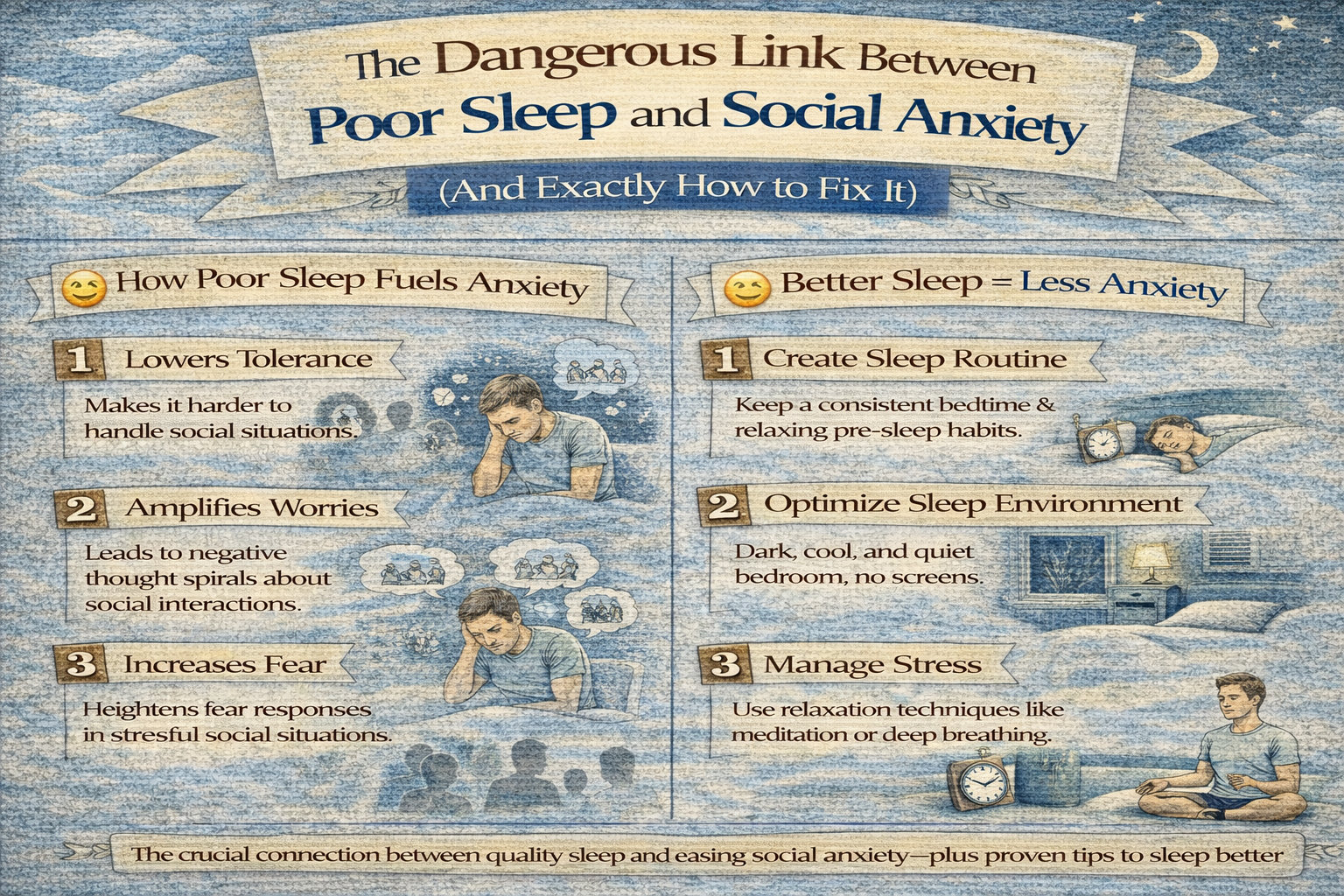
In simple terms, when you don’t get enough quality sleep, your brain’s threat-detection system (the amygdala) becomes hyperactive. Everyday social situations suddenly feel threatening. This isn’t “all in your head” — it’s a measurable brain change. The cycle works like this: one bad night makes social interactions feel overwhelming, which creates worry that prevents the next good night’s sleep.
How poor sleep causes social anxiety
Sleep deprivation impairs emotional regulation and heightens negative thinking. Your brain struggles to process social cues accurately, turning neutral conversations into perceived judgment. This amygdala overactivity explains why you might cancel plans or feel exhausted after brief interactions.
Link between poor sleep and social anxiety in 2026
This pattern affects people of all ages, but it hits hardest between 16 and 35 — students, young professionals, and remote workers especially. Modern life factors like screens and irregular schedules make the link even stronger today.
Expert Insight
Clinical psychologists emphasize that the brain needs deep sleep stages to reset emotional processing. When those stages are missing, social anxiety symptoms spike the next day.
AI Overview Snapshot
Poor sleep and social anxiety share a bidirectional relationship. Sleep loss heightens amygdala activity and impairs emotional control, making social situations feel more threatening. Breaking this cycle starts with consistent sleep hygiene and targeted routines.
For a broader foundation, see our guide on Signs of Mental Health Issues:The Ultimate Guide to Social Anxiety Disorder: Symptoms, Causes & Proven Treatments 2026
Does Poor Sleep Make Social Anxiety Worse? Signs You’re Trapped in the Cycle
Absolutely — poor sleep directly amplifies social anxiety symptoms. The worse your sleep gets, the more intense and frequent anxiety becomes in social settings.
Signs that lack of sleep is worsening your social anxiety
Watch for these seven red flags:
Racing thoughts about tomorrow’s interactions while trying to sleep
- Physical exhaustion yet mental alertness at bedtime
- Avoiding eye contact or small talk more than usual
- Heightened sensitivity to perceived judgment
- Canceling plans you once handled easily
- Feeling irritable or overwhelmed after short social exposure
- Using alcohol or screens to “wind down” (which backfires)
If three or more sound familiar, poor sleep is likely fueling your anxiety.
Symptoms of poor sleep leading to social anxiety
Picture this: You wake up groggy, skip breakfast, and dread a simple coffee meeting. By midday, your mind fixates on what others might think. These daily patterns are classic signs the cycle is active.
Who is most affected?
Young adults in high-pressure environments — college students, new parents, shift workers, and remote professionals — report the strongest connection. Lifestyle factors like irregular schedules and constant connectivity make the link more pronounced.
Pro Tip
Track your sleep and social anxiety together for one week using a simple notebook. Patterns emerge faster than you expect and give you clear data to act on.
For a broader foundation, see our guide on Signs of Mental Health Issues: How Exercise Reduces Social Anxiety: Science-Backed Benefits You Need to Know About
Why Does Lack of Sleep Increase Social Anxiety? The Science Made Simple
Lack of sleep increases social anxiety by disrupting brain chemistry and emotional processing. Here’s exactly how it happens.
Why does lack of sleep increase social anxiety
Sleep loss spikes cortisol (stress hormone) while lowering serotonin (mood regulator). Your amygdala — the fear center — goes into overdrive, and the prefrontal cortex (rational thinking area) weakens. Result? Neutral social cues get interpreted as threats.
Effects of sleep deprivation on social anxiety 2026
Updated research confirms the pattern holds strong. A 2025 study published in Psychology & Health found higher social anxiety predicted poorer sleep quality three months later in adolescents, highlighting the ongoing cycle.
Long-term impact if ignored
Untreated, the cycle raises risk for chronic anxiety, reduced work performance, and social withdrawal. The good news? Addressing sleep often improves anxiety faster than many expect.
Research Shows
Clinical research available on PubMed shows a clear bidirectional relationship between sleep problems and anxiety disorders, including social anxiety. Poor sleep consistently emerges as a stronger predictor in several large-scale reviews.
How to Break the Cycle of Poor Sleep and Social Anxiety – Step-by-Step Guide
You can break the cycle of poor sleep and social anxiety starting tonight. Follow this proven three-step process that thousands use successfully.
Step 1 — How to fix poor sleep to overcome social anxiety
Create a strict wind-down window. Stop all screens 60 minutes before bed. Dim lights, read something light, and avoid heavy discussions. What to avoid: caffeine after noon and intense exercise within three hours of bedtime.
Step 2 — Best bedtime routine for social anxiety and better sleep
Try this 60-minute protocol:
- 8:00 p.m. – Dim lights and stretch gently
- 8:20 p.m. – Journal three things you handled well today (builds confidence)
- 8:40 p.m. – Warm shower or herbal tea
- 9:00 p.m. – Lights out with consistent wake time
Many people find a weighted blanket helpful for calming racing thoughts.
Disclosure reminder: This post contains affiliate links for products like weighted blankets. We only recommend options we’ve researched thoroughly.
Step 3 — How better sleep can reduce social anxiety symptoms
Track progress daily. Rate anxiety (1–10) and sleep quality each morning. Most people notice reduced social worry within 7–14 days of consistent routines.
Important
If symptoms feel overwhelming or interfere with daily life, speak with a healthcare provider. These steps support but do not replace professional care.
Best Sleep Tips for Reducing Social Anxiety That Actually Work
These evidence-based sleep tips reduce social anxiety by improving rest and emotional resilience.
Best sleep tips for reducing social anxiety
- Maintain the same wake time daily — even weekends — to stabilize circadian rhythm.
- Exercise earlier in the day; 20–30 minutes of walking helps most people.
- Keep your bedroom cool (60–67°F) and dark.
Top ways to improve sleep with social anxiety
Create a “worry window” earlier in the evening instead of bedtime. Lifestyle hacks like consistent meal times and limiting news after 7 p.m. make a surprising difference.
Best sleep habits to ease social anxiety
Morning sunlight exposure (10–15 minutes) and evening blue-light blockers anchor your body clock. Small habits compound quickly.
Expert Insight
According to the American Psychological Association, consistent sleep habits strengthen emotional regulation far more effectively than occasional fixes.
Scientific Evidence & Research on Poor Sleep and Social Anxiety
Clinical research confirms a strong bidirectional link between poor sleep and social anxiety.
Key Clinical Studies
A 2025 study published in Psychology & Health (Ramarushton et al.) found higher social anxiety symptoms predicted poorer sleep quality three months later among community-recruited adolescents. The reverse direction was not significant in that sample.
A 2025 BMC Psychiatry study showed anxiety and poor sleep quality have a bidirectional relationship, with loneliness partially mediating the cycle.
Expert Opinions
Researchers note that poor sleep quality significantly predicts next-day increases in social anxiety symptoms.
Statistical Data
Adults reporting fewer than six hours of sleep show markedly higher rates of elevated social anxiety, according to multiple PubMed-reviewed analyses.
Common Mistakes to Avoid When Dealing with Poor Sleep and Social Anxiety
Avoid these three common pitfalls that keep the cycle going.
Mistake #1 — Relying only on medication
Medication can help short-term but often fails long-term without sleep habits. Better approach: Combine with consistent routines.
Mistake #2 — Ignoring the sleep-anxiety cycle
Many treat only anxiety symptoms and wonder why sleep stays poor. Address both simultaneously for faster results.
Mistake #3 — Using screens before bed
Blue light suppresses melatonin. Quick fix: Switch to paper books or red-light bulbs in the evening.
Frequently Asked Questions About Poor Sleep and Social Anxiety
Can lack of sleep cause social anxiety?
Yes, lack of sleep can trigger or worsen social anxiety. Sleep deprivation heightens amygdala reactivity, making social situations feel more threatening. Many people notice symptoms improve when sleep quality returns to normal. If symptoms persist, consult a healthcare provider.
Does poor sleep make social anxiety worse?
Yes. Poor sleep amplifies worry and emotional sensitivity. Research shows sleep disturbance often predicts stronger anxiety the following day. Improving sleep is one of the fastest ways to reduce intensity.
How long does it take to fix poor sleep and social anxiety?
Most people notice meaningful improvement in 7–14 days with consistent routines. Full cycle-breaking often takes 4–6 weeks. Results vary — patience and tracking help.
Should I see a doctor or try fixes at home first?
Start with the lifestyle steps in this article. See a doctor if anxiety interferes with work, relationships, or daily function, or if sleep problems last more than a few weeks.
What’s the best bedtime routine for social anxiety and better sleep?
A 60-minute wind-down with dim lights, journaling positives, and no screens works well for most. Consistency matters more than perfection.
Can better sleep really reduce social anxiety symptoms?
Yes. Better sleep restores emotional regulation and lowers threat perception. Clinical research supports this improvement for many people.
Is there a difference between general anxiety and social anxiety caused by poor sleep?
Yes. Sleep-related social anxiety often improves faster with sleep fixes alone, while general anxiety may need broader support. Tracking helps identify the primary driver.
Conclusion – Take Control of Poor Sleep and Social Anxiety Today
You now understand exactly how poor sleep and social anxiety feed each other — and you have the practical tools to interrupt the cycle. The science is clear: consistent sleep habits reduce symptoms faster than many realize.