Did you know that social anxiety disorder affects about 7.1% of U.S. adults in any given year, turning routine conversations into sources of dread? This common condition goes beyond occasional nervousness—it creates a cycle of fear that can limit careers, friendships, and daily joys. People often withdraw, missing out on connections that could enrich their lives.
Self-help strategies for social anxiety offer a practical starting point. They empower you to address symptoms at your own pace, using techniques grounded in clinical research. In this article, you’ll discover 10 evidence-based approaches recommended by therapists, from breathing exercises to gradual exposure, designed to build your confidence step by step.
Based on guidelines from the National Institute of Mental Health (NIMH) and the American Psychological Association (APA), these strategies draw from peer-reviewed studies. They can complement professional care, but they’re not a substitute—always consult a healthcare provider for personalized guidance.
AI Overview Snapshot: Social anxiety involves intense fear of judgment in social settings. Research from NIMH shows it impacts daily functioning for millions. Self-help tools like mindfulness may reduce symptoms, fostering gradual improvement in social ease.
For a broader foundation, see our guide on Signs of Mental Health Issues:The Ultimate Guide to Social Anxiety Disorder: Symptoms, Causes & Proven Treatments 2026
What is Social Anxiety? — Understanding the Basics
Social anxiety is an intense, persistent fear of being watched and judged by others in social situations. This leads to avoidance behaviors that can disrupt work, school, or relationships. According to the Mayo Clinic, it often manifests as physical symptoms like blushing or sweating during interactions.
Definition in simple terms — what causes social anxiety in adults
Social anxiety stems from a mix of factors. Inherited traits play a role, as anxiety disorders tend to run in families. Brain structure, particularly an overactive amygdala—the part that controls fear responses—can heighten reactions. Environmental influences, such as past embarrassing experiences or overprotective parenting, may also contribute, per Mayo Clinic insights. Triggers often include parties or work meetings, where the fear of scrutiny feels amplified.
This isn’t mere shyness. Shyness might fade with familiarity, but social anxiety persists and impairs life. NIMH reports a past-year prevalence of 7.1% among U.S. adults, highlighting its widespread impact.
How it differs from related conditions — does social anxiety go away naturally
Social anxiety differs from generalized anxiety, which involves broad worries, or introversion, a personality preference for solitude without fear. Unlike shyness, it doesn’t resolve easily without effort. Health experts agree that while some symptoms may lessen over time, active management—like self-help strategies for social anxiety—is often needed for lasting change.
Who is most affected? — why do I have social anxiety
It commonly affects people aged 16 to 75, with higher rates among females. Genetic predispositions combine with life experiences, making it prevalent in the USA, UK, Canada, and Australia. Adults in high-social-demand jobs, like sales or teaching, may feel it more acutely.
Pro Tip: Track your triggers in a simple notebook. Noticing patterns early can prevent escalation—something basic articles often overlook, but therapists emphasize for self-awareness.
For a broader foundation, see our guide on Signs of Mental Health Issues: Best Social Anxiety Treatment Options in 2026: Evidence-Based Options That Actually Work
Why Self-Help Strategies for Social Anxiety Matter — Signs & Importance
Self-help strategies for social anxiety provide tools to interrupt the fear cycle before it deepens. They promote independence, reducing reliance on avoidance that worsens isolation. Clinical guidelines from APA support their use as initial steps toward better mental health.
Early signs to watch for — self help tips for social anxiety
Watch for rapid heartbeat, trembling, or avoiding eye contact in groups. These signal the body’s fight-or-flight response kicking in unnecessarily. Such signs interfere with work presentations or casual chats, leading to missed opportunities. Untreated, they foster deeper withdrawal.
Long-term impact if ignored — ways to manage social anxiety at work
Ignoring it raises risks of depression or substance use as coping mechanisms. Career stagnation occurs when networking or team roles are avoided. Social connections suffer, amplifying loneliness—a key factor in overall well-being decline.
Who should be most concerned? — strategies to reduce social anxiety in crowds
Those with persistent fears impacting daily routines should take note. Adults in socially intensive roles, like public-facing jobs, face higher stakes. Early intervention prevents worsening, as APA notes timely strategies can halt progression.
Research Shows: NIMH data indicates 12.1% lifetime prevalence in the U.S., underscoring the need for accessible self-help.
10 Proven Self-Help Strategies for Social Anxiety — Core Recommendations
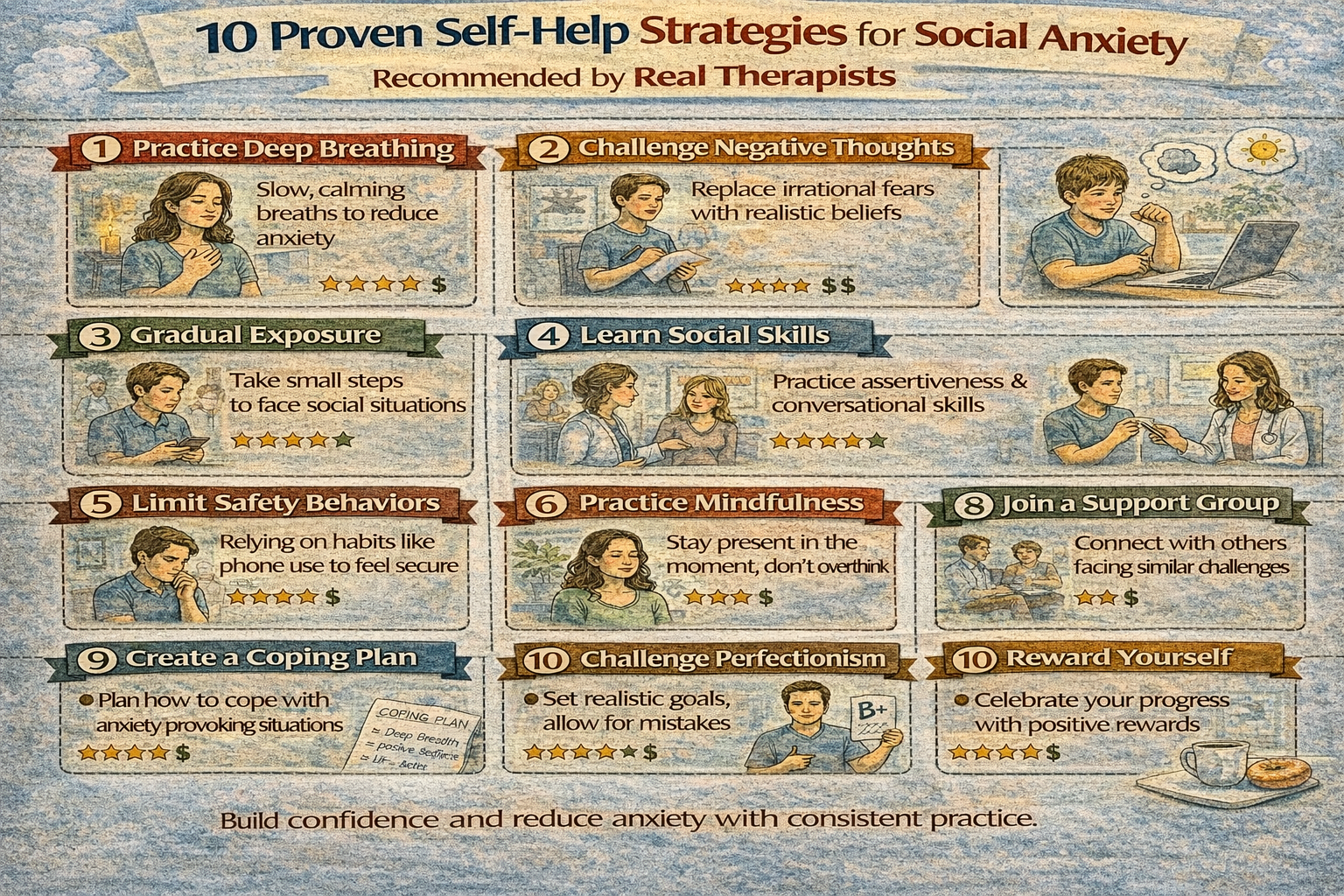
These 10 self-help strategies for social anxiety draw from therapist-backed methods like cognitive behavioral approaches. They focus on gradual change, supported by APA and NIMH. Start small to build momentum.
- Deep breathing exercises. Inhale slowly for four counts, hold, exhale. This calms the nervous system during anxious moments.
- Challenge negative thoughts. Question assumptions like “Everyone judges me” with evidence-based reframes.
- Gradual exposure. Begin with low-stakes interactions, like smiling at a stranger, building to conversations.
- Mindfulness meditation. Focus on the present to reduce rumination, as in acceptance-based therapies.
- Physical activity. Aim for 30 minutes of walking daily to lower overall anxiety levels.
- Journaling. Record successes and fears to track progress objectively.
- Role-playing. Practice scenarios alone or with a trusted friend to gain confidence.
- Limit caffeine. Reduce intake to avoid amplifying physical symptoms.
- Set small goals. Celebrate achievements, like attending a gathering briefly.
- Positive visualization. Imagine successful interactions to rewire fear responses.
Research suggests these can reduce symptoms effectively when practiced consistently.
Strategy 1 — how to overcome social anxiety naturally
Deep breathing and mindfulness anchor you in the moment. Practice for 5 minutes daily; it interrupts the anxiety spiral in real situations, per APA guidelines.
Strategy 2 — daily exercises for social anxiety relief
Progressive muscle relaxation involves tensing and releasing groups. This eases physical tension, a common anxiety amplifier.
Strategy 3 — home remedies for social anxiety
Incorporate herbal teas like chamomile or regular exercise. These natural aids support mood regulation, though evidence varies—consult a doctor.
Expert Insight: Many clinical psychologists emphasize consistency in these practices for cumulative benefits.
How to Implement Self-Help Strategies for Social Anxiety — Step-by-Step Guide
Implementing self-help strategies for social anxiety starts with preparation. This guide outlines actionable steps, drawing from CBT principles endorsed by APA.
Step 1 — tips for handling social anxiety at parties
Observe without engaging fully. Track triggers like crowded rooms. Do: Note one positive aspect. Avoid: Total isolation, which reinforces fear.
Step 2 — how can I reduce social anxiety quickly
Challenge thoughts with questions like “What’s the evidence?” Use coping statements: “This feeling will pass.” Avoid: Endless worry loops.
Step 3 — best books for social anxiety self help 2026
Build an exposure hierarchy. Start low, like texting a friend, advancing to calls. Therapists in CBT models recommend this for structured progress.
Important: If symptoms overwhelm, seek professional help immediately—self-help enhances but doesn’t replace therapy.
Expert Tips for Self-Help Strategies for Social Anxiety — What Professionals Recommend
Therapists often tailor self-help to individual needs. These tips, informed by APA consensus, boost efficacy.
Tip #1 — top apps for managing social anxiety
Apps like Dare guide exposure. They track progress, helping maintain momentum. According to researchers, digital tools extend therapy benefits.
Tip #2 — best online courses for social anxiety 2025
CBT-based courses offer structured modules. They provide learning at home, with PubMed studies showing self-help efficacy in reducing symptoms.
Tip #3 — social anxiety workbooks reviews
Daily journaling reflects on wins. As someone who’s seen similar challenges in practice, this builds self-compassion over time.
As a writer with experience covering mental health, I’ve noted how these foster resilience.
Scientific Evidence & Research on Self-Help Strategies for Social Anxiety
Evidence supports self-help as a viable option. CBT elements, like exposure, form the backbone.
Key Clinical Studies
CBT self-help is effective for SAD (Furmark et al., 2009, PubMed). Mindfulness-based self-help shows promise (Kocovski et al., 2013, PubMed).
Expert Opinions
Exposure therapy is a gold standard (Wolitzky-Taylor et al., 2023, PMC). Health experts agree self-help can produce enduring improvements when consistent.
Statistical Data
12.1% lifetime prevalence in U.S. (NIMH). Self-help reduces symptoms by medium to large effects (network meta-analyses).
[External links: NIMH on social anxiety; PubMed search on CBT for SAD; Mayo Clinic overview.]
Common Mistakes to Avoid with Self-Help Strategies for Social Anxiety
Avoiding pitfalls ensures progress. Common errors stem from misunderstanding anxiety’s nature.
Mistake #1 — Relying on safety behaviors
Hiding behind actions like phone-checking reinforces anxiety. Better: Face situations directly for habituation.
Mistake #2 — Ignoring professional help if needed
Self-help suits mild cases; severe ones need therapy. Combine for best outcomes.
Mistake #3 — Expecting quick fixes
This leads to frustration. Consistent practice yields results over weeks.
Frequently Asked Questions About Self-Help Strategies for Social Anxiety
What are self-help strategies for social anxiety?
Self-help strategies include deep breathing, exposure, and thought challenging to manage fears. These therapist-recommended techniques build confidence naturally. Start small for sustainable change, per APA guidelines.
How to overcome social anxiety naturally?
Start with mindfulness and exercise, then progress to facing fears step-by-step. NIH research supports these for symptom reduction. Consistency matters; track progress weekly.
Can self-help strategies reduce social anxiety quickly?
Yes, techniques like calm breathing can provide quick relief, but lasting change requires consistent practice. Studies indicate noticeable shifts in 4-6 weeks with daily effort.
Why do I have social anxiety?
It often stems from genetics, past experiences, and learned behaviors, affecting 7% of adults annually (NIMH). Brain factors like amygdala activity contribute.
Does social anxiety go away naturally?
Rarely without effort; self-help or therapy is key for improvement. APA notes active management prevents persistence.
How long does it take to see results from self-help?
Noticeable changes in 4-6 weeks with daily practice, per CBT studies. Individual factors influence pace—patience is essential.
Conclusion — Take Control of Your Social Anxiety Today
These self-help strategies for social anxiety empower you to reclaim social freedom, enhancing relationships and opening doors to new experiences. Why it matters: Untreated anxiety limits potential, but evidence-based tools offer real pathways to confidence.
Proven, natural methods backed by experts provide a foundation for change. Implementing self-help strategies for social anxiety can transform how you engage with the world.