Social anxiety is one of those things that sneaks up on you. One day you’re just a little nervous before a presentation. Then you start avoiding phone calls. Then you cancel plans because the idea of walking into a room full of people feels genuinely terrifying.
According to the National Institute of Mental Health (NIMH), about 7.1% of American adults deal with social anxiety disorder every year — that’s roughly 15 million people. And that number has been climbing since the COVID-19 pandemic pushed millions of us into isolation.
The good news? You don’t have to wait until it gets bad. There are real, research-backed ways to stop social anxiety before it takes over your life. This guide covers all of them — in plain, simple language that anyone can understand and actually use.
For a broader foundation, see our guide on Signs of Mental Health Issues: Stress Management Techniques That Prevent Social Anxiety From Spiraling Out of Control
What Even Is Social Anxiety?
Let’s start from the beginning.
Social anxiety isn’t just being shy. Shy people might feel a little uncomfortable at parties but still go. People with social anxiety feel an intense, overwhelming fear of being judged, embarrassed, or rejected in social situations — and that fear starts affecting their daily life.
It can show up in situations like:
- Speaking up in class or at work
- Making eye contact with strangers
- Eating in front of others
- Going to parties or social gatherings
- Even just texting someone back
The fear often comes with physical symptoms too — heart racing, face turning red, sweating, or feeling like your mind suddenly goes blank.
For a broader foundation, see our guide on Signs of Mental Health Issues:The Ultimate Guide to Social Anxiety Disorder: Symptoms, Causes & Proven Treatments 2026
Why Is Social Anxiety Getting Worse in 2025?
This is an important question, especially if you’re a young person trying to make sense of what you’re feeling.
Several things have pushed social anxiety rates higher in recent years:
The pandemic effect. The WHO reported a 25% rise in anxiety and depression globally during COVID-19. When millions of people spent years avoiding in-person contact, many lost confidence in social situations. That confidence doesn’t automatically come back when lockdowns end.
Social media comparison. Scrolling through carefully curated highlight reels of other people’s lives makes it easy to feel like you’re the only one who struggles. You compare your real self to everyone else’s best self — and that comparison breeds insecurity.
High-pressure environments. Whether it’s school, university, or the workplace, modern life demands constant performance. Presentations, group projects, job interviews, networking events — there are more opportunities to feel judged than ever before.
Less face-to-face practice. A generation that grew up texting and messaging often has fewer chances to develop casual conversation skills in person. When you don’t practice something regularly, it starts to feel harder.
Understanding these causes matters because it shifts the blame away from you. Social anxiety isn’t a sign that something is wrong with you as a person. It’s often a natural response to an unusually pressured world.
For a broader foundation, see our guide on Signs of Mental Health Issues: 10 Proven Self-Help Strategies for Social Anxiety Recommended by Real Therapists
Early Warning Signs You Shouldn’t Ignore
Prevention works best when you catch things early. Here are signs that social anxiety might be starting to develop:
Physical signs:
- Your heart pounds before social events
- You blush easily or sweat when talking to people
- You feel nauseous or have stomach issues before social situations
Emotional signs:
- You dread upcoming events days in advance
- You replay conversations in your head afterward, looking for things you did wrong
- You feel an intense fear of saying something stupid or embarrassing
Behavioral signs:
- You cancel plans at the last minute to avoid social situations
- You avoid eye contact or speaking up even when you want to
- You over-prepare for simple interactions, rehearsing what you’ll say
If you recognize two or more of these in yourself, that’s a signal worth paying attention to — not to panic, but to take action.
7 Evidence-Based Methods to Prevent Social Anxiety
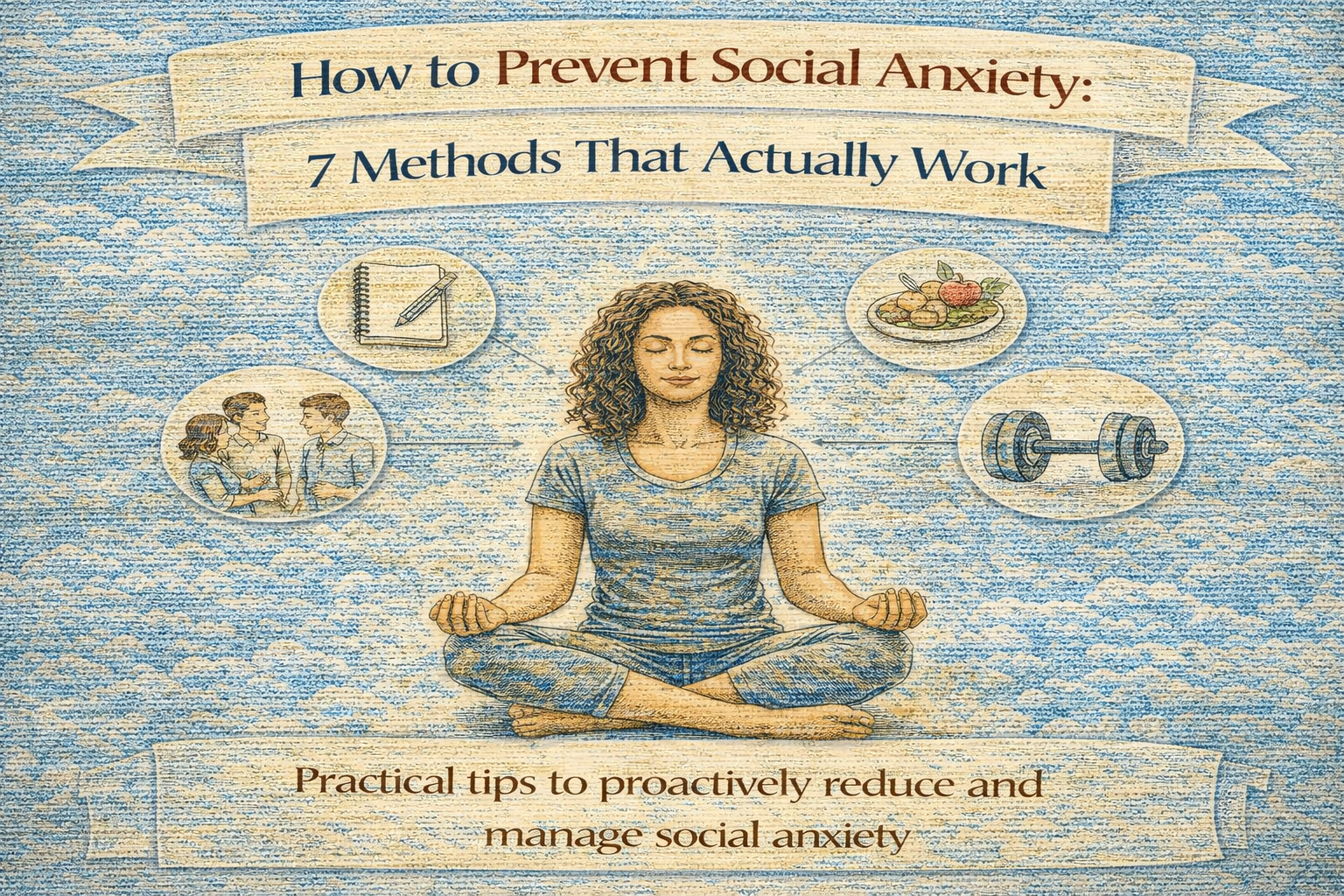
These aren’t random tips. They’re based on clinical research and expert recommendations. You don’t have to do all seven at once — even starting with one or two can make a genuine difference.
Method 1: Build Social Skills Through Small, Safe Exposures
The brain learns fear through avoidance. Every time you skip a social situation because it feels scary, your brain files a note: “That situation is dangerous. Avoid it.” Over time, the avoidance grows, and so does the fear.
The solution is gradual exposure — deliberately putting yourself in low-stakes social situations and proving to your brain that you survive them just fine.
Start ridiculously small. We’re talking:
- Saying “good morning” to a neighbor
- Making brief eye contact and smiling at a cashier
- Asking a stranger for the time
- Leaving a comment on someone’s social media post
None of these feel like much. But each one is a small piece of evidence you’re collecting: “I can handle social interaction. Nothing bad happened.”
Over weeks and months, you can gradually work up to bigger situations. The key is consistency, not speed.
Method 2: Fix Your Sleep, Diet, and Caffeine Habits
This one sounds too simple to matter. It’s not.
Anxiety of any kind — including social anxiety — is heavily influenced by your body’s baseline stress levels. When you’re sleep-deprived, hungry, or running on five cups of coffee, your nervous system is already in a heightened state. Any social pressure on top of that hits much harder.
Sleep: Aim for 7 to 9 hours. This isn’t a luxury — it’s when your brain processes emotions and resets its stress response. Chronic poor sleep genuinely makes anxiety worse.
Food: Blood sugar crashes — which happen when you skip meals or eat too much sugar — can mimic anxiety symptoms like shakiness, rapid heartbeat, and difficulty concentrating. Eating balanced, regular meals keeps your nervous system more stable.
Caffeine: Caffeine is a stimulant that increases heart rate and activates the same physical responses as anxiety. If you’re prone to social anxiety, even one or two extra cups of coffee can tip you into unnecessary nervousness before a social situation.
These changes won’t fix social anxiety on their own, but they remove fuel from the fire.
Method 3: Exercise Regularly
Multiple systematic reviews — including studies published on PubMed — show that regular physical activity reduces overall anxiety levels. And lower overall anxiety means less raw material for social anxiety to feed on.
You don’t need to become an athlete. The research-backed recommendation is 150 minutes of moderate exercise per week — that’s about 30 minutes, five days a week. Brisk walking counts. So does cycling, dancing, swimming, or any activity that gets your heart rate up.
Exercise works by:
- Reducing stress hormones like cortisol
- Releasing endorphins that improve mood
- Giving you a consistent sense of accomplishment
- Improving sleep quality
If you’re currently not exercising at all, even starting with 15-minute walks a few times a week is a real improvement.
Method 4: Practice Mindfulness Daily
Mindfulness sounds like a buzzword, but the research behind it is solid. Regular mindfulness practice trains your brain to observe thoughts and feelings without immediately reacting to them.
Why does that matter for social anxiety? Because social anxiety is largely driven by automatic thoughts — the instant, often catastrophic interpretations your brain makes in social situations. “They all think I’m stupid.” “I said something weird.” “Everyone noticed I was nervous.”
Mindfulness helps you create a small gap between the thought and your reaction to it. Instead of the thought triggering a spiral of panic, you can notice it and let it pass.
How to start:
- Set a timer for 5 to 10 minutes
- Sit quietly and focus on your breathing
- When thoughts come (and they will), just notice them without judging yourself for having them, then return to your breath
- Do this every day
Consistency matters more than duration. Five minutes every day beats one hour once a week.
Method 5: Learn Breathing Techniques for Immediate Calm
When you’re anxious, your breathing becomes shallow and fast. This signals your nervous system to stay in “danger mode.” Controlled breathing interrupts that cycle — it’s one of the fastest ways to calm your body down in a social situation.
The most effective technique backed by research is 4-7-8 breathing:
- Inhale slowly through your nose for 4 seconds
- Hold your breath for 7 seconds
- Exhale slowly through your mouth for 8 seconds
- Repeat 3 to 4 times
You can do this in a bathroom before a party, in your car before a meeting, or anywhere you need to quickly reduce anxiety. It works because the long exhale activates your parasympathetic nervous system — the “rest and relax” mode.
Practice it when you’re not anxious so that it becomes second nature when you are.
Method 6: Challenge Negative Thoughts Before They Spiral
Social anxiety feeds on distorted thinking. The thoughts feel true, but they’re usually exaggerated or flat-out wrong.
Common distortions include:
- Mind reading: “I know they think I’m boring.”
- Catastrophizing: “If I mess up this presentation, my career is over.”
- Overgeneralizing: “I always say the wrong thing.”
The technique to counter this is called cognitive reframing — basically, talking back to your anxious thoughts with more realistic ones.
How to practice it:
When a negative thought pops up, ask yourself:
- Is there actual evidence for this?
- What’s the most realistic thing that would happen here?
- What would I tell a friend who had this thought?
For example: “They’ll all think I’m awkward” becomes “Most people are focused on themselves, not analyzing me. Even if I feel awkward, it’s probably not as obvious as I think.”
This doesn’t mean forcing yourself to think everything is perfect. It means being accurate instead of catastrophic.
Method 7: Build Prevention Habits Specifically for Work or School
Social anxiety often hits hardest in structured environments — classrooms, offices, team meetings. These settings have built-in pressure: you’re being observed, evaluated, and expected to perform.
Small, specific habits can prevent anxiety from taking root in these environments:
Before a meeting or class:
- Arrive a few minutes early so you’re settled before others arrive
- Set one small, achievable goal — like asking one question or contributing one comment
- Do a quick breathing exercise in the few minutes beforehand
During the event:
- Focus outward, on what others are saying, rather than inward on how you’re coming across
- Remember that nervous feelings aren’t visible to others as much as they feel from the inside
After:
- Avoid the habit of replaying everything and judging yourself harshly
- Instead, notice one thing that went okay — no matter how small
These micro-habits add up. Over time, they change the story your brain tells about what social situations mean.
Combining Methods: What Works Best Together
No single method is a magic cure. The real power comes from combining them:
- Daily exercise + mindfulness builds a calmer nervous system baseline
- Breathing techniques + cognitive reframing handles in-the-moment anxiety
- Gradual social exposure + workplace habits builds real-world confidence over time
- Sleep and diet improvements remove unnecessary fuel from the anxiety fire
Most people start noticing a difference within two to four weeks of consistent practice. Deeper, more lasting change typically builds over several months.
When Self-Help Isn’t Enough
These methods are genuinely effective for prevention and for mild to moderate social anxiety. But sometimes professional support is the right call.
Consider reaching out to a therapist or counselor if:
- Social anxiety is significantly affecting your daily life, studies, or work
- You’ve been consistently avoiding important situations for months
- The anxiety feels overwhelming despite trying self-help strategies
Cognitive Behavioral Therapy (CBT) is the most well-researched treatment for social anxiety, with a strong track record. Seeking help isn’t a sign of weakness — it’s just using the most effective tool available.
Quick Reference: The 7 Methods at a Glance
| Method | What It Does | Time Required |
| Gradual social exposure | Rewires fear response | Daily, 5–10 min |
| Sleep, diet, caffeine | Lowers baseline anxiety | Ongoing lifestyle |
| Regular exercise | Reduces stress hormones | 30 min, 5x/week |
| Mindfulness | Trains calm observation of thoughts | 5–10 min daily |
| Breathing techniques | Immediate anxiety relief | 2–3 min as needed |
| Cognitive reframing | Stops thought spirals | As needed |
| Work/school habits | Prevents situational anxiety | Small daily actions |
Final Thoughts
Social anxiety doesn’t have to be your permanent reality. The research is clear: small, consistent actions — done before the problem becomes overwhelming — can genuinely change how your brain responds to social situations.
You don’t need to overhaul your entire life overnight. Pick one method from this list. Practice it for two weeks. Then add another. Over time, those small changes build into something real.
The version of you that walks into a room feeling calm and confident isn’t some distant fantasy. It’s built, one small step at a time.