Imagine stepping into a meeting or a crowded café and feeling your chest tighten, your thoughts scatter, and an overwhelming urge to leave. You’re not alone. According to the National Institute of Mental Health (NIMH), an estimated 7.1% of U.S. adults experience social anxiety disorder in any given year. Similar patterns appear across the UK, Canada, and Australia.
Many people delay seeking help because therapy waitlists are long, costs add up, or the idea of talking to a stranger feels too exposing. The good news? Practical, no-cost tools exist right now on your phone or computer.
This 2026 updated guide shares the most accessible resources for social anxiety — free apps, printable worksheets, online communities, and daily tools. You’ll learn exactly how to start using them today, what actually works based on clinical research, and how to avoid common pitfalls. By the end, you’ll have a clear starting plan that fits your life, whether you’re 16 or 75.
AI Overview Snapshot
Free digital resources for social anxiety include CBT-based apps, downloadable worksheets, and moderated peer communities. Clinical reviews on PubMed show these tools can produce small but meaningful reductions in symptoms when used consistently. They work best as a starting point or supplement to professional care.
For a broader foundation, see our guide on Signs of Mental Health Issues: When to Seek Professional Help for Social Anxiety: A Complete Guide for Patients Worldwide
What Are Resources for Social Anxiety? — Free Online Help Overview
Resources for social anxiety are self-guided digital tools, apps, worksheets, and communities designed to help you practice skills for everyday situations.
They focus on practical steps like noticing unhelpful thoughts, trying gentle exposure, and building confidence one small moment at a time. Unlike traditional therapy, these options are available 24/7, require no insurance, and cost nothing to begin.
How to find free online resources for social anxiety
Start with reputable organizations and app stores. Look for tools built on cognitive behavioral therapy (CBT) principles — the approach most studied for anxiety. You can filter by “free” and read user reviews from the past year to confirm current features.
How it differs from paid therapy — what are free online communities for social anxiety
Paid therapy offers personalized sessions with a licensed professional. Free online communities and apps give immediate peer connection and structured exercises instead. The difference is access speed and format: one is scheduled and deep; the other is on-demand and repeatable. Many people use both together.
Who is most affected? — how to access global free online social anxiety support
Social anxiety touches teens through seniors. In Tier-1 countries, rates are comparable, and privacy concerns often keep people searching online first. Anyone who wants low-pressure practice before (or instead of) formal care can benefit.
Pro Tip
Begin with just one resource for two weeks. Switching too soon creates overwhelm and makes it harder to notice progress.
Research Shows
The National Institute of Mental Health (NIMH) confirms social anxiety affects millions yearly. Digital tools provide a practical entry point while professional support is arranged.
For a broader foundation, see our guide on Signs of Mental Health Issues:The Ultimate Guide to Social Anxiety Disorder: Symptoms, Causes & Proven Treatments 2026
Why Resources for Social Anxiety Matter — Benefits & Importance
Free resources for social anxiety matter because they remove common barriers and let you start practicing skills immediately.
Early signs you may benefit — free tips for social anxiety in everyday situations
You might avoid eye contact during conversations, skip social events, or rehearse what to say for hours. Physical signs like sweating, racing heart, or shaky voice before meetings are also clues. These patterns often worsen without gentle practice.
Long-term impact if ignored — what free tools help manage social anxiety daily
Untreated social anxiety can shrink your world — fewer friendships, missed career chances, and higher risk of depression. Daily tools interrupt this cycle by building small wins that add up.
Who should start today?
Busy professionals, students, and anyone who values privacy often benefit first. If social situations regularly drain your energy, these resources offer a private way to experiment with change.
Expert Insight
Clinical psychologists note that starting small and consistent often leads to bigger shifts than waiting for the “perfect” time or program.
Important
If anxiety feels overwhelming or interferes with work, school, or relationships, reach out to a healthcare professional. These resources support but do not replace personalized care.
For a broader foundation, see our guide on Signs of Mental Health Issues: Your Most Pressing Questions About Social Anxiety — Answered by Real Experts
Best Free Apps for Social Anxiety 2026 — Top Picks & How to Use Them
How to use free apps to help with social anxiety is straightforward: open the app, spend 5–10 minutes daily, and track what feels useful.
Four standout free options in 2026:
- Wysa — AI chatbot using CBT techniques for quick chats when anxiety spikes.
- MindShift CBT (by Anxiety Canada) — interactive tools tailored to social situations, perfectionism, and panic.
- Sanvello (free tier) — mood tracking, guided audio, and thought-challenging exercises.
- Smiling Mind — completely free mindfulness programs designed by psychologists.
Real user results & 2026 updates
Many people report noticing calmer responses in social settings after consistent short sessions. Recent PubMed reviews of digital CBT tools confirm small but reliable symptom improvements for anxiety.
Free vs paid social anxiety apps comparison 2026
| Feature | Free Tier (Wysa, MindShift, Smiling Mind) | Paid Upgrades |
| Core CBT exercises | Full access | Extra coaching or advanced modules |
| Privacy | Strong anonymous options | Same |
| Daily tracking | Built-in | More detailed reports |
| Cost | $0 | Subscription or one-time fees |
Free versions deliver most daily benefits. Paid add-ons are optional.
AI Overview Snapshot
Free CBT apps like Wysa and MindShift CBT offer daily 5–10 minute practices that research links to reduced anxiety symptoms. Start with one app and use it at the same time each day for easiest habit building.
How to Get Free Worksheets for Social Anxiety — Printable Tools
Printable worksheets give you structured ways to track thoughts and practice skills offline.
Top sources and how to get free worksheets for social anxiety
- Visit the Centre for Clinical Interventions (CCI) in Australia — completely free modules and PDFs on social anxiety.
- Check Therapist Aid for additional CBT thought records and exposure planners (free for personal use).
- Download, print or save to your phone, and work through one page at a time.
How to use them daily
Pair a worksheet with an app — for example, note anxious thoughts in the morning, then review progress in the evening. Many users keep a simple folder on their phone for quick access.
Pro Tip
Complete just one section per day instead of the whole worksheet. Small, repeated practice builds confidence faster than occasional long sessions.
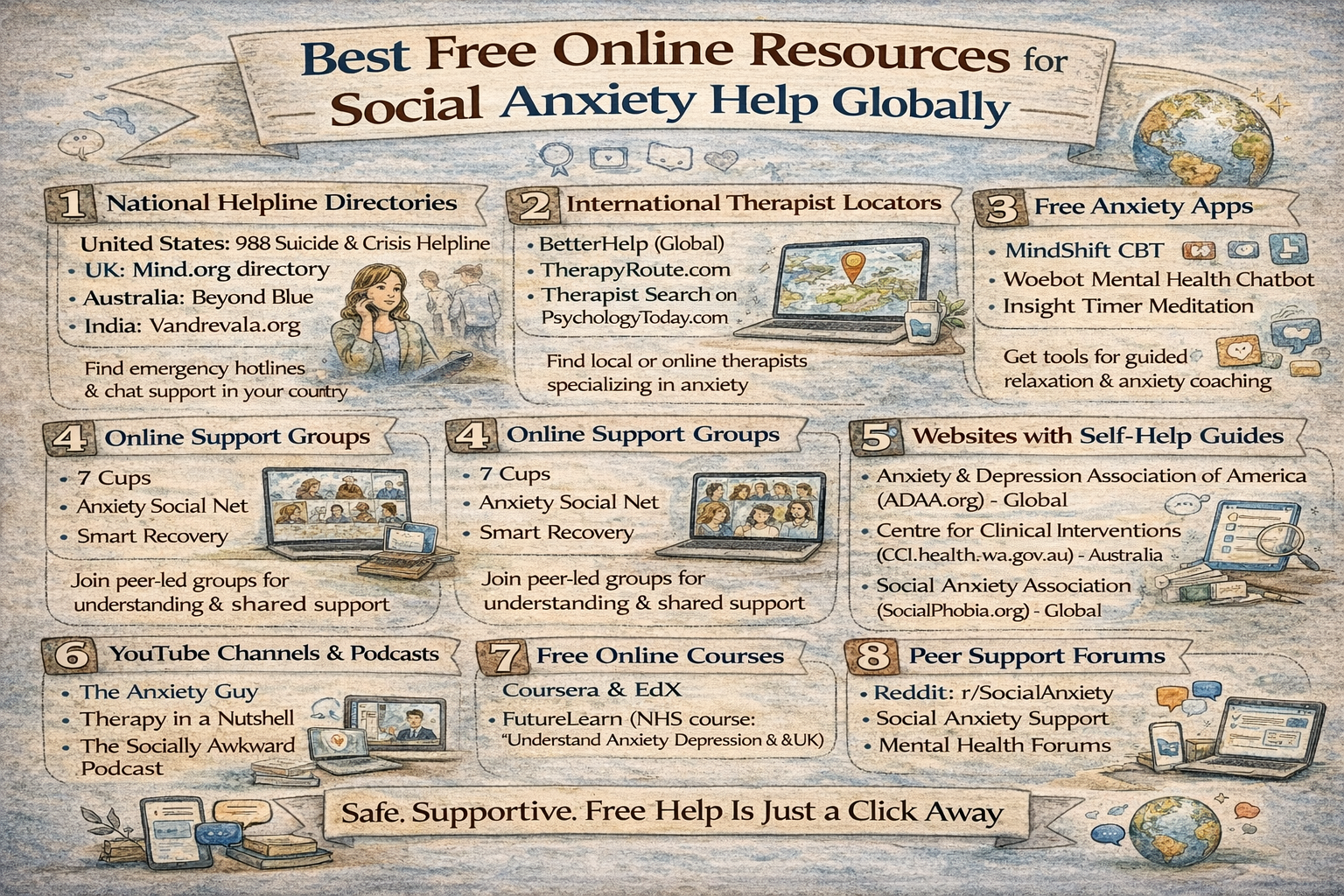
What Are Free Online Communities for Social Anxiety? — Global Support Options
Free online communities connect you with people who truly understand.
Top communities & how to join safely
- 7 Cups — trained listeners available 24/7 for free chats.
- Reddit r/socialanxiety — large, active forum with daily threads (use throwaway account for privacy).
- Other moderated anxiety forums linked from reputable mental health sites.
Set clear boundaries: share only what feels comfortable and never personal contact details. Most platforms have reporting tools for safety.
Does online support work for social anxiety
Peer support provides validation and practical tips. Systematic reviews on PubMed suggest guided digital support, including communities, can complement other tools and reduce feelings of isolation.
Research Shows
Clinical research consistently shows that feeling understood reduces the shame often tied to social anxiety.
Scientific Evidence & Research on Resources for Social Anxiety
Clinical research consistently shows that digital tools grounded in CBT can help many people manage social anxiety symptoms.
Key Clinical Studies
Systematic reviews available on PubMed (including 2025 analyses of transdiagnostic apps) report small but significant effects on anxiety symptoms. Effect sizes typically range around 0.29–0.30 in well-designed trials.
Expert Opinions
Many clinical psychologists emphasize that guided digital tools offer accessible first steps, especially when professional therapy is not immediately available.
Statistical Data
The NIMH reports clear prevalence data, while the World Health Organization highlights anxiety disorders as a major global concern affecting hundreds of millions.
Important
Results vary. These tools work best alongside professional guidance when symptoms are moderate to severe.
Common Mistakes to Avoid with Resources for Social Anxiety
Mistake #1 — Jumping between too many tools
Switching apps and worksheets weekly creates confusion. Pick one or two, use them daily for at least two weeks, then reassess.
Mistake #2 — Ignoring privacy settings
Always review permissions. Use anonymous usernames in communities and turn off unnecessary data sharing in apps.
Mistake #3 — Expecting instant results
Change happens gradually. Most people notice subtle shifts after 2–4 weeks of steady practice. Combine digital tools with small real-world steps for best outcomes.
Image suggestion: Simple “Do vs Don’t” graphic.
Frequently Asked Questions About Resources for Social Anxiety
Can free online apps help with social anxiety?
Yes. Multiple reviews on PubMed show that consistent use of CBT-based apps can lead to measurable reductions in anxiety symptoms for many people. Start with 5–10 minutes daily and track how you feel after two weeks. If symptoms persist or worsen, speak with a healthcare provider.
Does online support work for social anxiety?
Peer-reviewed evidence indicates that moderated online communities and guided digital tools can reduce isolation and provide practical coping strategies. They work best as part of a broader approach.
Why use free resources for social anxiety?
They remove cost and access barriers while giving immediate, private ways to practice skills. Millions use them successfully as a starting point or ongoing support.
How to start with free resources for social anxiety globally?
Choose one app or worksheet today. Set a daily reminder for 5–10 minutes. Build slowly and adjust based on what feels helpful.
Are free vs paid social anxiety apps comparison 2026 worth it?
Free versions deliver core CBT tools and tracking for most people. Paid features mainly add coaching or advanced analytics — useful for some, optional for many.
What free tools help manage social anxiety daily?
Breathing timers in apps, thought-challenge worksheets, and quick check-ins with communities are effective daily options.
How long until free resources for social anxiety show results?
Many people notice small improvements within 2–4 weeks of daily use. Progress continues with consistent practice.
Conclusion — Take Control with Resources for Social Anxiety Today
You now have a clear, no-cost map of resources for social anxiety that actually fit real life. These tools — apps, worksheets, and communities — give you immediate ways to practice calmer responses in social situations without waiting lists or high costs.