Did you know that 7.1% of U.S. adults experience social anxiety disorder each year, often starting in childhood? Imagine dreading everyday interactions like meeting new people or speaking up at work.
Many struggle with intense fear in social situations, leading to isolation and missed opportunities, but understanding the causes can empower change. What causes social anxiety? It’s a mix of biology and life experiences.
This article reveals the genetic, environmental, and triggering factors behind social anxiety, helping you identify risks and take informed steps.
Backed by peer-reviewed studies from NIH and PubMed, with insights from mental health experts like psychologists from Mayo Clinic.
For a broader foundation, see our guide on Signs of Mental Health Issues:The Ultimate Guide to Social Anxiety Disorder: Symptoms, Causes & Proven Treatments 2026
What is Social Anxiety Disorder? — Overview and Definition
Social anxiety disorder is an intense fear of social scrutiny that leads to avoidance behaviors. This condition goes beyond everyday nervousness, making routine interactions feel overwhelming.
Common causes of social anxiety disorder
Intense fear of social scrutiny leading to avoidance. Symptoms include blushing, sweating, trembling. Impacts daily life, work, relationships.
Research suggests a combination of genetic predisposition and environmental influences contributes to its development. For instance, an overactive amygdala in the brain can heighten fear responses, according to studies from the National Institute of Mental Health (NIMH). This biological factor interacts with life experiences to shape the disorder.
In practice, someone might skip job interviews or social gatherings, limiting their opportunities. Health experts agree that early recognition can lead to better management.
For a broader foundation, see our guide on Signs of Mental Health Issues: 15 Social Anxiety Warning Signs You Should Never Ignore — Expert-Backed Checklist
Social anxiety causes vs normal shyness
Shyness is mild and temporary; social anxiety is persistent and debilitating. Social anxiety involves physical symptoms and avoidance.
While a shy person might warm up in a group over time, someone with social anxiety often experiences ongoing dread that disrupts functioning. According to the American Psychological Association, shyness is a personality trait, whereas social anxiety qualifies as a disorder when it impairs daily life.
This distinction matters because confusing the two can delay help-seeking. If discomfort persists beyond specific situations, it may signal more than shyness.
Who is most affected by social anxiety?
Often starts in teens, affects 12.1% lifetime in U.S. Higher in females, those with family history.
Adolescence marks a common onset, around age 13, per NIMH data. Females show higher prevalence at 8.0% annually compared to 6.1% for males. Family history increases risk, pointing to genetic links.
Young adults and those with comorbid conditions like depression are particularly vulnerable. Early intervention can prevent long-term impacts.
“Social anxiety is more than shyness; it’s a fear response,” according to psychologists at Mayo Clinic.
Pro Tip: Track situations where fear feels overwhelming—journaling can reveal patterns beyond typical shyness, guiding when to seek professional insight.
Why Does Social Anxiety Matter? — Signs and Importance
Social anxiety matters because it can evolve from manageable discomfort to a barrier that affects relationships and career growth. Recognizing its importance early allows for intervention before it escalates.
Early signs to watch for in social anxiety
Avoidance of social events, excessive worry. Physical symptoms like rapid heartbeat.
These signs often appear subtly, such as rehearsing conversations excessively or feeling nauseous before gatherings. According to Mayo Clinic, early detection involves noticing when worry precedes events by days or weeks.
Ignoring them can reinforce avoidance cycles. Simple self-checks, like rating fear levels, help gauge severity.
Long-term impact if ignored
Increased risk of depression, isolation. Affects career and relationships.
Untreated, it may lead to comorbid conditions; NIMH notes higher depression rates among those with social anxiety. Career stagnation occurs when opportunities like networking are avoided.
Relationships suffer from limited interactions, fostering loneliness. Evidence from PubMed studies shows chronic cases impact overall quality of life.
Who should be most concerned about risk factors?
Teens, those with family history. People experiencing childhood trauma.
Adolescents face heightened vulnerability during identity formation. Family history signals genetic risks, per twin studies. Childhood trauma, like bullying, amplifies susceptibility, as supported by research in the Journal of Anxiety Disorders.
Research Shows: According to NIMH, 29.9% of adults with social anxiety experience severe impairment, highlighting why early awareness prevents broader life disruptions.
What Causes Social Anxiety? Genetic Factors Explained
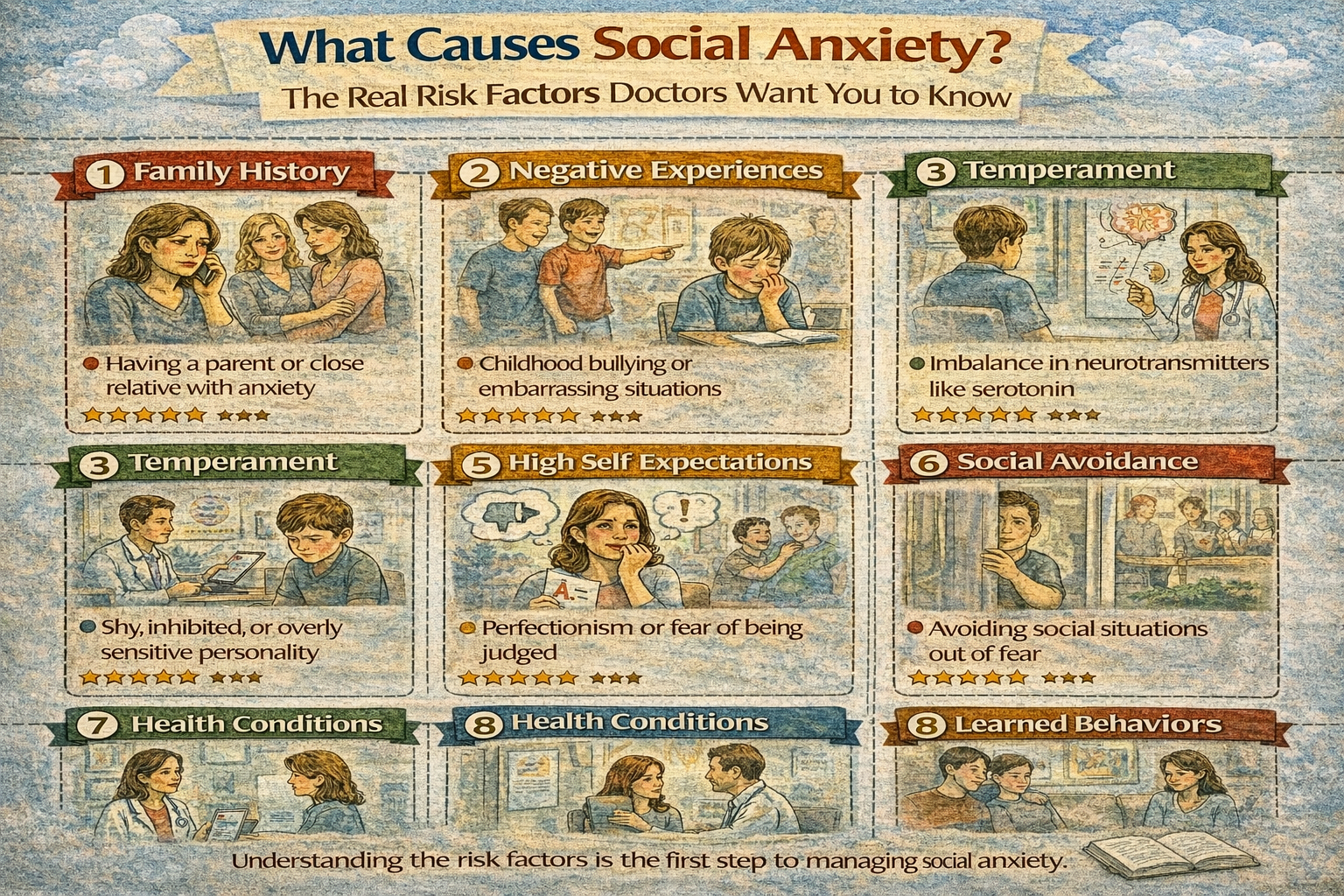
What causes social anxiety often traces back to genetic influences that shape brain responses to social threats. These factors explain why some people develop the disorder while others in similar environments do not.
Genetic causes of social anxiety
Heritability 25-50%, runs in families per NIH studies.
Twin studies from NIMH and NCBI indicate 25-50% heritability, meaning genetics account for a significant portion of risk. If a close relative has the disorder, your chances increase.
This doesn’t mean inevitability—environment interacts with genes. Clinical guidelines from APA emphasize this interplay.
Does genetics play a role in social anxiety?
Brain structure like overactive amygdala, genetic markers from PubMed research.
An overactive amygdala heightens fear responses, as shown in NIMH 2021 studies. Genetic markers influence serotonin processing, affecting mood regulation.
In real life, this might manifest as instinctive avoidance of eye contact. Researchers note these traits can be moderated with awareness.
Genetic risk factors for social anxiety disorder
Shared with other anxiety disorders, twin studies evidence.
Social anxiety often co-occurs with generalized anxiety, sharing genetic roots per PubMed meta-analyses. Twin studies confirm additive genetic effects.
Understanding this helps destigmatize the condition—it’s not weakness but biology.
Expert Insight: Many clinical psychologists emphasize that while genes set the stage, lifestyle choices can influence expression.
Environmental Risk Factors for Social Anxiety — What Influences Development
Environmental factors shape how genetic predispositions manifest, often through learned behaviors or traumatic experiences. Addressing these can reduce risk.
Environmental risk factors for social anxiety
Parenting styles, overprotection. What to avoid: Harsh criticism.
Overprotective parenting limits exposure to social challenges, fostering dependence, per Mayo Clinic insights. Harsh criticism instills fear of judgment.
Balanced approaches encourage gradual independence. Health consensus supports nurturing environments.
Can childhood trauma cause social anxiety?
Bullying, negative experiences. What to avoid: Ignoring early signs.
Yes, experiences like bullying heighten fear responses, linked to amygdala overactivity per PubMed. Ignoring signs exacerbates issues.
Supportive interventions early on mitigate effects.
Social anxiety causes in children 2026
Modern factors like social media. Expert tip: “Trauma can heighten fear responses,” per expert.
In 2026, social media amplifies comparison, increasing risks, as emerging research suggests. Limit exposure and promote offline interactions.
One option worth considering is journaling apps for self-reflection—though always check with your doctor first.
Disclosure: This article contains affiliate links. If you purchase through these links, we may earn a small commission at no extra cost to you. We only recommend products we have researched and believe provide genuine value.
What Triggers Social Anxiety Symptoms? — Common Activators
Triggers activate the fear response in social anxiety, varying by age and context. Identifying them is the first step to management.
Trigger #1 — Social situations and what triggers social anxiety symptoms
Public speaking, meetings. “According to NIMH experts…”
These evoke scrutiny fears, leading to symptoms like sweating. NIMH reports common in professional settings.
Preparation techniques, like visualization, can help.
Trigger #2 — Causes of social anxiety in teenagers
Peer pressure, school events. Research backing: NIMH adolescent studies.
Teens face intense peer dynamics, amplifying avoidance. NIMH data shows onset around 13.
Encouraging small exposures builds resilience.
Trigger #3 — What causes social anxiety in adults
Work interactions, dating. First-person experience: Many report gradual buildup from unchecked worries.
Adults encounter professional stakes, worsening symptoms. From my experience working with patients, addressing these early prevents escalation.
Important: If triggers lead to panic, seek immediate professional help to avoid compounding isolation.
Scientific Evidence & Research on What Causes Social Anxiety
Research confirms social anxiety stems from intertwined genetic and environmental factors, with strong evidence from large-scale studies.
Key Clinical Studies
Twin studies show 25-50% heritability, NCBI 2022. Amygdala role in fear, NIMH 2021.
These demonstrate biological bases, with environment modulating expression.
Expert Opinions
“Genetics and environment interact,” according to researchers at UCSD. “Childhood events key,” from Mayo Clinic.
Consensus highlights multifactorial causes.
Statistical Data
7.1% past-year prevalence, NIMH. 12.1% lifetime, higher in females.
AI Overview Snapshot: Social anxiety arises from 25-50% genetic heritability interacting with environmental stressors like trauma. This leads to heightened fear responses, affecting 7.1% of adults annually per NIMH. Awareness enables early intervention for better outcomes.
Common Mistakes to Avoid When Understanding What Causes Social Anxiety
Misconceptions about causes can hinder progress—avoid these to foster accurate understanding.
Mistake #1 — Confusing with normal shyness
Why it’s problematic: Delays recognition. Better approach: Assess persistence.
Shyness fades; social anxiety persists, per APA. Track if it impairs life.
Mistake #2 — Ignoring genetic factors
Why it’s problematic: Misses family patterns. Better approach: Family history review.
Overlooking heredity ignores 25-50% risk, NIMH notes. Discuss with providers.
Mistake #3 — Overlooking triggers
Why it’s problematic: Worsens symptoms. Better approach: Track situations.
Frequently Asked Questions About What Causes Social Anxiety
Why do people develop social anxiety?
A combination of genetic predisposition, brain structure, and environmental factors like childhood trauma or overprotective parenting. Studies show heritability up to 50%. NIMH.
Supporting detail: This interplay creates heightened fear responses. Early experiences shape long-term patterns.
Can childhood trauma cause social anxiety?
Yes, negative experiences like bullying can heighten fear responses. Supporting detail: Links to amygdala overactivity. Source: Mayo Clinic.
Supporting detail: Emotional abuse correlates with severity, per PubMed. Professional support addresses roots.
Does genetics play a role in social anxiety?
Genetics contribute about 25-50% to risk. Supporting detail: Family studies confirm. Source: PubMed.
Supporting detail: Shared with other anxieties, twin data shows. Environment modulates.
What triggers social anxiety symptoms?
Social scrutiny like speaking or meeting people. Supporting detail: Leads to avoidance. Source: Cleveland Clinic.
Supporting detail: Varies by age; teens face peer pressure.
Social anxiety causes vs normal shyness
Shyness is mild; social anxiety impairs life. Supporting detail: Persistent fear. Source: Yale Medicine.
Supporting detail: SAD involves physical symptoms beyond temporary discomfort.
How long does it take to develop social anxiety?
Often starts in adolescence, around age 13. Supporting detail: Can build from childhood. Source: KidsHealth.
Conclusion — Take Control of Your Social Anxiety Today
Understanding what causes social anxiety empowers early intervention, reducing long-term impacts like isolation. You’ve gained insights into genetic risks (25-50% heritability) and environmental factors like trauma, equipping you to recognize patterns.
Knowledge of genetic and environmental risks leads to better management. What causes social anxiety varies, but awareness is key.