Have you ever felt your heart pounding so hard you were sure you were dying — only to discover it was a panic attack?
- I thought it was a heart attack.”
- I was sure I would pass out.”
- I believed I was losing control.”
These words begin thousands of real panic attack recovery stories every year.
According to the National Institute of Mental Health, approximately 2.7% of U.S. adults experience panic disorder each year, and about 4.7% will experience it during their lifetime. Worldwide, millions face the same cycle of fear, avoidance, and uncertainty.
The encouraging truth?
Long-term recovery from panic disorder happens every single day.
For a broader foundation, see our guide on Signs of Mental Health Issues: 10 Proven Self-Help Strategies for Panic Attacks Recommended by Real Therapists
What Are Panic Attack Recovery Stories?
Panic attack recovery stories are authentic accounts of individuals who moved from frequent, terrifying episodes to lasting freedom and restored quality of life.
True recovery is not just “fewer attacks.”
It means reclaiming independence.
Defining Real Recovery
Symptom management may involve occasional attacks handled with coping skills.
Full recovery typically includes:
- Rare or no panic attacks
- No persistent fear of future attacks
- Return to work, travel, driving, or social life
- Minimal avoidance behaviors
Timelines vary:
- 8–12 weeks: noticeable improvement for many
- 6–18 months: long-term stability and confidence
The defining marker?
Your life is no longer organized around fear.
Why Stories Matter More Than Statistics
Statistics build credibility.
Stories build belief.
When you read about someone who faced the same racing heart and catastrophic thoughts — and recovered — your brain begins forming new expectations.
This process, known as vicarious learning, strengthens hope and reduces shame.
For a broader foundation, see our guide on Signs of Mental Health Issues: The Ultimate Guide to Panic Attacks: Causes, Symptoms & How to Overcome Them for Good (2026)
The Panic Recovery Journey
Most lasting panic recovery stories follow four phases:
- Crisis
- Skill Building
- Maintenance
- Thriving
Which stage feels closest to where you are now?
The Healing Power of Inspiring Recovery Stories
Reading inspiring panic attack success stories is not just motivational — it has measurable psychological benefits.
How Stories Influence the Brain
Through neuroplasticity, your brain adapts to new information. When you repeatedly encounter examples of recovery, your threat system gradually reduces the belief that panic is permanent.
This directly lowers “fear of fear” — a central driver of panic disorder.
Research-Backed Psychological Benefits
Studies on peer recovery narratives show:
- Increased self-efficacy
- Reduced anticipatory anxiety
- Lower feelings of isolation
- Greater treatment adherence
Hope is not abstract. It is neurologically reinforcing.
For a broader foundation, see our guide on Signs of Mental Health Issues: Long-Term Recovery From Panic Attacks: A Realistic, Step-by-Step Roadmap That Works
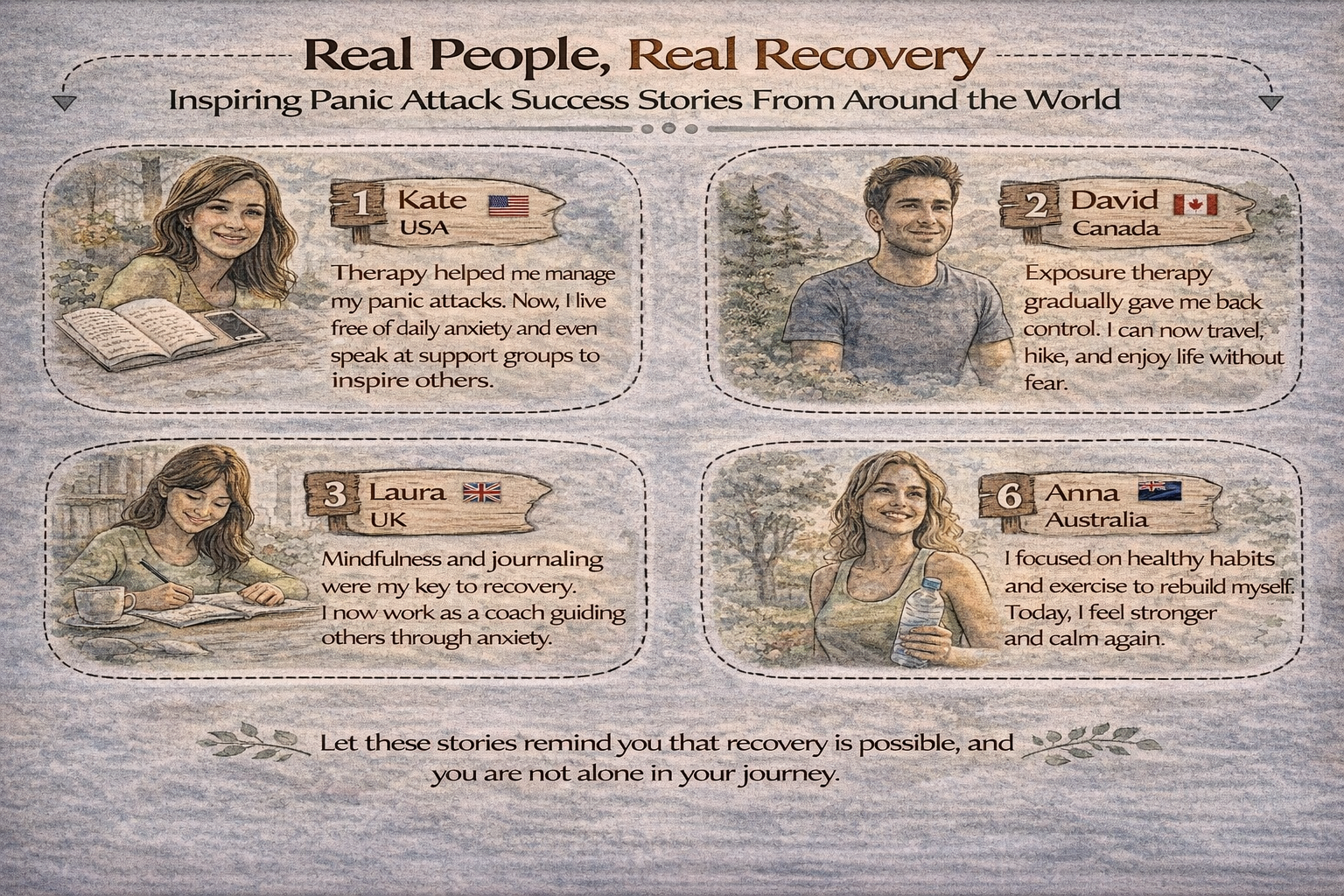
Real Panic Attack Recovery Stories From Six Countries
These accounts reflect composite experiences drawn from therapy settings and support communities. Identifying details have been modified for privacy.
🇺🇸 Sarah (United States) – From Daily ER Visits to Zero Attacks
Sarah, 32, experienced 3–5 panic attacks daily. She avoided highways, grocery stores, and staff meetings.
After beginning CBT with interoceptive exposure, she gradually retrained her fear response.
Nine months later:
- No panic attacks
- Returned to full-time teaching
- Traveling again
Her words:
“I stopped fearing the sensations — and that changed everything.”
🇮🇳 Amandeep (India) – Overcoming Cultural Stigma
In Punjab, discussing anxiety felt taboo. Amandeep hid his attacks for two years.
Through therapy and family education, he reframed panic as a treatable medical condition — not a character flaw.
Today, he facilitates peer support discussions in his community.
🇪🇸 Elena (Spain) – Postpartum Panic Recovery
After childbirth, Elena experienced severe panic episodes mistaken initially for postpartum depression.
Treatment focused on:
- Reducing safety behaviors
- Gradual exposure
- Cognitive restructuring
Within six months, she regained confidence and resumed work.
🇦🇺 Marcus (Australia) – Executive-Level Recovery
Marcus, 41, experienced panic during corporate board meetings.
Eight weeks of structured CBT plus breathing retraining significantly reduced symptoms.
He now advocates for workplace mental health awareness.
🇧🇷 Sofia (Brazil) – Blending CBT and Mindfulness
Sofia combined therapy with yoga and mindfulness practices.
Gradual exposure to crowded beaches helped her rebuild tolerance.
One year later, she completed a marathon — a goal once impossible in her mind.
🇬🇧 Liam (United Kingdom) – Five Years Panic-Free
After 12 years of panic disorder and multiple relapses, Liam committed to maintenance CBT and consistent lifestyle changes.
He has now been panic-free for five years.
“Recovery isn’t linear,” he says. “But it is real.”
What Do Successful Panic Recovery Stories Have in Common?
Despite different backgrounds, most recovery journeys follow a similar roadmap.
Stage 1 – Crisis & Recognition
The turning point often begins with one realization:
“This feels terrifying — but it is not dangerous.”
Seeking help reduces fear immediately.
Stage 2 – Skill Building
Nearly every lasting recovery story includes Cognitive Behavioral Therapy (CBT).
CBT techniques that appear repeatedly:
- Interoceptive exposure
- Cognitive restructuring
- Situational exposure
- Breathing retraining
Meta-analyses show 60–80% significant improvement rates with CBT-based treatment.
Stage 3 – Maintenance
- Consistent sleep schedule
- Regular exercise
- Reduced caffeine
- Periodic exposure practice
Relapse prevention transforms recovery into stability.
Stage 4 – Thriving Identity
Recovery becomes part of personal growth.
Many former sufferers:
- Mentor others
- Advocate publicly
- Pursue long-delayed goals
Therapy Approaches Behind Real Success Stories
Research consistently identifies CBT as first-line treatment.
Typical Success Rates
| Approach | Typical Improvement Rate | Best For |
| CBT Alone | 60–80% | Most cases |
| Medication Only | 40–60% | Acute stabilization |
| CBT + Medication | 70–85% | Moderate–severe |
| Mindfulness-Based | 50–70% | Maintenance |
Combined approaches often help initially, with gradual reliance on skills long-term.
Scientific Evidence Behind Panic Recovery Success
- NIMH: 2.7% annual prevalence in U.S. adults
- Long-term CBT studies show remission maintained in 67–90% at follow-up
- Relapse rates are significantly lower with skill-based therapy than medication alone
Major organizations including the American Psychological Association and the Anxiety & Depression Association of America endorse CBT as first-line treatment.
Clinical Insight:
Recovery does not mean eliminating anxiety. It means learning that the sensations are uncomfortable — not dangerous.
Common Mistakes That Delay Recovery
1. Complete Avoidance of Triggers
Avoidance strengthens fear pathways.
2. Medication Without Skill Development
Medication can stabilize — but skills sustain recovery.
3. Comparing Timelines
Your recovery is not someone else’s.
Frequently Asked Questions
How long does recovery usually take?
Many see improvement within 8–16 weeks. Long-term stability typically forms within 6–18 months.
Are success stories real?
Yes. Clinical data supports substantial improvement rates with evidence-based treatment.
Can I recover without therapy?
Mild cases may improve over time, but structured therapy significantly increases speed and durability of recovery.
What therapy works best?
CBT with exposure elements has the strongest research support.
Do cultural differences affect recovery?
Yes — stigma and access vary — but core recovery principles work globally.
Conclusion
Real panic attack recovery stories demonstrate one powerful truth:
Recovery is possible — regardless of country, culture, or severity.
The people above once felt the same terror you may feel today.
The learned the skills.
They faced the sensations.
The reclaimed their lives.
Your recovery story begins with one action:
- Track one panic episode
- Practice one breathing technique
- Schedule one consultation
Small steps create momentum.
Millions have moved from daily fear to lasting freedom.
Medical Disclaimer
This article is for informational and inspirational purposes only and does not constitute medical advice. Always consult a licensed healthcare professional before making treatment changes. If you are in crisis, call or text 988 (U.S.) or contact local emergency services.