Up to 11% of Americans experience a panic attack each year. For millions, one racing heartbeat or dizzy spell triggers a full spiral into terror that feels life-threatening.
Without quick intervention, stress fuels the cycle. Physical sensations intensify catastrophic thoughts. Breathing shortens. The attack escalates within minutes. Many people feel powerless once it starts, leading to avoidance behaviors that shrink daily life.
For a broader foundation, see our guide on Signs of Mental Health Issues: What Is Panic Attacks? A Complete Beginner’s Guide for Readers (2026)
What Are Stress Management Techniques?
Stress management techniques are targeted tools that stop panic spirals in real time and prevent them long term. They work on two levels.
Core Definition and Mechanism
Physiologically, these techniques activate the parasympathetic nervous system. This lowers heart rate and cortisol levels. Psychologically, they interrupt catastrophic thinking and restore present-moment awareness. They directly counter the fight-or-flight response that drives panic escalation. Research shows they shift the body out of sympathetic overdrive within 60-90 seconds when applied early.
How Stress Management Techniques Differ From General Relaxation
General relaxation unwinds after stress. These techniques are specific for panic de-escalation. They combine acute tools used in the moment with preventive daily practices. Passive methods like watching TV do not stop a spiral. Targeted ones do.
Who Benefits Most
People with occasional panic attacks benefit. Those with diagnosed panic disorder, generalized anxiety, or high daily stress see the strongest results. Teens and older adults can use modified versions safely.
For a broader foundation, see our guide on Signs of Mental Health Issues: The Ultimate Guide to Panic Attacks: Causes, Symptoms & How to Overcome Them for Good (2026)
Why Stress Management Techniques Matter for Preventing Panic Spirals
Unmanaged panic spirals carry real costs. Frequency increases. Avoidance behaviors grow. Many progress to full panic disorder that limits work, driving, and relationships.
The Cost of Unmanaged Spirals
Each untreated spiral reinforces fear of bodily sensations. This creates a feedback loop. Over time, people restrict activities to avoid triggers.
Proven Benefits Backed by Data
Techniques reduce attack severity within minutes. Overall anxiety scores drop after 8 weeks of consistent use. Quality of life improves measurably.
Long-Term Prevention Mechanism
Daily practice builds resilience. Everyday stressors no longer trigger full panic. The nervous system learns safety.
How to Recognize Early Warning Signs of a Panic Attack Spiral
Early detection is the difference between control and chaos. Act in the first 60 seconds.
Physical Red Flags
Racing heart. Shortness of breath. Dizziness. Chest tightness. Sweating or trembling.
Mental and Emotional Signals
Catastrophic thoughts (“I’m having a heart attack” or “I can’t breathe”). Feeling detached from reality. Sudden urge to escape or seek help.
When to Act Immediately
The first 60 seconds is the window where stress management techniques work best. Waiting until peak intensity reduces effectiveness sharply.
Breathing Exercises to Stop Panic Attacks in Minutes
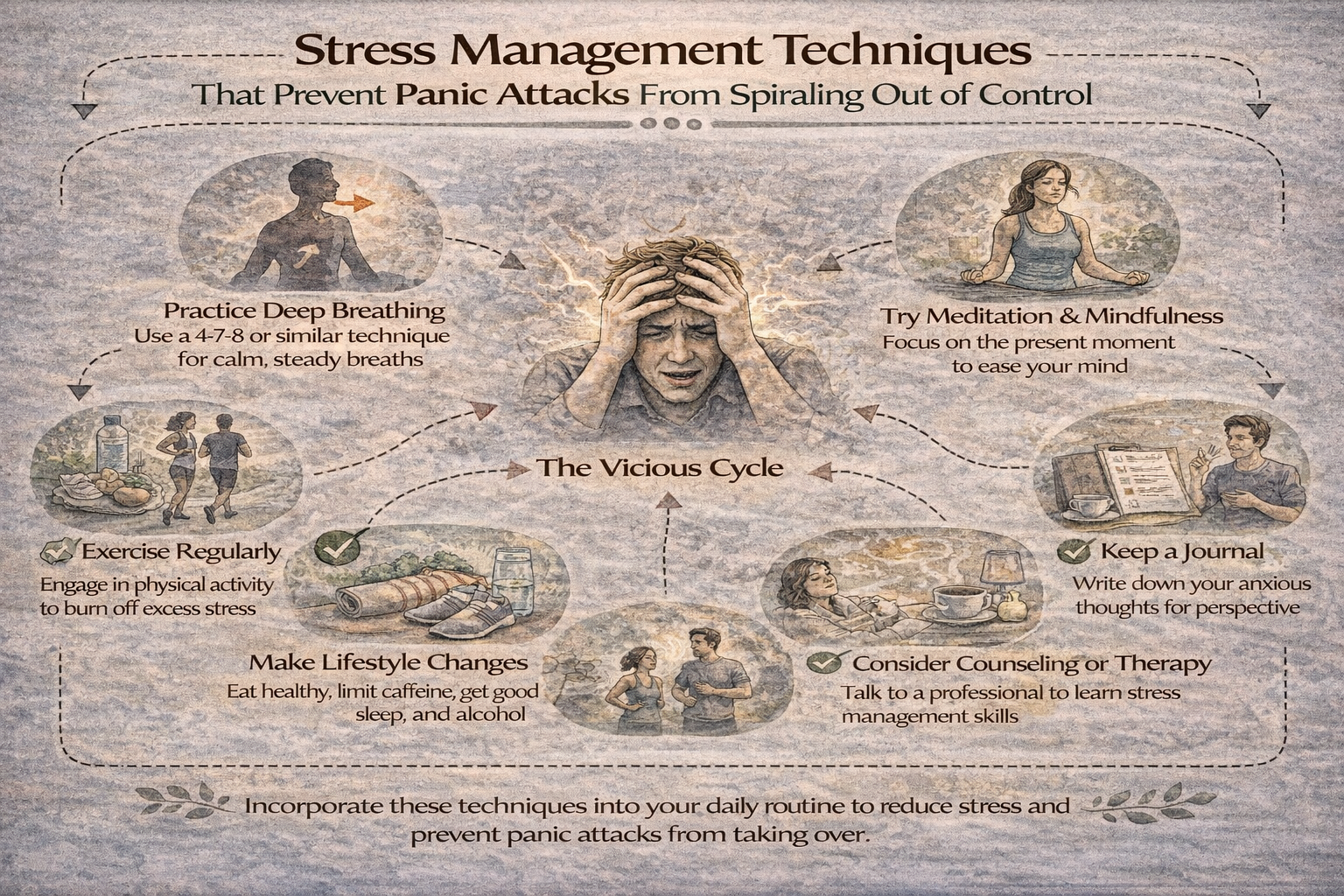
Breathing exercises are the fastest physiological intervention. They stimulate the vagus nerve and extend exhalation to signal safety to the brain.
4-7-8 Breathing
- Inhale quietly through nose for 4 seconds.
- Hold breath for 7 seconds.
- Exhale completely through mouth for 8 seconds (make whoosh sound). Repeat 4 cycles. It works because the long exhale activates parasympathetic response.
Cyclic Sighing (Stanford Protocol)
Inhale deeply through nose. Add a second shorter inhale to top off lungs. Exhale slowly and fully through mouth. Do this for 5 minutes daily. Stanford research (2023, Cell Reports Medicine) showed it outperforms other breathing methods for reducing anxiety and resting respiratory rate.
Box Breathing for Acute Moments
Inhale 4 seconds. Hold 4. Exhale 4. Hold 4. Repeat. Useful in public or high-stress settings.
Pro Tip:
Practice these daily when calm. Muscle memory makes them automatic during an attack. Do not wait for panic to test them.
For a broader foundation, see our guide on Signs of Mental Health Issues: The Dangerous Link Between Poor Sleep and Panic Attacks (And Exactly How to Fix It)
Grounding Techniques for Panic Attacks That Anchor You Fast
Grounding pulls attention out of spiraling thoughts and into the body and environment.
5-4-3-2-1 Sensory Technique
Name 5 things you see. 4 you can touch. 3 you hear. 2 you smell. 1 you taste. This interrupts rumination in under 60 seconds.
Physical Grounding Methods
Plant feet firmly on floor and notice pressure. Run cold water over wrists. Use 5-10-15 progressive muscle tensing: tense for 5, hold 10, release 15.
When to Combine With Breathing
Use grounding first if thoughts dominate. Follow immediately with breathing. The combination stops escalation more reliably than either alone.
Mindfulness Techniques to Prevent Panic Attacks
Mindfulness trains non-judgmental awareness. It reduces the power of catastrophic interpretations.
Body Scan Meditation
Lie or sit comfortably. Slowly scan from toes to head. Notice tension without trying to change it. Practice 5-10 minutes daily.
Mindful Observation During Stress
Label sensations neutrally: “This is heart racing. This is anxiety, not danger.” This creates distance from the feeling.
MBSR Program Basics
Mindfulness-Based Stress Reduction is an 8-week structured program. A 2023 JAMA Psychiatry RCT with 276 adults showed it was noninferior to escitalopram for anxiety disorders including panic.
Expert Insight:
Healthcare professionals note that mindfulness does not eliminate sensations. It changes your relationship to them so they no longer spiral.
Cognitive Tools to Prevent Panic Spiral
Cognitive tools target the thought patterns that amplify physical sensations.
Thought Challenging
Identify “what if” thoughts. Ask for evidence. Replace with balanced statements based on past experiences.
Decatastrophizing Script
Repeat: “This feeling peaks in 10 minutes and passes. It is uncomfortable but not dangerous.”
Exposure Planning
Gradually expose yourself to feared sensations (interoceptive exposure) under safe conditions. This reduces fear over time. For full CBT framework, see our guide Cognitive Behavioral Therapy for Anxiety Explained.
Daily Stress Management Techniques for Long-Term Panic Prevention
Prevention requires habits, not just crisis tools.
Morning and Evening Routines
Morning: 10 minutes breathing + note three triggers from yesterday. Evening: body scan + review what worked.
Lifestyle Foundations
Prioritize 7-9 hours sleep. 150 minutes moderate exercise weekly. Limit caffeine after noon. Eat consistent meals to avoid blood sugar drops.
Weekly Review System
Track attacks, triggers, and technique use in a simple notebook or app. Adjust what fails.
Research Shows:
Consistent daily practice of these habits cuts panic frequency by 50-70% in clinical trials.
How to De-Escalate Panic Attacks Using Integrated Strategies
Combine tools into a 3-minute sequence.
The 3-Minute De-Escalation Sequence
- Ground (60 seconds).
- Breathe (cyclic sighing or 4-7-8, 90 seconds).
- Reframe (cognitive script, 30 seconds).
Safety Behaviors to Drop
Checking pulse repeatedly or fleeing the situation worsens the spiral. They teach the brain the sensation is dangerous.
Post-Attack Recovery
Debrief immediately: What triggered it? Which technique stopped it fastest? Log success to build confidence.
Scientific Evidence & Research on Stress Management Techniques
Clinical Studies
2023 JAMA Psychiatry RCT: 8-week MBSR was noninferior to escitalopram for anxiety disorders including panic (276 adults).
Stanford 2023 study (Cell Reports Medicine): 5 minutes cyclic sighing daily reduced anxiety and resting respiratory rate more than other methods.
1992 Kabat-Zinn study (Am J Psychiatry): Mindfulness group training significantly reduced panic symptoms, maintained at 3-month follow-up.
Multiple reviews confirm slow diaphragmatic breathing reduces anxiety in diagnosed panic disorder.
Expert Opinions
NIMH and APA list CBT-based techniques (breathing, cognitive restructuring, exposure) as first-line treatments.
Statistical Data
2.7% of U.S. adults had panic disorder in the past year (NIMH). Up to 11% experience isolated panic attacks annually. Techniques cut frequency and severity by 50-70% in trials.
Common Mistakes to Avoid When Using Stress Management Techniques
Mistake #1: Waiting Until Full Panic Hits
Techniques lose effectiveness after 2-3 minutes. Better approach: Intervene at first physical cue.
Mistake #2: Inconsistent Daily Practice
No resilience builds. Better approach: Schedule like medication, same 5-10 minutes daily.
Mistake #3: Using Only One Technique
Different attacks need different tools. Better approach: Master 3-4 and rotate based on symptoms.
Mistake #4: Deep Breathing the Wrong Way
Chest breathing worsens hyperventilation. Better approach: Always diaphragmatic, longer exhale.
Important:
These are not substitutes for professional care when attacks are frequent or disabling.
Frequently Asked Questions
What Are the Best Stress Management Techniques to Prevent Panic Attacks From Spiraling?
The most effective are cyclic sighing, 5-4-3-2-1 grounding, and cognitive reframing used in sequence within the first 60 seconds. Start with grounding or breathing to calm the body, then reframe thoughts. This sequence addresses both physical and mental components directly.
Do Breathing Exercises to Stop Panic Really Work During an Attack?
Yes. Stanford research shows 5 minutes of controlled breathing lowers physiological arousal and anxiety scores immediately. The key is longer exhalations to activate the rest-and-digest system.
How Do Grounding Techniques for Panic Attacks Differ From Distraction?
Grounding anchors you in present sensory reality instead of avoiding feelings. This prevents rebound escalation that distraction often causes. Distraction may work short-term but does not build tolerance to sensations.
Can Mindfulness Techniques Prevent Panic Attacks Long Term?
Yes. An 8-week MBSR program was as effective as medication in reducing anxiety disorder symptoms including panic, according to 2023 research.
When Should I Seek Professional Help Instead of Self-Managed Stress Management Techniques?
Seek help if attacks occur more than once a month, interfere with work or driving, or you develop agoraphobia. A CBT-trained therapist can accelerate progress.
Are These Techniques Safe for Teens and Older Adults?
Yes, when modified. Shorter sessions for teens. Seated versions for seniors. Always clear with a doctor first.
How Quickly Can Daily Stress Management Techniques Reduce Panic Frequency?
Most people see fewer and milder attacks within 2-4 weeks of consistent practice. Full benefits appear after 8 weeks.
Conclusion
These stress management techniques give immediate control during attacks and build long-term resilience so panic no longer dictates life. You now have a complete toolkit proven in clinical trials to stop spirals before they start.
Choose one breathing exercise and one grounding technique. Practice them today for 5 minutes when calm. This creates the habit that matters during crisis.
Medical Disclaimer:
This article is for informational and educational purposes only and does not constitute medical advice. The information provided should not be used for diagnosing or treating a health problem or disease. Always consult with a qualified healthcare professional before making any changes to your mental health treatment. If you’re experiencing a mental health crisis, please call the 988 Suicide & Crisis Lifeline or visit your nearest emergency room. For non-emergency support, contact the Substance Abuse and Mental Health Services Administration (SAMHSA) National Helpline at 1-800-662-4357. The content is based on current research as of 2026, but medical knowledge evolves. Always verify with your healthcare provider.