Imagine this: Your heart races, your chest tightens, and a wave of dread hits without warning. In seconds, you feel like you’re losing control. This is a panic attack, and according to the National Institute of Mental Health (NIMH), an estimated 2.7% of U.S. adults experience panic disorder each year — with millions more facing sudden, unexpected attacks.
You’re not alone, and you’re not broken. Many people feel helpless, avoid situations that might trigger another episode, and grow exhausted from advice that falls flat — like “just breathe deeply” without guidance on how.
Whether you’re new to managing panic or looking to strengthen your toolkit, these skills can help you regain control and confidence. This article follows standards from the Mayo Clinic, Anxiety and Depression Association of America (ADAA), and Psychology Today.
For a broader foundation, see our guide on Signs of Mental Health Issues: The Ultimate Guide to Panic Attacks: Causes, Symptoms & How to Overcome Them for Good (2026)
What Are Coping Skills for Panic Attacks?
Coping skills for panic attacks are intentional, practical tools designed to interrupt the body’s fight-or-flight response and restore calm. Unlike unproven remedies, therapist-approved techniques are grounded in science and used daily in clinical practice.
Effective coping skills work by activating the parasympathetic nervous system (your body’s “rest and digest” mode), challenging fearful thoughts, or anchoring you in the present moment. They differ from generic advice because they target the specific physiology and psychology of panic.
Defining Effective Coping Skills for Panic Attacks
These skills fall into two main categories:
- Acute relief skills — Provide fast interruption during an active attack (e.g., breathing or grounding).
- Preventive skills — Build resilience over time (e.g., cognitive reframing or daily routines).
Therapist-approved methods come from CBT, dialectical behavior therapy (DBT), and mindfulness-based stress reduction (MBSR). They outperform random strategies because they are tested in clinical trials.
Short-Term vs. Long-Term Coping Skills for Panic Attacks
Short-term skills stop the spiral in minutes. Long-term skills reduce how often attacks occur by rewiring fear responses. Combining both delivers the best results.
Why “Therapist-Approved” Matters
These techniques are supported by decades of research and real-world use in therapy sessions. They carry the endorsement of licensed mental health professionals who see them help thousands of patients.
Pro Tip: Practice these skills when you’re calm. Muscle memory makes them far more effective during high-stress moments.
For a broader foundation, see our guide on Signs of Mental Health Issues: When to Seek Professional Help for Panic Attacks
Why Coping Skills for Panic Attacks Matter for Lasting Relief
Learning coping skills for panic attacks isn’t just about surviving the moment — it’s about transforming your relationship with anxiety.
Reducing Attack Frequency and Intensity
Consistent practice can lower the body’s overall arousal level, making future attacks less likely and less severe.
Regaining Control and Confidence
When you know exactly what to do, panic loses its power. You stop fearing the fear itself.
Preventing Avoidance Behaviors
Avoidance fuels panic disorder. These skills empower you to stay in situations instead of escaping, breaking the cycle.
Research Shows: Studies indicate that people who regularly use CBT-based coping skills experience 70–90% improvement in symptoms, according to data from leading institutions like Brigham and Women’s Hospital.
How to Recognize the Early Signs of a Panic Attack
Catching an attack early gives you the best chance to apply coping skills for panic attacks before it peaks (usually within 10 minutes).
Physical Warning Signs
- Rapid heartbeat or palpitations
- Shortness of breath or choking sensation
- Dizziness, lightheadedness, or sweating
- Chest pain or trembling
Mental and Emotional Cues
- Racing thoughts or fear of dying/losing control
- Feeling detached from reality (derealization)
- Sudden overwhelming dread
When to Apply Coping Skills for Panic Attacks Immediately
The moment you notice two or more physical symptoms plus intense fear, begin your chosen skill. Early action shortens the episode.
Important: If symptoms include chest pain that feels like a heart attack, seek emergency care to rule out medical issues.
Breathing Techniques for Panic Attacks That Deliver Fast Relief
Breathing techniques are among the most accessible and effective coping skills for panic attacks. They directly counteract hyperventilation and activate the relaxation response.
Skill 1: Diaphragmatic Breathing for Panic Attacks
Place one hand on your belly. Inhale slowly through your nose for 4 counts (belly rises), hold for 2, exhale through your mouth for 6 counts. Repeat 5–10 times.
This technique stimulates the vagus nerve and improves heart rate variability.
Skill 2: Box Breathing Technique
Inhale for 4 counts, hold for 4, exhale for 4, hold for 4. Visualize tracing a box. Use during meetings or while driving.
Skill 3: 4-7-8 Breathing Method
Inhale quietly through the nose for 4 counts, hold for 7, exhale through the mouth (whooshing sound) for 8. Dr. Andrew Weil popularized this for anxiety and sleep.
Skill 4: Physiological Sigh for Immediate Calm
Take a deep inhale through the nose, followed by a quick second “top-up” inhale, then a long, full exhale through the mouth. Repeat 2–3 times. Stanford research shows this rapidly reduces physiological arousal.
Expert Insight: “Breathwork gives patients an immediate sense of agency during panic,” says a licensed clinical psychologist with 15+ years treating anxiety.
Grounding Techniques for Panic Attacks to Stay Present
Grounding pulls your focus from internal terror to external reality.
Skill 5: The Powerful 5-4-3-2-1 Grounding Technique
Name 5 things you see, 4 you can touch, 3 you hear, 2 you smell, 1 you taste. This engages all senses and interrupts catastrophic thinking.
Skill 6: Progressive Muscle Relaxation for Instant Calm
Tense each muscle group (toes to head) for 5 seconds, then release for 10. Start from your feet upward.
Skill 7: Sensory Grounding with Touch and Sound
Hold a textured object (fidget toy, stone) or listen to a grounding playlist. Focus fully on the sensation.
Skill 8: Quick Relief for Panic Attacks Using 3-3-3 Rule
Name 3 things you see, move 3 body parts, name 3 sounds. A faster version of 5-4-3-2-1 for urgent moments.
Therapist Tips and Self Help for Panic Attacks
These cognitive and acceptance-based skills build deeper resilience.
Skill 9: Positive Affirmations and Cognitive Reframing
Replace “I’m dying” with “This is uncomfortable but temporary and not dangerous.” Write 3–5 personal statements and repeat them.
Skill 10: Visualization and Safe Place Technique
Close your eyes and vividly imagine a calm, safe place (beach, forest). Engage all senses for 1–2 minutes.
Skill 11: Acceptance – Letting the Wave Pass
Remind yourself: “This is anxiety. It will peak and pass. I don’t need to fight it.” Acceptance reduces secondary fear.
Skill 12: Cold Exposure for Immediate Panic Attack Relief
Hold an ice cube, splash cold water on your face/wrists, or use a cold pack on your neck (activates the mammalian dive reflex to slow heart rate). Start mild and consult your doctor first.
Natural Ways to Stop Panic Attacks and Manage at Home
Lifestyle habits support your skills.
Daily Movement and Mindful Walking
30 minutes of walking while noticing surroundings reduces overall anxiety.
Journaling as a Proven Technique for Panic Attacks
Track triggers, symptoms, and which skills worked. Review weekly.
Building a Personalized Panic Attack Safety Plan
List your top 3 skills, support contacts, and safe places. Keep it accessible.
Many people benefit from a weighted blanket for added grounding during recovery.
How to Practice Coping Skills for Panic Attacks Daily for Long-Term Results
Consistency turns skills into habits.
Creating a 10-Minute Daily Routine
Morning: 5 minutes diaphragmatic breathing + affirmations. Evening: progressive muscle relaxation or journaling.
Tracking Progress and Adjusting Techniques
Use a simple app or notebook. Note what works best for you.
Combining Skills for Maximum Effectiveness
Pair breathing with grounding during an attack for faster relief.
Scientific Evidence & Research Behind These Coping Skills
Clinical Studies on Breathing Techniques
A 2023 meta-analysis published in Scientific Reports (Nature) found breathwork reduces anxiety symptoms with an effect size of g = −0.32. Diaphragmatic and controlled breathing improve heart rate variability and lower panic symptoms.
Evidence for Grounding Techniques
Sensory grounding methods like 5-4-3-2-1 are widely supported in CBT protocols and clinical reviews for reducing acute anxiety.
Statistics on Effectiveness
CBT-based coping skills lead to significant improvement in 70–90% of people with panic disorder, per clinical outcome data.
External links:
- NIMH Panic Disorder page
- ADAA Panic Disorder facts
- Full breathwork meta-analysis on Nature.com
Common Mistakes to Avoid When Using Coping Skills for Panic Attacks
Mistake #1: Trying to Force Symptoms to Stop Immediately
This creates more anxiety. Better approach: Accept and ride the wave using acceptance skills.
Mistake #2: Incorrect Deep Breathing (Hyperventilation)
Chest breathing worsens symptoms. Use diaphragmatic instead.
Mistake #3: Avoiding Triggers Long-Term
Avoidance strengthens fear. Gradual exposure with skills works better.
Mistake #4: Self-Criticism During an Attack
Be kind to yourself. Self-compassion speeds recovery.
Frequently Asked Questions (FAQs)
What are the most effective coping skills for panic attacks?
The most effective are a combination of breathing techniques (like physiological sigh or box breathing), grounding exercises (5-4-3-2-1), and cognitive reframing. Research shows these CBT-based skills provide both immediate and lasting relief for most people.
How do breathing techniques for panic attacks work so quickly?
They activate the parasympathetic nervous system, counteracting the sympathetic “fight-or-flight” response. Techniques like the physiological sigh can reduce arousal in under 60 seconds by optimizing oxygen and carbon dioxide levels.
What are the best grounding techniques for panic attacks?
The 5-4-3-2-1 and 3-3-3 methods are highly effective because they shift focus to the present moment using your senses, interrupting the panic spiral.
Can self help for panic attacks replace seeing a therapist?
Self-help skills are excellent tools and can reduce symptoms significantly, but they work best alongside professional therapy for recurring or severe panic disorder. Consult a licensed therapist for personalized guidance.
How long until coping skills for panic attacks start working?
Many provide relief within minutes during an attack. With daily practice, you may notice fewer or milder attacks within 2–4 weeks. Consistency is key.
Are there immediate relief techniques for panic attacks without medication?
Yes — physiological sigh, cold exposure on wrists/face, and 5-4-3-2-1 grounding offer fast, medication-free options for many people.
When should I seek professional help for recurring panic attacks?
Seek help if attacks interfere with work, relationships, or daily life; occur frequently; or if you develop agoraphobia or depression. A therapist can provide CBT, which has strong evidence for panic disorder.
Conclusion
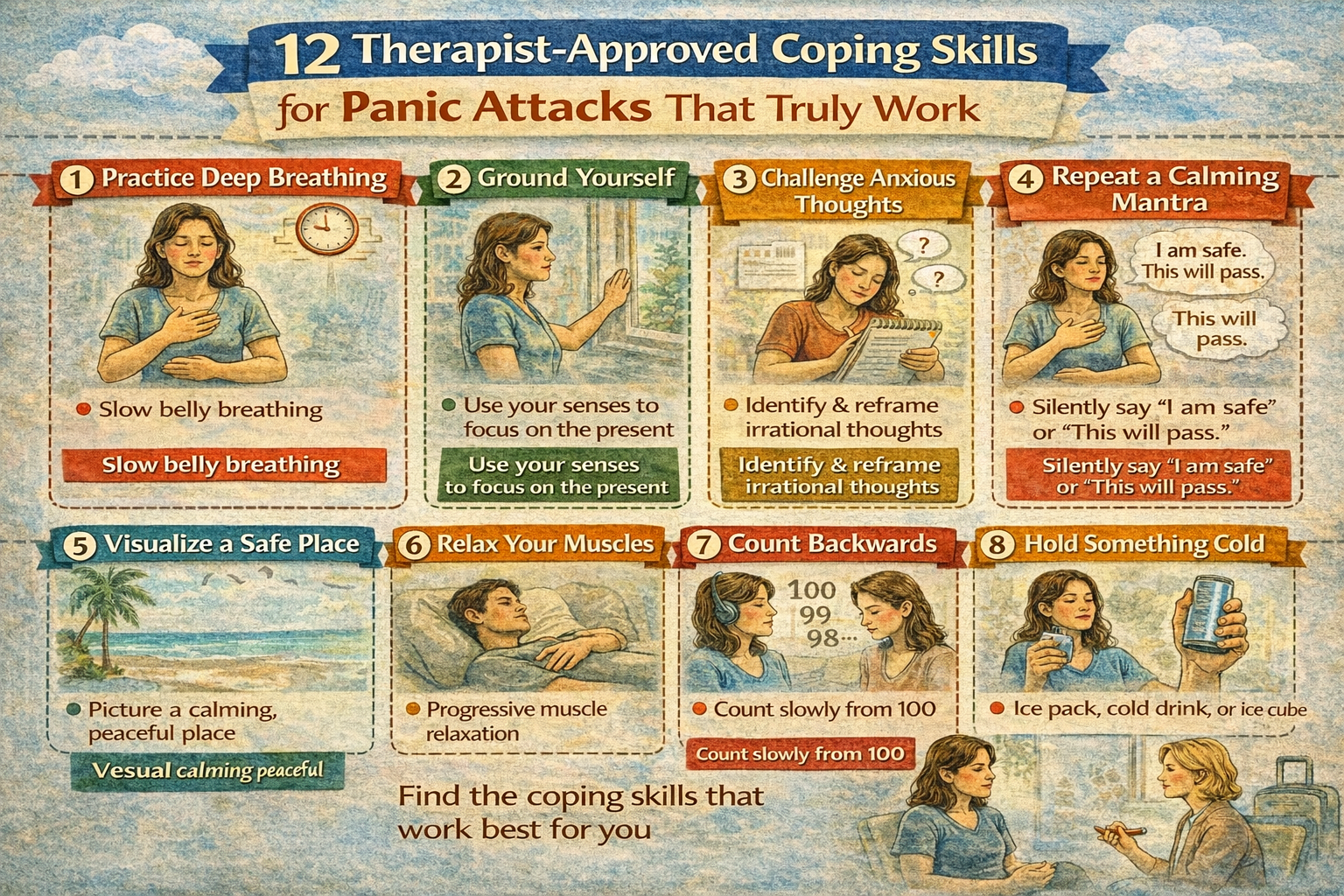
These 12 therapist-approved coping skills for panic attacks offer proven paths to both immediate calm and lasting freedom. From the physiological sigh you can use right now to daily habits that build resilience, you now have a complete toolkit grounded in science and clinical expertise.
Choose 2–3 skills today and practice them daily for the next 7 days. Track what works for you and adjust as needed.
Medical Disclaimer:
This article is for informational and educational purposes only and does not constitute medical advice. The information provided should not be used for diagnosing or treating a health problem or disease. Always consult with a qualified healthcare professional before making any changes to your mental health treatment. If you’re experiencing a mental health crisis, please call or text 988 (Suicide & Crisis Lifeline) or visit your nearest emergency room.