Nearly 1 in 5 American adults experiences an anxiety disorder each year, yet health anxiety often goes unrecognized until it disrupts daily life. Imagine waking at 2 a.m. to check WebMD because a simple headache “feels wrong,” convinced it signals a brain tumor—only to repeat the cycle despite normal test results. For millions of adults aged 25-55, this relentless worry about serious illness defines health anxiety, also known as hypochondria.
This constant fear, even after medical reassurance, leads to exhaustion, frequent doctor visits, strained relationships, and reduced quality of life. The COVID-19 pandemic intensified these struggles for many, turning everyday sensations into sources of dread.
In this comprehensive guide, readers will learn the clear difference between hypochondria and health anxiety, the full list of physical symptoms, how to stop anxiety spirals quickly, proven CBT techniques, medication options when needed, and evidence-based strategies to overcome health anxiety for good. Practical tools are provided to help reclaim peace of mind.
For a broader foundation, see our guide on Signs of Mental Health Issues: Complete Guide to Anxiety Disorders
What Is Health Anxiety (Hypochondria)?
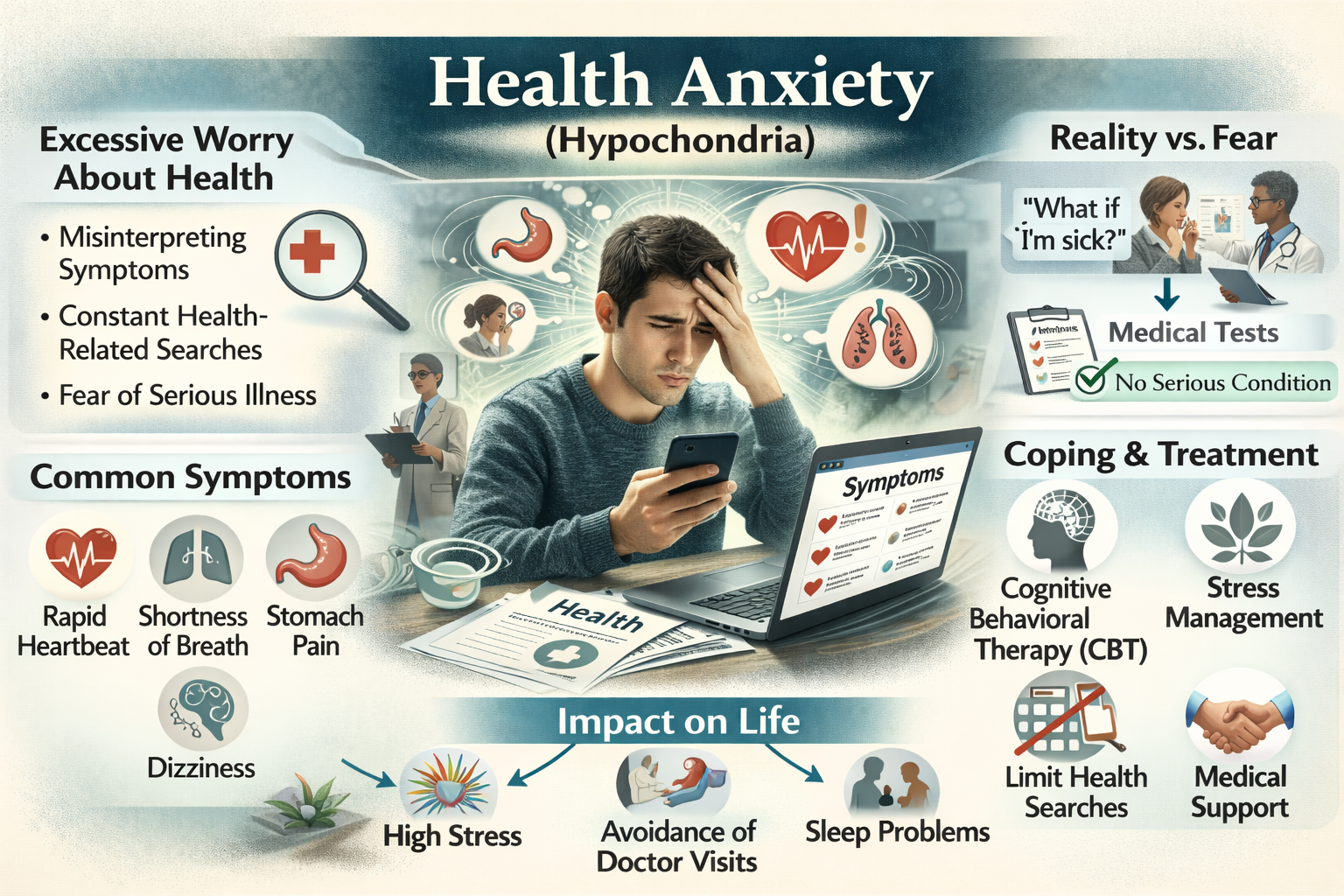
Health anxiety involves excessive worry about having or developing a serious illness, even when medical evaluations show otherwise. It goes beyond normal concern and can dominate thoughts and behaviors.
What Is Illness Anxiety Disorder? (DSM-5 Definition)
According to the DSM-5, illness anxiety disorder (the clinical term) requires a preoccupation with having or acquiring a serious illness lasting at least six months. Somatic symptoms are absent or mild, yet anxiety remains high. People often perform excessive health checks or avoid medical care altogether.
This differs from normal health concern, which is brief and proportional to actual risks. In illness anxiety disorder, reassurance from doctors provides only temporary relief before worry returns.
Hypochondria vs Health Anxiety – Clearing the Confusion
“Hypochondria” was the older term used for decades. In 2013, DSM-5 replaced it with two diagnoses:
- Illness anxiety disorder (little or no physical symptoms, pure worry).
- Somatic symptom disorder (prominent physical symptoms plus excessive health anxiety).
| Aspect | Hypochondria (Old Term) | Illness Anxiety Disorder (Current) |
| Preoccupation level | High fear of illness | High, ≥6 months |
| Somatic symptoms | Often present | Absent or mild |
| Daily impairment | Significant | Significant |
Why the Name Change Matters
The update reduces stigma—people hear “hypochondriac” as dismissive. The new terms focus on treatable anxiety rather than “imaginary” illness, encouraging more people to seek effective help.
For a broader foundation, see our guide on Signs of Mental Health Issues: What is Anxiety Disorder?
Signs of Hypochondria in Adults
Recognizing patterns early can prevent years of unnecessary suffering.
7 Common Behavioral Signs
Adults with health anxiety often:
- Frequently check their body for lumps, rashes, or changes.
- Visit doctors repeatedly or switch providers seeking confirmation.
- Spend hours researching symptoms online (“cyberchondria”).
- Avoid activities, people, or news that might trigger health fears.
- Seek constant reassurance from family or friends.
- Track vital signs obsessively (blood pressure, heart rate).
- Request unnecessary tests or scans.
Emotional and Cognitive Red Flags
Catastrophic thinking turns minor sensations into disasters (“This headache must be a tumor”). Reassurance-seeking creates short-term calm followed by renewed doubt. Many feel exhausted yet unable to stop the mental loop.
For guidance on when professional support becomes essential, see our guide: When to See a Therapist for Anxiety.
Health Anxiety Symptoms and Treatment – The Complete Physical Symptoms List
Anxiety itself produces very real physical sensations that fuel the fear cycle.
Health Anxiety Physical Symptoms List (Most Common)
Common symptoms include:
- Heart palpitations or racing heartbeat
- Dizziness or lightheadedness
- Muscle tension or aches
- Gastrointestinal distress (nausea, stomach upset)
- Headaches or migraines
- Shortness of breath or chest tightness
- Fatigue or weakness
- Sweating or hot flashes
- Tingling or numbness in limbs
- Sleep disturbances
- Dry mouth or difficulty swallowing
- Changes in appetite
These arise from the body’s fight-or-flight response but get misinterpreted as disease signs.
How Symptoms Fuel the Anxiety Cycle
Symptom → Catastrophic interpretation → Heightened anxiety → More intense symptoms → More checking or reassurance → Temporary relief, then repeat. Breaking this loop is key to recovery.
Note: Keep a daily symptom diary noting triggers, intensity (1-10), and what was happening at the time. Patterns often reveal anxiety, not illness.
For a broader foundation, see our guide on Signs of Mental Health Issues: Panic Disorder Overview
Health Anxiety After COVID Symptoms – Why the Pandemic Made It Worse
The COVID-19 era amplified health fears for millions.
Post-COVID Health Anxiety Triggers
Lingering symptoms (fatigue, brain fog), fear of long COVID, constant media updates, and personal losses created perfect conditions for health anxiety to spike. Many who never worried before now scan every cough or ache.
Recovery Timeline and Hope
Most people see meaningful improvement within 6–12 months with proper treatment. The brain can unlearn these patterns.
According to the World Health Organization, the first year of the pandemic triggered a 25% global increase in anxiety and depression prevalence.
How to Overcome Health Anxiety – Step-by-Step Self-Help Plan
People don’t need to wait for perfect conditions to start feeling better.
Step 1–3: Immediate Coping Tools
- Use the 5-4-3-2-1 grounding technique: Name 5 things seen, 4 that can be touched, 3 heard, 2 smelled, 1 tasted.
- Complete a thought record: Write the worry, evidence for and against it, and a balanced alternative.
- Schedule “worry time” — 15 minutes daily to address fears, then postpone them.
Step 4–7: Long-Term Strategies
- Practice gradual exposure (e.g., reading health articles without checking symptoms).
- Conduct behavioral experiments to test feared outcomes.
- Build lifestyle anchors: consistent sleep, exercise, and limited health-information consumption.
- Track progress weekly to see small wins add up.
Many people benefit from structured support like guided journaling workbooks designed specifically for health anxiety.
Cognitive Behavioral Therapy for Health Anxiety – The Gold Standard
CBT remains the most researched and effective treatment.
How CBT Rewires Health Anxiety
CBT targets two core processes:
- Cognitive restructuring — challenging catastrophic thoughts.
- Interoceptive and situational exposure — safely experiencing body sensations and triggers without avoidance.
What to Expect in 8–12 Sessions
A 2019 meta-analysis of 19 randomized controlled trials found CBT produces a moderate-to-large effect (g = 0.79), with 66% response and 48% remission rates. Benefits typically last 12–18 months or longer.
Research Shows: A 2017 systematic review reported even larger effects (d = 1.01) sustained at follow-up, outperforming other therapies.
Best Medication for Health Anxiety and Hypochondria Treatment Without Medication
Treatment is highly individualized.
SSRIs and SNRIs (First-Line Options)
When therapy alone isn’t enough or symptoms are severe, doctors may prescribe:
- Sertraline (Zoloft)
- Fluoxetine (Prozac)
- Escitalopram (Lexapro)
These help regulate serotonin and reduce overall anxiety. Side effects are usually mild and improve over time. Always discuss risks and benefits with a provider.
Hypochondria Treatment Without Medication
CBT, mindfulness-based approaches, regular exercise, and limiting reassurance-seeking often suffice for mild-to-moderate cases. Many achieve full relief without medication.
Expert Insight: “The goal isn’t to eliminate all worry — that’s impossible — but to respond to it differently,” notes clinical psychologists specializing in anxiety.
If exploring professional support feels right, evidence-based telehealth platforms can connect people with licensed therapists experienced in health anxiety.
How to Stop Health Anxiety Spirals Fast and Manage Health Anxiety at Night
Quick tools can interrupt the cycle in minutes.
5 Techniques to Calm Health Anxiety Fast
- Physiological sigh (double inhale through nose, long exhale).
- Cold exposure (splash face with cold water or hold ice).
- Scheduled worry time to contain rumination.
- Progressive muscle relaxation.
- Fact-checking with a pre-written “evidence card.”
Nighttime-Specific Strategies
Establish a phone curfew two hours before bed, practice body-scan meditation, and use white noise. Avoid health searches after dark.
Self Help Books for Hypochondria – Top Evidence-Based Reads
Targeted reading accelerates progress when paired with other strategies.
Top recommendations include:
- Overcoming Health Anxiety by Rob Willson and David Veale — a practical CBT workbook with exercises proven to reduce symptoms.
- The Hypochondriac’s Guide to Life and Death or similar CBT-based workbooks.
These outperform generic self-help because they teach specific skills rather than just offering encouragement.
Many readers find these books available on major retailers and report using them alongside therapy for faster results.
Scientific Evidence & Research
Decades of research confirm health anxiety responds well to treatment.
Clinical Studies
The 2019 meta-analysis (Axelsson et al., Taylor & Francis) across 19 trials showed robust CBT effects sustained long-term. Earlier 2017 work confirmed large effect sizes.
Expert Opinions
Leaders at the Anxiety and Depression Association of America (ADAA) and Mayo Clinic emphasize early intervention and CBT as first-line.
Statistical Data
Post-COVID data from WHO and U.S. studies show 25–35% rises in health-related anxiety, highlighting the need for accessible care.
- Mayo Clinic – Illness Anxiety Disorder
- PubMed CBT Meta-Analysis
- ADAA Health Anxiety Facts
Common Mistakes to Avoid
Avoiding these pitfalls speeds recovery.
Mistake #1: Endless Online Symptom Checking
Why it backfires: It provides temporary answers but fuels uncertainty. Better approach: Adopt an “information diet” — limit searches to 10 minutes daily with a trusted source.
Mistake #2: Seeking Constant Reassurance
Friends and family can’t provide lasting relief. Better approach: Practice response prevention — sit with uncertainty using CBT skills.
Mistake #3: Avoiding All Medical Care
This increases fear over time. Better approach: Maintain one trusted primary doctor for routine check-ups and stick to the plan.
Frequently Asked Questions (FAQs)
What is illness anxiety disorder?
Illness anxiety disorder is a condition involving excessive worry about having or developing a serious illness for at least six months, despite little or no physical symptoms and medical reassurance. It differs from normal health concerns by its intensity and persistence. Treatment with CBT is highly effective.
How to overcome health anxiety without medication?
CBT, mindfulness, exposure exercises, and lifestyle changes often lead to significant relief without medication. Start with grounding techniques and thought records, then gradually face feared sensations. Many achieve lasting results within 8–12 weeks of consistent practice. Consult a professional if symptoms interfere with daily life.
What are the best medications for health anxiety?
SSRIs such as sertraline, fluoxetine, or escitalopram are commonly prescribed when therapy alone is insufficient. They help regulate mood and reduce overall anxiety. Work closely with a doctor to find the right option and dosage, as individual responses vary.
How do you stop health anxiety spirals fast?
Use immediate techniques like the physiological sigh, 5-4-3-2-1 grounding, or cold water on the face. Schedule worry time to contain rumination. These interrupt the cycle within minutes and become more effective with practice.
Is hypochondria the same as health anxiety?
Yes — “hypochondria” is the older, common term now largely replaced by “illness anxiety disorder” in clinical settings. The conditions describe the same core experience of excessive health worry.
Can health anxiety cause real physical symptoms?
Yes. Anxiety activates the nervous system, producing very real sensations such as heart palpitations, dizziness, muscle tension, and stomach issues. These symptoms are harmless but feel alarming and reinforce the fear cycle until properly addressed.
Conclusion
Health anxiety (hypochondria) is highly treatable. With CBT, most people experience meaningful relief within weeks, and many achieve lasting remission. The difference between normal concern and clinical anxiety is now clear, the symptom cycle is recognized, and practical tools are available to interrupt spirals, challenge catastrophic thoughts, and build healthier responses.
The most important step is the first one. Book an appointment with a CBT-trained therapist this week, or download our free Health Anxiety Toolkit (sign up below for the 7-day “worry-free” challenge and weekly tips). No one has to live in constant fear anymore.
Recovery isn’t just possible — it’s the most common outcome for those who take action. Peace of mind is deserved, and the path forward starts today.
Medical Disclaimer
This article is for informational and educational purposes only and does not constitute medical advice. The information provided should not be used for diagnosing or treating a health problem or disease. Always consult with a qualified healthcare professional before making any changes to mental health treatment, starting new medications, or trying new approaches.
If experiencing a mental health crisis, please call or text 988 (Suicide & Crisis Lifeline) or visit the nearest emergency room. For non-emergency support, contact the SAMHSA National Helpline at 1-800-662-4357.