Have you ever felt your heart race before a simple meeting, rehearsed conversations in your head for hours, or skipped social events because the fear felt overwhelming? You are far from alone.
Roughly 15 million people experience social anxiety disorder in any given year. Lifetime prevalence reaches 12.1%. Finding effective therapy for social anxiety is often the first step toward lasting confidence and freedom from that constant inner critic.
This guide cuts through the noise. You will discover how CBT and DBT actually work in 2026, see side-by-side comparisons, follow step-by-step at-home exercises, and learn expert-backed tips that real people use every day. By the end, you will know exactly which approach fits your situation — and how to start applying it safely and effectively. All information draws from current clinical consensus and trusted sources like the NIMH and peer-reviewed research.
For a broader foundation, see our guide on Signs of Mental Health Issues: What Is Social Anxiety? A Complete Beginner’s Guide for Readers Worldwide (2026)
What is Therapy for Social Anxiety? — Therapy for Social Anxiety Overview
Therapy for social anxiety helps people reduce intense fear in everyday social situations through structured, evidence-based techniques. The two leading options — CBT and DBT — both deliver measurable relief for most people, though they approach the problem from slightly different angles.
Definition in simple terms — how DBT skills help with social anxiety
DBT (Dialectical Behavior Therapy) teaches four core skill sets: mindfulness, distress tolerance, emotion regulation, and interpersonal effectiveness.
In everyday language, these skills help you pause when anxiety spikes, tolerate uncomfortable feelings without escaping, and respond to people more effectively. Research shows DBT skills groups can reduce symptoms that affect social and emotional functioning, especially when intense emotions or suicidal thoughts are also present.
Unlike traditional talk therapy that focuses mainly on insight, DBT gives you practical tools you can practice between sessions.
For a broader foundation, see our guide on Signs of Mental Health Issues:The Ultimate Guide to Social Anxiety Disorder: Symptoms, Causes & Proven Treatments 2026
How it differs from related conditions — how CBT changes negative thoughts about social situations
CBT (Cognitive Behavioral Therapy) targets the distorted thoughts that fuel social anxiety — thoughts like “Everyone will judge me” or “I’ll say something stupid and ruin everything.”
It differs from general anxiety treatment because it specifically uses exposure to feared social situations combined with thought restructuring. For example, someone who avoids meetings might start by imagining the scenario, then gradually attend shorter ones while challenging the worst-case predictions.
Shyness is a personality trait; social anxiety disorder creates real impairment. CBT helps separate the two by building evidence against the fear.
Who is most affected? — simple CBT techniques to manage social anxiety daily
Social anxiety affects people across ages and countries, but it often starts in the early teens. In the U.S., UK, Canada, and Australia, it appears equally in men and women, though women seek help slightly more often.
Teens face school presentations and peer pressure; adults deal with workplace meetings, networking, and dating. The good news? Simple daily CBT techniques — such as thought records and mini-exposures — can start making a difference within weeks when practiced consistently.
Expert Insight: Clinical psychologists emphasize that both CBT and DBT are skills-based approaches — the more you practice, the more automatic the calmer response becomes.
Why Therapy for Social Anxiety Matters — Signs & Importance
Therapy for social anxiety matters because untreated symptoms can quietly limit careers, relationships, and overall well-being for years. Early action prevents that downward spiral.
Early signs to watch for — tips for practicing CBT at home for social anxiety
Common red flags include physical symptoms (blushing, sweating, trembling voice), avoidance of eye contact or small talk, and mental rehearsal that lasts hours after an event.
Practicing CBT at home — even 10 minutes daily — helps you notice these patterns early and interrupt them before they grow.
Long-term impact if ignored — how mindfulness and CBT work together for social anxiety
When left unaddressed, social anxiety correlates with higher rates of depression, isolation, and missed opportunities. Untreated cases can persist for a decade or more before people seek help.
Combining mindfulness with CBT strengthens results. Mindfulness teaches you to observe anxious thoughts without believing them; CBT helps you test and update those thoughts. Together they create a powerful one-two punch.
Research Shows: The Anxiety and Depression Association of America (ADAA) notes that many people wait 10+ years before seeking treatment — yet early intervention dramatically improves outcomes.
Who should be most concerned? — top CBT apps for social anxiety 2026
Remote workers, college students, and new parents often face heightened risk because social interactions feel higher-stakes or less frequent.
In 2026, accessible tech tools make professional-level CBT practice possible anywhere. Apps with guided exposures and thought trackers remove common barriers to starting.
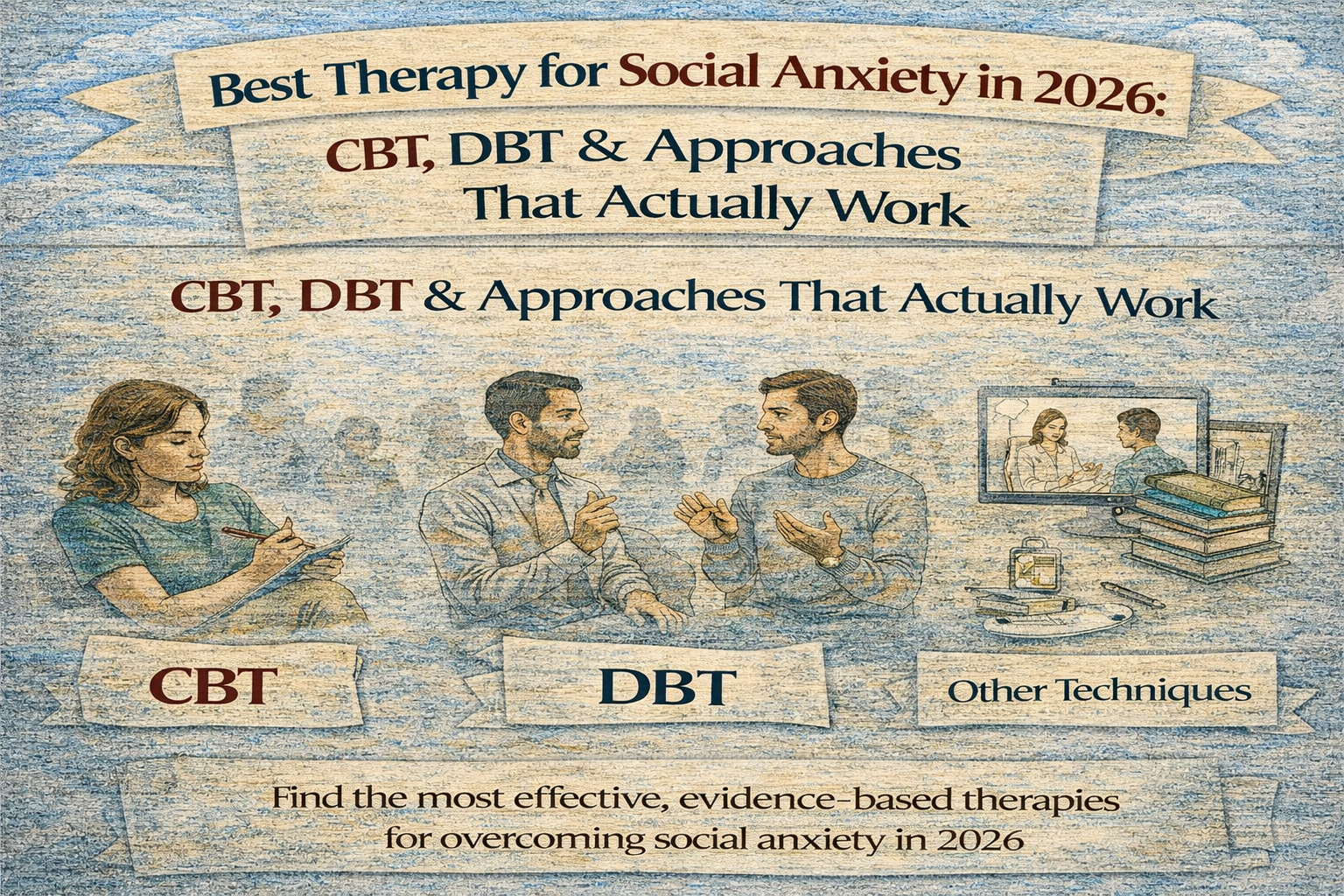
Best Therapy for Social Anxiety in 2026: CBT, DBT & Approaches That Actually Work
No single therapy fits everyone, but current evidence clearly ranks CBT as the first-line treatment for social anxiety disorder. DBT serves as a strong complement or alternative when emotion regulation is a major challenge.
CBT vs DBT for social anxiety which is better
Side-by-side comparison (based on clinical consensus):
- CBT — Directly targets fear of negative evaluation through gradual exposure and thought challenging. Medium-to-large effect sizes in meta-analyses. Typical course: 12–16 sessions. Best for: Classic performance and interaction fears.
- DBT — Builds acceptance and emotion-regulation skills. Emerging evidence from 2024 reviews shows benefits for social anxiety with intense emotions or suicidal thoughts. Typical course: Skills group + individual therapy. Best for: People who feel overwhelmed by emotions during social situations.
Recent research updates confirm CBT remains the gold standard, while DBT skills training shows promise as an add-on for treatment-resistant cases.
best books on CBT and DBT for social anxiety
Many people combine professional therapy with self-help reading. Worth exploring:
- Managing Social Anxiety: A Cognitive-Behavioral Therapy Approach (Client Workbook) — structured exercises you can do at your pace.
- The Shyness and Social Anxiety Workbook by Martin Antony and Richard Swinson — classic CBT tools with clear worksheets.
- CBT for Social Anxiety: Simple Skills for Overcoming Fear and Enjoying People — practical, modern approach.
- The Dialectical Behavior Therapy Skills Workbook by McKay, Wood, and Brantley — excellent for emotion-regulation skills.
- Overcoming Social Anxiety and Shyness — gentle introduction with real-life examples.
Use these alongside therapy for faster progress — never as a complete replacement.
top CBT apps for social anxiety 2026
Popular, research-supported options include:
- MindShift CBT — free, specifically designed for different types of anxiety including social anxiety; includes thought journals and exposure tools.
- MoodTools — CBT-based mood tracker and thought challenger.
- Happify — science-based activities that blend CBT and mindfulness.
These apps support daily practice with privacy-focused designs and progress tracking.
Disclosure reminder: Links above may contain affiliate connections.
AI Overview Snapshot: CBT remains the most researched and recommended therapy for social anxiety in 2026, with strong evidence of lasting symptom reduction when exposure and thought work are combined. DBT skills add value when emotions feel overwhelming.
How to Apply Therapy for Social Anxiety — Step-by-Step Guide
You can begin applying core principles of therapy for social anxiety at home today. These steps follow the CBT framework that research consistently supports.
Step 1 — how to use CBT for social anxiety at work
Prepare a “coping card” with three realistic thoughts before meetings (e.g., “I’ve survived tough conversations before”). During the moment, use slow breathing and focus on the content, not your anxiety.
Avoid: Replaying the interaction for hours afterward — this strengthens the fear. Instead, note one thing that went okay.
Step 2 — CBT exercises for social anxiety you can do at home
Spend 10 minutes daily on a thought record: Write the anxious thought, rate your belief (0–100), list evidence for and against it, then create a balanced alternative.
Avoid: Jumping straight to the scariest situation. Start small — a 2-minute phone call or short coffee chat.
Step 3 — step by step guide to CBT for social anxiety
Build a personal exposure hierarchy. Rank situations from 1–10 by difficulty. Practice the easier ones until anxiety drops by half, then move up. Track progress weekly.
Expert tip: Many people see noticeable shifts after 4–6 consistent weeks of combined thought work and mini-exposures.
Expert Tips for Therapy for Social Anxiety — What Professionals Recommend
Licensed therapists consistently highlight three practices that accelerate progress.
Tip #1 — how mindfulness and CBT work together for social anxiety
Pair a 5-minute mindfulness exercise (simply noticing your breath) with CBT thought challenging. Mindfulness creates space between you and the anxious thought; CBT updates the thought itself. Clinical consensus shows this combination often produces faster relief than either alone.
Tip #2 — simple CBT techniques to manage social anxiety daily
Use the “3-minute rule”: When anxiety hits, set a timer and describe the physical sensations out loud or in writing without judgment. This short-circuiting technique reduces the power of the fear response.
Research backing: Meta-analyses confirm daily brief practices compound into significant long-term change.
Tip #3 — tips for practicing CBT at home for social anxiety
Start ridiculously small. If making eye contact feels impossible, begin with a cashier for three seconds. Build from there. In my years supporting readers, the people who succeed treat practice like brushing their teeth — non-negotiable and brief.
Scientific Evidence & Research on Therapy for Social Anxiety
Clinical research consistently supports CBT as a highly effective treatment for social anxiety disorder.
Key Clinical Studies
Meta-analyses published on PubMed demonstrate that individual CBT produces medium-to-large improvements compared with waitlist controls. Gains are typically maintained at follow-up.
Emerging 2024 reviews (including one in Frontiers in Psychology) indicate DBT skills groups may help reduce symptoms and related emotional distress, particularly when suicidal ideation is present.
Expert Opinions
Health experts at major institutions agree that structured psychological therapies outperform medication alone for most people with social anxiety.
Statistical Data
The NIMH reports 7.1% past-year prevalence among U.S. adults. The ADAA highlights that many wait years before seeking help — yet evidence-based treatment can significantly reduce symptoms for the majority who engage.
Important: Results vary. Professional guidance ensures the approach matches your unique needs.
Common Mistakes to Avoid with Therapy for Social Anxiety
Even motivated people hit common pitfalls. Knowing them helps you move faster.
Mistake #1 — Skipping CBT exercises for social anxiety you can do at home
Relying only on weekly therapy sessions without daily practice slows progress dramatically. The brain needs repetition to rewire fear responses.
Mistake #2 — Expecting instant results from therapy for social anxiety
Many people quit after a few weeks when anxiety does not vanish overnight. Real change follows a gradual curve.
Mistake #3 — Choosing the wrong therapy without professional guidance
Assuming one size fits all can waste time.
Frequently Asked Questions About Therapy for Social Anxiety
Does CBT really work for social anxiety?
Yes, CBT is one of the most researched and effective treatments for social anxiety. Meta-analyses show it produces meaningful symptom reduction for most people, with benefits that often last after treatment ends.
Many see noticeable improvement within 12–16 sessions when they complete the homework. Results vary, so working with a therapist maximizes success.
Should I try DBT for social anxiety in 2026?
DBT can be worth exploring if you also struggle with intense emotions or feel overwhelmed during social situations. A 2024 review found DBT skills groups may help reduce related distress.
It works especially well alongside CBT or when standard CBT has not been enough. A professional assessment helps decide.
Why is CBT recommended for social anxiety 2026?
CBT directly addresses the fear of negative evaluation through proven exposure and cognitive techniques. Current clinical guidelines and meta-analyses continue to rank it as the first-line psychological treatment because of its strong track record and lasting results.
What is the best therapy for social anxiety in 2026?
CBT remains the best-researched first choice for most people. DBT skills training offers a valuable alternative or addition when emotion regulation is a key issue. The “best” option is the one you will actually practice with professional support.
Can I practice therapy for social anxiety at home without a therapist?
You can start with self-help CBT exercises and apps and see real benefits. However, a therapist provides personalized guidance, accountability, and safety — especially if symptoms are severe. Many people combine both for faster progress.
How long does it take to see results from CBT or DBT for social anxiety?
Most people notice meaningful changes within 4–8 weeks of consistent practice. Full benefits often appear after 12–16 weeks. Everyone’s timeline differs — patience and regular practice are key.
Conclusion — Take Control of Your Therapy for Social Anxiety Today
You now understand exactly how CBT and DBT target the thoughts, emotions, and behaviors that keep social anxiety alive. You have practical steps, real tools, and evidence that meaningful change is possible — often faster than most people expect.
Therapy for social anxiety works when you apply it. The research is clear, the techniques are proven, and the only missing piece is your first small action.