In the American Psychological Association’s 2025 poll, 67% of Americans reported feeling anxious about current events happening around the world — and millions are still suffering in silence.
If someone lies awake at night replaying worries, avoids social situations because their heart races, or feels constant dread that disrupts work and relationships, they are not alone. Anxiety disorders affect 19.1% of U.S. adults each year, according to the National Institute of Mental Health (NIMH).
Yet for generalized anxiety disorder specifically, only 43.2% receive any treatment (Anxiety and Depression Association of America). Many people feel isolated, ashamed, or unsure where to begin.
For a broader foundation, see our guide on Signs of Mental Health Issues: Complete Guide to Anxiety Disorders
What Are Anxiety Support Groups?
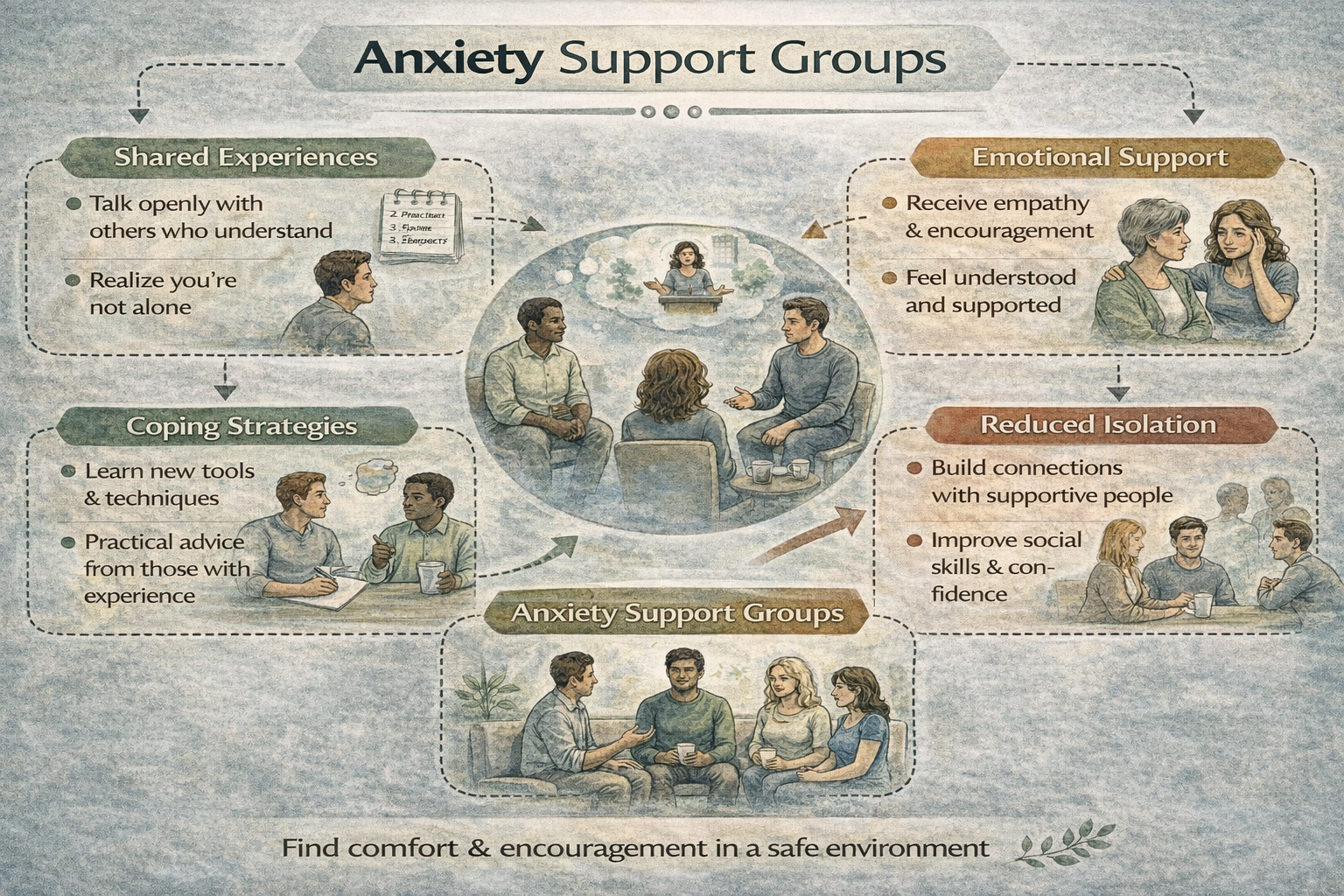
Anxiety support groups bring together people who share similar experiences with anxiety in a safe, structured environment to offer mutual understanding and practical coping strategies. Unlike traditional therapy, these groups are typically peer-led or professionally facilitated but focus on shared lived experience rather than clinical diagnosis and treatment.
Understanding Peer-Led Anxiety Support Groups
Peer-led anxiety support groups emphasize connection and normalization. Participants share stories, exchange coping tools, and remind one another that their struggles are valid. These groups differ from therapy because they are not designed to provide professional diagnosis or individualized treatment plans. Instead, they offer community and hope through collective wisdom.
Peer support versus professionally led groups: Peer-led groups are often free or low-cost and run by trained volunteers with personal experience. Professionally led groups may include licensed therapists who guide discussions while still encouraging peer interaction.
Anxiety Support Groups vs One-on-One Therapy
| Aspect | Anxiety Support Groups | One-on-One Therapy |
| Cost | Often free or low-cost | Insurance-dependent or $100–$250/session |
| Format | Group (8–15 people), weekly or bi-weekly | Individual sessions |
| Confidentiality | Group agreement, not legally protected like therapy | Legally protected by HIPAA |
| Focus | Shared experiences, coping skills | Personalized diagnosis and treatment |
| Outcomes | Reduced isolation, skill-sharing | Targeted symptom reduction |
Many people combine both for the best results.
Modern Formats Available in 2026
Today’s anxiety support groups come in three main formats: traditional in-person meetings, hybrid (in-person + virtual), and fully virtual options via Zoom or secure apps. Virtual formats have exploded in popularity because they remove barriers like travel, childcare, or mobility issues.
For a broader foundation, see our guide on Signs of Mental Health Issues: Types of Anxiety Disorders
Why Join an Anxiety Support Group?
Joining an anxiety support group can be life-changing because it directly addresses the isolation that fuels anxiety.
Emotional and Psychological Benefits
People discover they are not broken or alone. Hearing others describe the exact same racing thoughts or panic symptoms normalizes the experience and reduces shame. Shared stories create hope — many members report feeling lighter after just a few sessions.
Research Shows: A 2023 systematic review and meta-analysis of peer support interventions found small but significant improvements in personal recovery (g = 0.15) and clinical symptoms (g = 0.19) for people with mental health conditions, including anxiety.
Practical Advantages Over Going It Alone
Group members exchange real-world coping strategies that therapists may not cover in 50-minute sessions. Accountability is gained (“I’ll check in next week”) and 24/7 access through online communities. Virtual groups mean support is available even at 2 a.m. when anxiety peaks.
Expert Insight: “The power of peer support lies in the ‘me too’ moment,” says clinical psychologist Dr. Elena Rivera. “When someone says, ‘I get it,’ the brain registers safety in a way no textbook can provide.”
For a broader foundation, see our guide on Signs of Mental Health Issues: Anxiety Exposure Therapy
Online Anxiety Support Groups: The Most Accessible Option
Online anxiety support groups have become the gateway to relief for millions because they fit busy lives and offer immediate access.
Free Online Anxiety Support Groups
“Free” usually means no cost to join or attend, though some platforms offer optional paid upgrades for 1-on-1 listening. Reputable free options include the ADAA’s four anonymous peer communities, 7 Cups anxiety chat rooms, and NAMI Connection recovery groups (many now hybrid).
Virtual Anxiety Support Groups and Weekly Online Anxiety Support Groups
Virtual meetings provide schedule flexibility — many run evenings, weekends, or even 24/7 text-based support. Anonymity (using only first names or handles) helps people open up faster. Rural residents or those with mobility challenges especially benefit.
Pro Tip: Choose platforms with clear moderation guidelines and trained facilitators to ensure psychological safety.
How to Find Anxiety Support Groups Online
Finding the right anxiety support group takes less than 10 minutes when following a proven process.
Step-by-Step: Find Anxiety Support Groups Online in Under 10 Minutes
- Search using exact phrases: “free online anxiety support groups,” “virtual anxiety support groups,” or “anxiety support groups for [specific demographic].”
- Check the top results from trusted organizations (ADAA, NAMI, 7 Cups).
- Read the group rules and moderator credentials.
- Attend a trial session before committing.
Red-flag checklist: Avoid groups that promise cures, pressure payment upfront, or lack clear confidentiality policies.
Anxiety Support Group Online Free – Best Platforms & Directories
- ADAA Online Support Communities — Free, anonymous, moderated.
- 7 Cups — 24/7 listeners and themed anxiety rooms.
- NAMI Connection — Peer-led, free or donation-based.
- Psychology Today Support Group Directory — Filter by virtual, anxiety, and location.
Many people start with one free session and stay for years.
Anxiety Support Groups for Specific Needs
One size does not fit all. Specialized anxiety support groups address unique life stages and identities.
Anxiety Support Groups for Adults
These focus on work stress, parenting anxiety, relationship worries, and midlife transitions. Most virtual adult groups meet evenings.
Anxiety Support Groups for Teens
Teen-specific groups (ages 13–17) are professionally moderated and often require parental consent. Topics include school pressure, social media anxiety, and identity.
Anxiety Support Groups for Women
Women-only groups create safer spaces to discuss hormonal influences, postpartum anxiety, caregiving stress, and gender-specific experiences.
Christian Anxiety Support Groups
Faith-integrated groups combine peer support with scripture, prayer, and spiritual encouragement. Many meet virtually and welcome all denominations.
Peer Support Groups for Anxiety – What to Expect
Walking into a first peer support group for anxiety can feel intimidating, but most members remember feeling the same way.
Online Anxiety Peer Support Groups Structure
Typical sessions last 60–90 minutes and follow a consistent format: check-in round, topic discussion or skill-sharing, and closing with positive affirmations or resources. Ground rules always include confidentiality, no advice-giving unless requested, and respect for all experiences.
Anxiety Support Groups Meeting Online – First Session Checklist
- Test tech 10 minutes early
- Choose a quiet, private space
- Prepare one short sentence about why attending (optional)
- Remember: Listening only on the first visit is fine
Scientific Evidence & Research
Anxiety support groups are more than just “talking about feelings” — rigorous research supports their value as a complement to professional care.
Clinical Studies
A 2020 meta-analysis by Barkowski et al. (Psychotherapy Research) examined group psychotherapy for anxiety disorders and found a large effect size versus no treatment (g = 0.92) and comparable outcomes to individual therapy.
A 2023 systematic review and meta-analysis of peer support interventions showed small but meaningful gains in clinical recovery (g = 0.19) and personal recovery (g = 0.15).
Expert Opinions
The Anxiety and Depression Association of America (ADAA) and American Psychological Association endorse peer support as a valuable adjunct to evidence-based treatment.
Statistical Data
19.1% of U.S. adults experience an anxiety disorder each year (NIMH), yet treatment gaps remain significant. Support groups help close that gap for the millions who are untreated or waiting for professional care.
External Links:
- ADAA Facts & Statistics
- Barkowski 2020 Meta-Analysis
- NIMH Any Anxiety Disorder
Common Mistakes to Avoid
Even well-intentioned people make these errors when exploring anxiety support groups.
Mistake #1: Joining Without Checking Moderation or Safety Guidelines
Problem: Unmoderated spaces can contain harmful advice or trigger content. Better approach: Stick to established organizations with clear rules and trained facilitators.
Mistake #2: Expecting Instant Cure Instead of Long-Term Support
Problem: Anxiety support groups provide ongoing tools, not overnight fixes. Better approach: View groups as one part of a broader wellness plan.
Mistake #3: Oversharing Too Soon or Comparing Journeys
Problem: Early oversharing can increase vulnerability; comparison fuels anxiety.
Important: If a group ever makes someone feel worse or unsafe, leave immediately and consider speaking with a licensed professional.
Frequently Asked Questions (FAQs)
What are the best online anxiety support groups?
The best online anxiety support groups in 2026 include ADAA’s free peer communities, 7 Cups anxiety chat rooms, and NAMI Connection groups. These platforms offer trained moderation, anonymity options, and consistent meeting schedules. Start with ADAA or 7 Cups for immediate access.
Are free online anxiety support groups effective?
Yes, research suggests free online anxiety support groups can reduce feelings of isolation and improve coping skills. While they are not a substitute for therapy, studies show peer support delivers small but meaningful gains in recovery. Many participants report lasting benefits when they attend regularly.
How do I join virtual anxiety support groups for teens or women?
For teens, search NAMI or local mental health centers for age-appropriate moderated groups (parental consent usually required). For women, use Psychology Today filters or ADAA communities that offer women-only rooms. Most allow observing the first session.
What is the difference between Christian anxiety support groups and secular ones?
Christian anxiety support groups incorporate prayer, scripture, and faith-based encouragement alongside peer sharing. Secular groups focus purely on psychological coping strategies. Both can be helpful — choose based on what aligns with personal values.
Are anxiety support groups meeting online confidential?
Reputable anxiety support groups meeting online require participants to agree to confidentiality rules. However, they are not protected by the same legal standards as therapy. Never share information that wouldn’t want repeated, and choose platforms with strong privacy policies.
Can peer support groups for anxiety replace therapy?
Peer support groups for anxiety complement but do not replace professional therapy. They excel at reducing isolation and teaching practical skills, while therapy provides personalized clinical treatment. Many people benefit from both.
How often do weekly online anxiety support groups meet?
Most weekly online anxiety support groups meet once per week for 60–90 minutes. Some offer multiple weekly options or drop-in 24/7 chat support for extra flexibility.
Conclusion
Anxiety support groups deliver science-backed relief, genuine connection, and practical tools that many people cannot find anywhere else — especially the free and virtual options available around the clock in 2026.
What these groups offer, how to find them safely, what to expect, and why they work is now clear. The next step is simple: choose one group from the resources above and attend a first meeting this week.
No one has to face anxiety alone. Join a free online anxiety support group today or book a consultation with a licensed therapist if symptoms feel overwhelming.
Medical Disclaimer
This article is for informational and educational purposes only and does not constitute medical advice. Always consult a qualified healthcare professional for personalized guidance. In crisis, call or text 988.