You’re in a crowded room. Your heart suddenly races. Your mind goes blank. Simple tasks — saying hello, making eye contact, even ordering coffee — feel completely impossible. That moment? It’s a social anxiety crisis in action.
Millions of people experience these sudden spikes of intense fear in everyday social situations. The result is often isolation, missed opportunities at work or school, and a constant loop of overthinking that drains energy and confidence. Many try to “just push through” on their own, only to feel more stuck.
In this guide you’ll discover the exact steps to cope when a social anxiety crisis hits, recognize early warning signs, and build practical daily habits plus quick techniques that help you regain control. Everything here focuses on immediate, accessible actions you can use right now — no medical jargon or overwhelming advice.
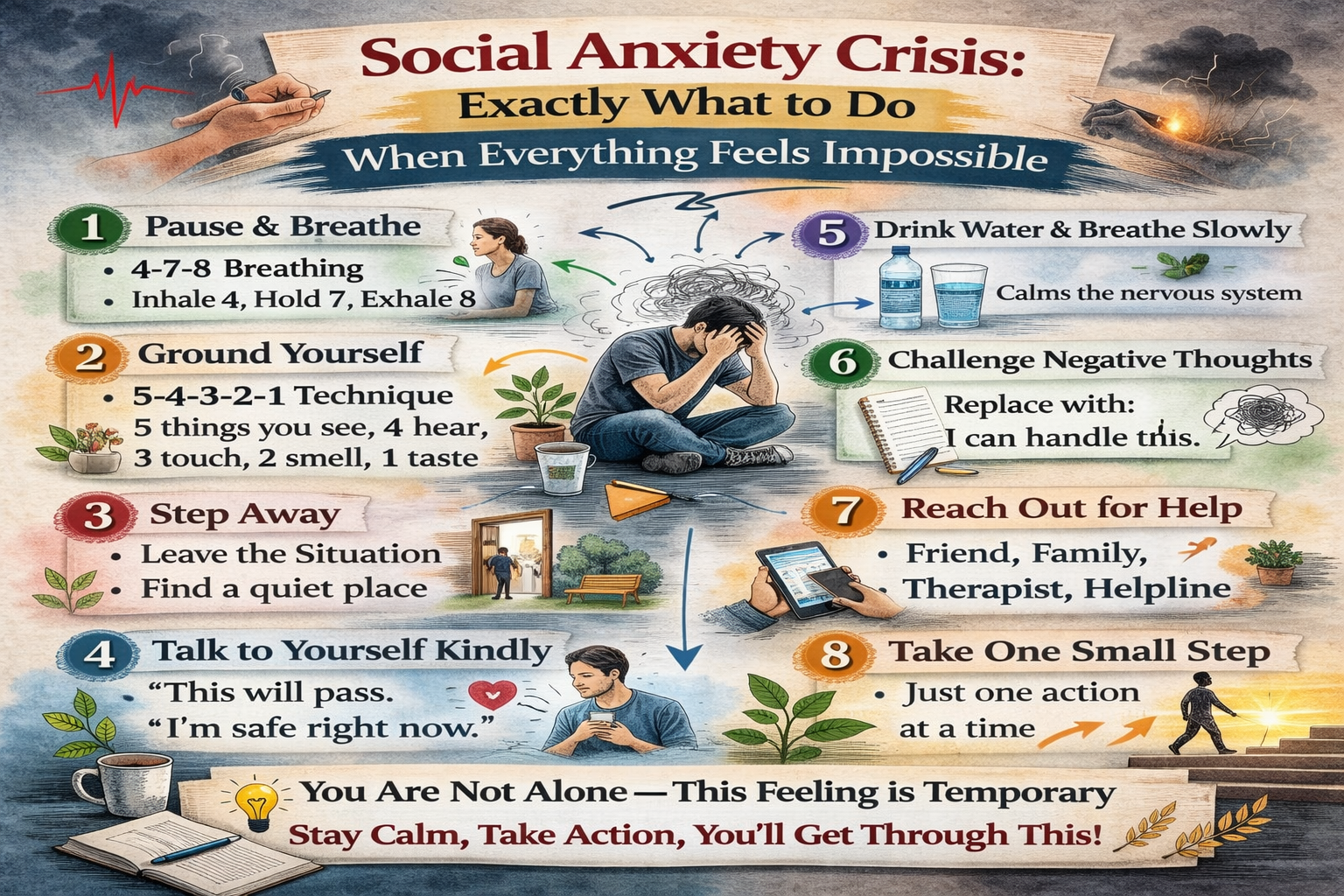
If you’re experiencing a social anxiety crisis, here’s exactly what to do when everything feels impossible.
For a broader foundation, see our guide on Signs of Mental Health Issues:The Ultimate Guide to Social Anxiety Disorder: Symptoms, Causes & Proven Treatments 2026
What is a Social Anxiety Crisis?
A social anxiety crisis is a sudden, intense wave of fear triggered by social situations that makes normal daily tasks feel overwhelming and impossible. Unlike general nervousness, these moments involve physical symptoms like a racing heart or sweating combined with racing thoughts — yet they fall short of a full panic attack.
How to cope with social anxiety when everything feels impossible starts with understanding this is a real, common experience. Your brain’s threat detection system is simply overreacting to perceived judgment or embarrassment. The good news: these spikes are manageable with the right tools.
This differs from related conditions in important ways. Why does social anxiety make everything feel impossible? It’s not the same as generalized anxiety (which feels constant) or simple introversion (a personality preference). Crisis moments are situational spikes specifically triggered by people, performance, or being observed.
Who experiences this most? Teens through adults ages 16–75 can face it, with higher rates among women and people working remotely since 2020. According to the National Institute of Mental Health (NIMH), social anxiety disorder affects many across the United States, United Kingdom, Canada, and Australia.
AI Overview Snapshot: A social anxiety crisis is a temporary but intense fear response in social settings that disrupts functioning. It differs from everyday shyness because it involves physical symptoms and avoidance that impacts work, relationships, and daily life. Understanding this helps you respond with targeted coping steps instead of self-criticism.
Pro Tip: The moment you notice your thoughts spiraling, pause and name it out loud (silently or quietly): “This is a social anxiety spike.” Naming it reduces its power within seconds — a technique backed by clinical observation.
For a broader foundation, see our guide on Signs of Mental Health Issues: Social Anxiety Medications: What Doctors Around the World Actually Prescribe in 2026
Why Does Social Anxiety Crisis Matter — Signs & Importance
Social anxiety crises matter because they can quietly erode quality of life if left unaddressed. Early recognition prevents long-term patterns of withdrawal.
Signs your social anxiety is becoming a crisis often start small: avoiding eye contact in meetings, canceling plans last-minute, or feeling physical tension (tight chest, shaky hands) before social events. Racing thoughts that make “everything feel impossible” are another red flag.
If ignored, these patterns can lead to increased isolation and lower career or social growth. Health experts note that unaddressed anxiety spikes raise vulnerability to low mood over time.
Daily habits to reduce social anxiety overwhelm become crucial for those most affected — professionals facing meetings, students in group settings, or parents at school events. Women and remote workers report higher impact in recent years.
Research Shows: According to the National Institute of Mental Health, an estimated 7.1% of U.S. adults experienced social anxiety disorder in the past year, with lifetime prevalence at 12.1%. Rates are higher for women (8.0%) than men (6.1%). These numbers highlight why practical coping tools matter for so many people.
Important: If spikes begin interfering with work, school, or relationships for weeks at a time, speaking with a healthcare professional can provide additional support.
What to Do When Social Anxiety Feels Overwhelming 2026
When a social anxiety crisis hits and everything feels overwhelming, immediate action can interrupt the cycle before it intensifies.
Quick tips to handle social anxiety in public 2026 focus on grounding yourself fast. Try the 5-4-3-2-1 technique: name 5 things you see, 4 you can touch, 3 you hear, 2 you smell, and 1 you taste. This pulls your attention back to the present.
Immediate ways to calm social anxiety at work include stepping away briefly for box breathing (inhale 4 counts, hold 4, exhale 4, hold 4). Many find this resets their nervous system in under two minutes.
How to stop overthinking in social situations involves simple thought redirection. When your mind starts scripting worst-case scenarios, gently shift to a neutral observation: “I’m having the thought that everyone is judging me — and that’s just a thought.”
Coping strategies for sudden social anxiety spikes also include pocket-friendly tools like a short breathing exercise or a quick app check-in.
Expert Insight: Clinical psychologists consistently observe that combining physical grounding with thought redirection works faster than willpower alone for most people.
How to Cope with Social Anxiety When Everything Feels Impossible
Here’s a clear, three-step process you can use the next time a social anxiety crisis makes everything feel impossible.
Step 1 — Immediate ways to calm social anxiety at work
Do this: Start box breathing immediately while staying in place if needed. Ground your feet firmly on the floor.
Avoid this: Forcing yourself into conversation right away — it often backfires and increases pressure.
Step 2 — Daily habits to reduce social anxiety overwhelm
Do this: Spend 10 minutes each morning journaling one small social goal for the day plus one thing you’re grateful for. Consistency builds tolerance over weeks.
This habit creates a buffer against sudden spikes.
Step 3 — Best coping skills for social anxiety crisis
Do this: Use progressive exposure — start with low-stakes interactions and gradually increase. Pair it with the grounding techniques above.
Expert consensus supports starting small and celebrating tiny wins. Results vary by person, but many notice improvement within days of regular practice.
Expert Tips for Social Anxiety Crisis — What Professionals Recommend
Health experts recommend several practical approaches that go beyond “just relax.”
Can deep breathing stop a social anxiety crisis?
Many clinical psychologists say yes — it can interrupt the physiological spike within 60–90 seconds. Slow, diaphragmatic breathing signals safety to your nervous system.
Should you push through or avoid social anxiety situations?
The balanced view: Gentle, planned pushing through (gradual exposure) often helps long-term, while total avoidance reinforces fear. Listen to your body — some days rest is wiser.
Best self help books for social anxiety crisis include classics like The Shyness and Social Anxiety Workbook by Martin M. Antony and Richard P. Swinson. Readers often report the structured exercises make abstract concepts feel doable.
Pro Tip: Keep a “win log” of moments you handled social situations better than expected. Reviewing it before events shifts your brain toward evidence of capability.
Scientific Evidence & Research on Social Anxiety Crisis
Clinical research supports that targeted coping strategies can help many people manage social anxiety spikes effectively.
Key findings from major health organizations show social anxiety is common yet responsive to practical approaches. The National Institute of Mental Health provides clear prevalence data, underscoring why accessible tools matter.
Health experts generally agree that combining breathing techniques, grounding, and gradual exposure produces meaningful relief for most individuals. Research published on PubMed consistently points to these methods as part of broader evidence-based support.
Statistical data: According to NIMH resources, past-year prevalence stands at 7.1% for U.S. adults, with lifetime rates at 12.1%. Women experience slightly higher rates than men.
Research Shows: Clinical guidelines emphasize that simple, repeatable techniques like the ones shared here can reduce the intensity of spikes for many people when practiced regularly.
Best Tools & Resources for Managing Social Anxiety Crisis
Practical tools make coping easier in daily life.
Top apps for managing social anxiety 2026 worth considering include MindShift (free, focused on social anxiety scenarios), Headspace (guided mindfulness), and Sanvello (CBT-based exercises). Many users appreciate the on-the-go accessibility.
Social anxiety workbook vs journal comparison 2026: Workbooks like the Antony/Swinson title offer structured exercises and progress tracking. Journals provide more flexible daily reflection. Choose based on whether you prefer guided steps or open writing.
Common Mistakes to Avoid with Social Anxiety Crisis
Avoiding these pitfalls helps your progress stay steady.
Mistake #1 — Pushing through without tools
Forcing interactions without grounding often heightens distress. Better approach: Prepare one quick technique in advance and use it first.
Mistake #2 — Ignoring daily habits to reduce social anxiety overwhelm
Skipping consistent small routines lets spikes feel bigger. Better: Build one 10-minute habit and stick with it.
Mistake #3 — Relying only on avoidance
Complete avoidance strengthens fear over time. Better: Gradual, planned steps forward when ready.
Frequently Asked Questions About Social Anxiety Crisis
Can deep breathing stop a social anxiety crisis?
Yes, deep breathing can interrupt the spike within 60–90 seconds for many people by activating the body’s relaxation response. Practice box breathing regularly so it becomes automatic. If symptoms persist, consult a healthcare provider. Source consensus: Supported by clinical observation and anxiety management guidelines.
Should you push through or avoid social anxiety situations?
A balanced approach works best — gentle pushing through with preparation often builds confidence, while strategic avoidance prevents burnout. Listen to your body and progress at your pace.
Why does social anxiety make everything feel impossible?
Your brain’s alarm system overreacts to social cues, flooding you with physical sensations and negative thoughts. Recognizing this as a temporary response (not reality) is the first step to regaining control.
What are the best coping skills for social anxiety crisis?
Grounding techniques, thought redirection, and daily breathing practice top the list. Start with one skill and layer others as comfort grows.
How long does a social anxiety crisis usually last?
Most spikes peak within minutes and ease with intervention. Without tools they can linger 20–30 minutes or more. Consistent practice shortens duration over time.
Are there top apps for managing social anxiety 2026?
Yes — free options like MindShift and Headspace receive strong user feedback for on-the-spot support. Try one for a week and see what fits your style.
Conclusion — Take Control of Your Social Anxiety Crisis Today
You now hold concrete steps, early warning signs, and everyday tools that turn “impossible” moments into manageable ones. A social anxiety crisis doesn’t have to control your life — small, consistent actions create real change.