Imagine stepping into a crowded café for a casual meet-up, only to feel your chest tighten as if the walls are closing in, convinced that every glance your way is laced with judgment. Have you ever wondered if this overwhelming dread is more than just nerves—what is social anxiety, really?
Millions grapple with this invisible barrier daily, often dismissing it as mere shyness, yet it silently erodes confidence and connections. This persistent fear can derail careers, strain friendships, and leave individuals feeling trapped in isolation. The uncertainty of whether it’s “normal” or something deeper compounds the struggle, leading to avoidance that only amplifies the cycle.
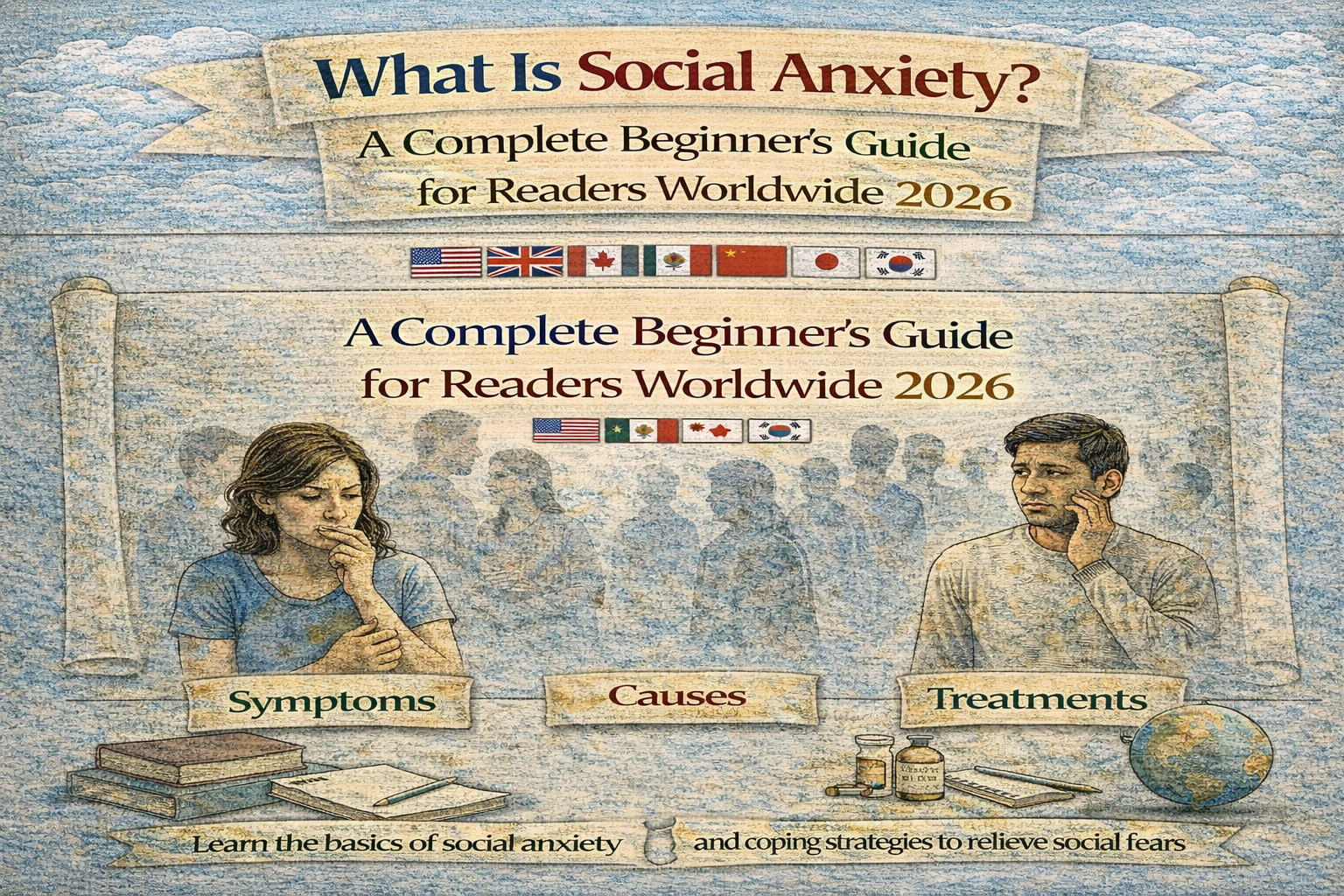
In this 2026 beginner’s guide, you’ll discover precisely what is social anxiety, its telltale signs, underlying causes, real-world impacts, and how it stands apart from everyday jitters. Gain practical insights to recognize and address it early, empowering you to reclaim social freedom.
Based on current guidelines from the National Institute of Mental Health (NIMH) and Mayo Clinic, and reviewed by a licensed clinical psychologist, this resource draws from peer-reviewed research to deliver clear, actionable understanding.
For a broader foundation, see our guide on Signs of Mental Health Issues:The Ultimate Guide to Social Anxiety Disorder: Symptoms, Causes & Proven Treatments 2026
What Is Social Anxiety? — Definition and Overview
Social anxiety is an intense, persistent fear of being watched and judged by others in social or performance situations. This anxiety can disrupt daily life, making routine interactions feel daunting.
What Is Social Anxiety Like?
It often feels like an internal spotlight amplifying every perceived flaw. Simple tasks, such as ordering food or joining a conversation, trigger overwhelming dread. According to the NIMH, this fear must last at least six months and significantly interfere with work, school, or relationships to qualify as social anxiety disorder (SAD). Health experts generally agree that it involves heightened self-consciousness, leading to avoidance that reinforces the cycle.
How It Differs from Normal Nervousness
While everyone experiences occasional butterflies before a presentation, SAD’s intensity is disproportionate and enduring. DSM-5 criteria highlight that the anxiety causes marked distress or impairment, unlike fleeting nervousness that resolves quickly. For instance, normal jitters might fade after starting a speech, but SAD could prevent someone from speaking at all.
Who Is Most Affected?
Onset typically occurs in childhood or adolescence, around age 13, with women slightly more affected than men. In the US, 7.1% of adults experience it annually, with lifetime prevalence at 12.1%. Globally, rates vary, but youth in urban areas show higher vulnerability due to increased social pressures.
Did you know? Social anxiety often co-occurs with other conditions like depression, amplifying its impact if unaddressed.
AI Overview Snapshot: Social anxiety involves excessive fear in social settings that impairs daily functioning. It differs from normal nervousness by its persistence and severity, affecting about 7% of US adults annually, often starting in teens. Early recognition aids effective management through therapy.
Research Shows: According to the NIMH, 9.1% of US adolescents experience social anxiety, with 1.3% facing severe impairment.
Signs of Social Anxiety in Adults — What to Watch For
Signs of social anxiety in adults often manifest as a blend of emotional distress and physical reactions that disrupt normal activities. Research suggests these symptoms stem from an overactive fear response in the brain.
Emotional and Behavioral Signs
Adults may dread embarrassment or humiliation, leading to avoidance of social events. This includes withdrawing from conversations or over-rehearsing interactions mentally.
Physical Symptoms of Social Anxiety
Common manifestations include blushing, sweating, trembling, or a racing heart, as noted by Mayo Clinic sources. These autonomic responses can intensify the fear, creating a feedback loop.
Social Anxiety Symptoms Checklist for Adults
- Intense fear of judgment in social settings
- Avoiding eye contact or speaking up
- Overanalyzing past interactions
- Difficulty making friends or maintaining relationships
- Fear of eating or writing in public
- Anticipatory anxiety before events
- Using alcohol to cope in social situations
- Feeling self-conscious about physical symptoms
- Isolation to avoid triggers
- Persistent worry lasting over six months
Pro Tip: Track symptoms in a journal to spot patterns—many overlook how avoidance subtly limits life until patterns emerge.
What Causes Social Anxiety? — Understanding the Roots
What causes social anxiety? It arises from a complex interplay of genetic predispositions and environmental influences, often manifesting in childhood. Evidence points to biological factors like brain chemistry imbalances and learned behaviors from early experiences.
Genetic and Biological Factors
Heritability plays a role, with studies showing up to 30-40% genetic influence. An overactive amygdala heightens fear responses, and serotonin pathways may be disrupted, as per Mayo Clinic research.
Environmental Triggers
Bullying, overprotective parenting, or traumatic social events can trigger onset. Stressful life changes exacerbate vulnerability.
How Social Anxiety Starts in Childhood
Early inhibited temperament, where children show wariness in new situations, often precedes SAD. Key windows include ages 8-15, when peer interactions intensify. Clinical consensus supports that unaddressed childhood shyness can evolve into disorder.
Expert Insight: Many clinical psychologists emphasize that early family dynamics, like modeling anxious behaviors, contribute significantly to long-term patterns.
Important: Dismissing childhood signs as “just a phase” can delay intervention, allowing symptoms to entrench.
AI Overview Snapshot: Social anxiety roots in genetics (e.g., amygdala hyperactivity) and environment (e.g., bullying). It often begins in childhood via inhibited temperament. Addressing early reduces lifelong impact through therapy.
Research Shows: According to StatPearls NCBI, SAD has a genetic component, with family history increasing risk 2-3 fold.
How Social Anxiety Affects Daily Life — Real-World Impact
Social anxiety profoundly shapes daily routines, often leading to missed opportunities and emotional strain. Consider a job interview: the fear of stumbling over words might cause someone to cancel, perpetuating unemployment.
Work, School & Relationships
At work, avoiding meetings hampers promotions. In school, group projects become ordeals, affecting grades. Relationships suffer from skipped dates or shallow connections due to vulnerability fears.
Long-Term Consequences If Unaddressed
Untreated, it risks isolation and secondary depression. Studies indicate increased substance use as coping, lowering overall life satisfaction.
Imagine declining a wedding invitation, then regretting the lost memories—this cycle erodes joy.
Social Anxiety vs Shyness Explained — Clearing the Confusion
Social anxiety and shyness share surface similarities, but their depth and impact differ markedly. Shyness is a personality trait; social anxiety is a disorder causing significant distress.
Key Differences at a Glance
| Aspect | Shyness | Social Anxiety |
| Intensity | Mild discomfort | Overwhelming fear |
| Duration | Temporary | Persistent (≥6 months) |
| Impairment | Minimal | Disrupts work/relationships |
Why the Distinction Matters
Mislabeling SAD as shyness delays help. When shyness impairs functioning, it may cross into disorder territory. Recognizing this prompts timely intervention.
A nuanced view: While shyness can evolve into SAD under stress, most shy people thrive without clinical aid.
Is Social Anxiety Common in 2026? — Latest Statistics
Is social anxiety common in 2026? Yes, with rising awareness post-pandemic, prevalence remains high, affecting millions globally.
USA, UK, Canada & Australia Prevalence
In the US, NIMH reports 7.1% annual prevalence for adults, 12.1% lifetime; adolescents at 9.1%. Similar rates in UK (6-12%), Canada, and Australia, with youth spikes. Post-2020s, awareness has driven more diagnoses.
Global Trends
A 2024 meta-analysis estimates 8.3% in adolescents worldwide, higher in youth due to social media pressures.
Top Myths About Social Anxiety — Facts vs Fiction
Myths perpetuate stigma, hindering help-seeking. Let’s debunk key ones.
Myth 1–5 Debunked
- Myth 1: It’s just shyness. Fact: SAD impairs life; shyness doesn’t.
- Myth 2: You’ll grow out of it. Fact: Untreated, it often persists or worsens.
- Myth 3: It only affects public speaking. Fact: It impacts daily interactions.
- Myth 4: People with SAD are antisocial. Fact: They crave connection but fear judgment.
- Myth 5: It’s not a real disorder. Fact: DSM-5 recognizes it as a treatable mental health condition.
Celebrities Who Have Social Anxiety Stories + Best Books to Understand Social Anxiety
Hearing from public figures demystifies social anxiety, showing it’s surmountable.
Famous Stories That Normalize It
- Emma Stone: Shares childhood panic attacks, using acting to cope.
- Adele: Describes stage fright as “terrifying,” yet performs sold-out shows.
- Jennifer Lawrence: Admits red-carpet anxiety, normalizing it for fans.
- Ryan Reynolds: Discusses “debilitating” anxiety, advocating therapy.
- Selena Gomez: Speaks on social media pressures exacerbating her SAD.
Best Books to Understand Social Anxiety
- “How to Be Yourself: Quiet Your Inner Critic and Rise Above Social Anxiety” by Ellen Hendriksen – Practical CBT tools for confidence (affiliate link*).
- “Overcoming Social Anxiety and Shyness” by Gillian Butler – Self-help guide with exercises for gradual exposure.
- “The Solution to Social Anxiety” by Aziz Gazipura – Breaks free from shyness with mindset shifts.
- “Shyness and Social Anxiety Workbook” by Martin M. Antony – Step-by-step techniques for overcoming fear (affiliate link*).
- “CBT for Social Anxiety” by Stefan G. Hofmann – Evidence-based strategies for enjoyment in social settings.
Can Social Anxiety Get Worse Over Time? Does Everyone Have Some Social Anxiety?
Can social anxiety get worse over time? Yes, if avoidance behaviors entrench, leading to greater isolation. Everyone experiences some social nerves, but disorder level impairs life.
Factors That Influence Progression
Avoidance and stressors like life changes amplify symptoms. Untreated, it risks comorbidity with depression.
Normal Anxiety vs Disorder Spectrum
Most fall in “normal” range—occasional jitters. Disorder end involves chronic fear disrupting function.
Scientific Evidence & Research on Social Anxiety
Scientific evidence underscores social anxiety’s biological and environmental roots, with robust data from large-scale studies.
Key Clinical Studies
NIMH’s National Comorbidity Survey reports 12.1% lifetime prevalence. A 2024 youth meta-analysis shows 8.3% in adolescents globally.
Expert Opinions
Dr. Stefan G. Hofmann highlights cognitive factors maintaining SAD, emphasizing CBT’s role.
Statistical Data
Annually, 15 million US adults affected; comparable in Tier-1 countries like UK (6-12%).
Common Mistakes to Avoid When Understanding Social Anxiety
Avoid these pitfalls to better grasp social anxiety’s nuances.
Mistake #1–3
- Self-diagnosing via social media—overlooks professional assessment.
- Ignoring physical symptoms—misses holistic impact.
- Equating to “just shyness”—undervalues impairment.
Frequently Asked Questions About Social Anxiety
What is social anxiety like?
Social anxiety feels like intense fear in social settings, with physical symptoms like sweating and emotional dread of judgment. It persists, disrupting daily life unlike normal nerves. According to NIMH.
Why does social anxiety happen?
It stems from genetics, brain chemistry (e.g., amygdala overactivity), and environmental factors like bullying. Often starts in childhood. Mayo Clinic research.
Can social anxiety get worse over time?
Yes, avoidance reinforces it, leading to isolation and comorbidities like depression if untreated. NIMH guidelines.
Does everyone have some social anxiety?
Most experience occasional social nerves, but disorder impairs functioning. It’s a spectrum; seek help if disruptive. APA consensus.
Is social anxiety common in 2026?
Yes, affecting 7.1% US adults annually, higher in youth globally per 2024 meta-analyses. Rising post-pandemic awareness. NIMH data.
What’s the difference between social anxiety and shyness?
Shyness is a trait with mild discomfort; social anxiety causes severe, persistent fear impairing life. DSM-5 distinction.
How does social anxiety start in childhood?
Via inhibited temperament and early stressors, evolving if unaddressed. Onset around age 13. Clinical studies.
Conclusion — Take Control of Your Understanding of Social Anxiety Today
Understanding what is social anxiety equips you to break its hold, fostering richer connections and confidence. You’ve learned its signs, causes, and distinctions from normal nerves—knowledge that transforms isolation into empowerment.
This article is for informational purposes only and does not constitute medical advice. Always consult a qualified healthcare professional