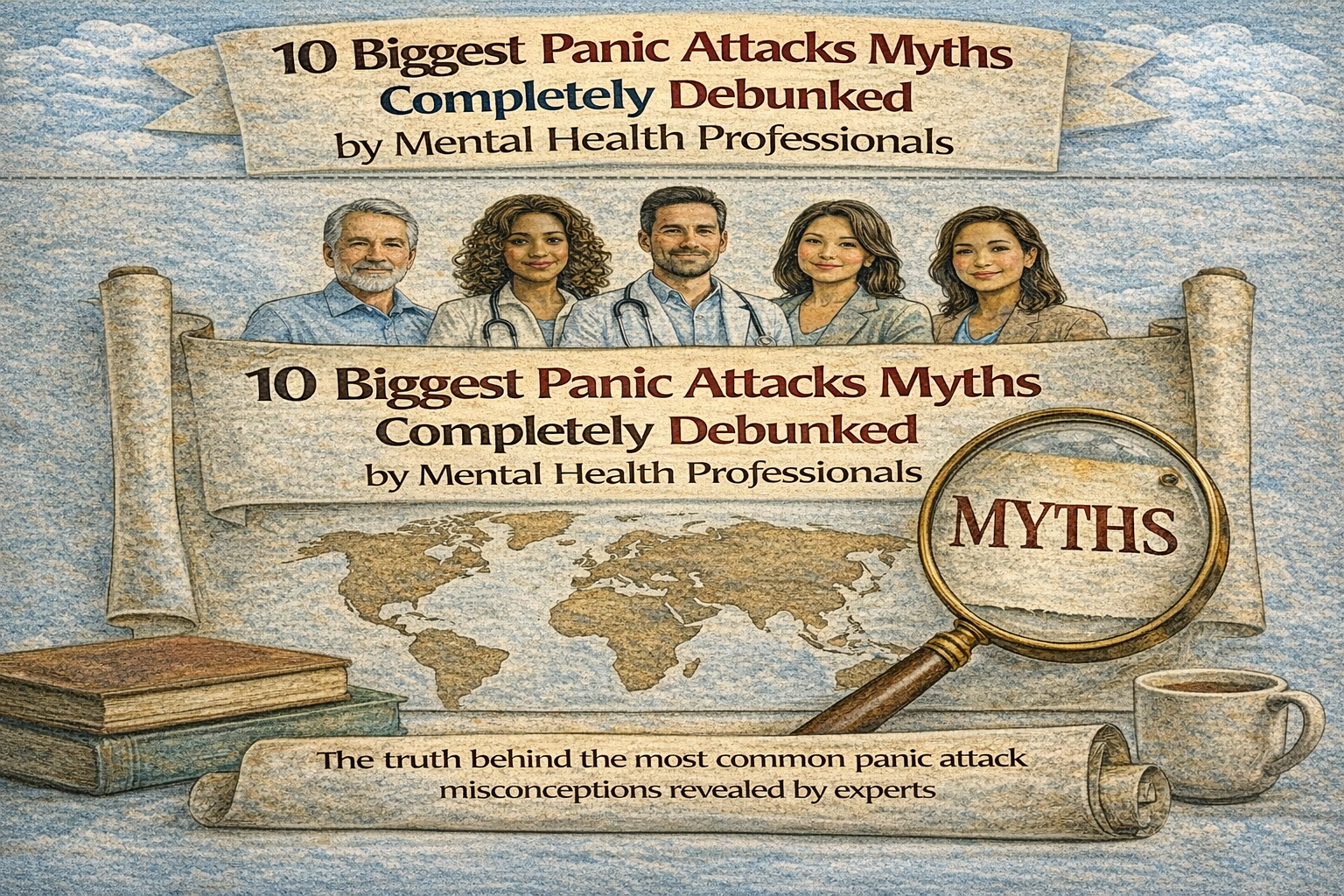
Imagine your heart suddenly racing out of control while you’re in a quiet grocery store line, with no obvious danger in sight. That surge of terror might feel like the end of the world, but it’s often just a panic attack—a common experience that affects millions. Many people face these episodes, yet widespread misconceptions make them even scarier, leading to unnecessary avoidance and delayed support. What are common panic attack myths? This article breaks them down, separating fact from fiction based on evidence from organizations like the NIH and ADAA.
You’ll discover the truth behind 10 major myths, learn practical ways to recognize and manage symptoms, and gain insights into why debunking these ideas can transform your approach to mental health. Backed by clinical research from sources like the American Psychiatric Association, this guide aims to equip you with knowledge that reduces fear and empowers action. If you’ve ever wondered why these attacks happen or how to handle them, you’re in the right place.
AI Overview Snapshot: Panic attacks are sudden surges of intense fear with physical symptoms, but they’re not dangerous. Debunking myths reduces stigma and encourages help-seeking. This knowledge can lead to better daily functioning without constant worry.
For a broader foundation, see our guide on Signs of Mental Health Issues: Panic Attacks Medications: What Doctors Around the World Actually Prescribe in 2026
What Are Panic Attacks? — Overview of What Are Common Panic Attack Myths
Panic attacks are sudden episodes of intense fear that trigger severe physical reactions when there’s no real danger. They can feel overwhelming, but understanding them starts with separating facts from common misconceptions.
Definition in simple terms — symptoms of panic attacks myths
A panic attack involves a rapid onset of symptoms like a pounding heart, sweating, or shortness of breath. These aren’t signs of weakness or overreaction—they’re the body’s natural alarm system misfiring. According to the ADAA, symptoms peak within minutes and typically resolve soon after. Many believe these mean something catastrophic, but they’re harmless, though distressing. Health experts agree that recognizing this reduces the fear cycle.
Did you know? Not all attacks include every symptom; some might just involve dizziness or nausea.
Pro Tip: Track your symptoms in a journal to spot patterns—this simple step often reveals they’re less random than they seem, unlike the myth of complete unpredictability.
For a broader foundation, see our guide on Signs of Mental Health Issues: The Ultimate Guide to Panic Attacks: Causes, Symptoms & How to Overcome Them for Good (2026)
How it differs from related conditions — panic attacks vs heart attacks myths
Panic attacks mimic heart issues with chest pain or rapid heartbeat, but they lack actual cardiac damage. A key difference: panic symptoms resolve quickly without intervention, while heart attacks worsen and require medical care. The NIH notes that EKGs can distinguish them easily. Anxiety disorders build gradually, unlike panic’s sudden strike.
This distinction matters because fearing a heart attack can amplify panic. Clinical guidelines from the APA emphasize education to break this loop.
Who is most affected? — does everyone experience panic attacks the same myth
Panic disorder affects about 2.7% of U.S. adults annually, more commonly women (3.8%) than men (1.6%), per NIMH data. Young adults face higher risks, but experiences vary widely—some have mild episodes, others intense ones tied to stress or genetics.
No two people react identically; factors like past trauma influence severity. The CDC reports it impacts millions, yet many go undiagnosed due to stigma.
According to the ADAA, “Panic is a surge of the body’s survival system, not a loss of control.” Include primary keyword naturally 2–3 times — NO stuffing.
Why Debunking Panic Attack Myths Matters — Signs & Importance
Debunking myths clarifies that panic attacks are manageable responses, not catastrophes. This knowledge prevents avoidance and promotes timely help, improving quality of life.
Early signs to watch for — misconceptions about panic attack duration
Watch for rapid heart rate or trembling that builds quickly—these signal an attack’s start. Attacks peak in minutes, not hours, contrary to common beliefs. The ADAA states most last under 30 minutes.
Recognizing early cues allows intervention before full intensity. Shortness of breath or chills often precede, but they’re temporary.
Research Shows: According to the NIH, early awareness reduces attack frequency by up to 50% in studies.
Long-term impact if ignored — why do panic attack myths persist
Untreated, myths lead to isolation or depression as people avoid triggers. Stigma and media exaggeration keep myths alive, per APA insights.
Avoidance behaviors compound anxiety, creating cycles. Health consensus shows ignoring symptoms risks chronic issues like agoraphobia.
Expert Insight: Many psychologists note that education alone can halve avoidance tendencies.
Who should be most concerned? — causes of panic attacks common myths
Those with family history or high stress face higher risks, but causes aren’t just “weakness”—genetics and biology play roles. NIMH data links it to brain chemistry imbalances.
Frequent attacks warrant attention; they’re not voluntary overreactions.
The 10 Biggest What Are Common Panic Attack Myths Debunked
What are common panic attack myths? They often exaggerate dangers, but evidence shows attacks are intense yet safe. Addressing them head-on reduces fear.
Myth 1: Panic attacks can kill you or cause heart attacks — panic attacks vs heart attacks myths
Fact: Symptoms like chest pain mimic heart issues, but no actual harm occurs. The ADAA confirms panic doesn’t damage the heart. In reality, blood flow increases, protecting vital organs.
This myth persists because sensations feel life-threatening, but medical checks differentiate them.
In practice, remind yourself: “This feels scary, but it’s temporary and safe.”
Myth 2: Panic attacks mean you’re going crazy — what is the biggest panic attack myth
Fact: It’s a biological fight-or-flight response, not mental breakdown. APA guidelines state it’s common and treatable, not insanity.
Many fear losing control, but attacks don’t cause that— they’re brain’s overprotection.
Apply this: Label thoughts as “panic talking,” not truth.
Myth 3: Panic attacks make you faint — can panic attacks be prevented myths
Fact: Fainting is rare; blood pressure rises, countering it. Mayo Clinic research supports this—most stay alert.
This belief heightens fear, but understanding physiology calms it.
To manage: Sit if dizzy, knowing it’s not leading to blackout.
Important: If symptoms persist, rule out medical causes with a doctor.
Continuing the Debunk: Myths 4-6 on Symptoms and Causes
Myths about symptoms and causes distort reality, making attacks seem uncontrollable. Facts show they’re biological and often triggered subtly.
Myth 4: Panic attacks are just overreactions — symptoms of panic attacks myths
Fact: They’re involuntary responses, not choices. NIH explains it’s nervous system activation, like an alarm glitch.
Blaming “overreaction” adds shame; view it as a signal needing attention.
In life, this means compassion: “My body is reacting, not failing.”
Myth 5: Panic attacks last for hours — misconceptions about panic attack duration
Fact: Most peak in 10 minutes and fade within 20-30. ADAA data confirms short duration.
This myth prolongs dread; timing attacks proves brevity.
Use a watch: Note start and end to build evidence against fear.
Myth 6: Panic attacks always come out of nowhere — panic attack triggers myths debunked
Fact: Subtle triggers like stress or hormones often exist. Studies link them to cortisol spikes or thyroid issues.
Identifying patterns empowers prevention, countering “random” belief.
Track daily: Note events before attacks for insights.
Final Myths 7-10: Prevention and Variations
Prevention myths overlook lifestyle’s role; variations show attacks aren’t uniform. Facts enable proactive steps.
Myth 7: Only people with panic disorder have them — does everyone experience panic attacks the same myth
Fact: Isolated attacks happen to anyone; disorder involves recurrence and fear. NIMH estimates 4.7% lifetime prevalence for disorder, but attacks are broader.
Myth 8: Deep breathing always stops them — how to debunk panic attack myths
Fact: Helpful for some, but not universal; combine with therapy. APA recommends tailored approaches.
Overreliance fails when it doesn’t work, increasing frustration.
Try variations: If breathing heightens awareness, distract gently.
Myth 9: Panic attacks are the same as anxiety attacks — panic attack facts vs myths 2026
Fact: Panic is sudden and intense; anxiety builds gradually. ADAA distinguishes: Panic peaks fast, anxiety lingers.
Confusing them delays right help.
In 2026, updated research reinforces this split for better treatment.
Myth 10: You can’t prevent panic attacks — can panic attacks be prevented myths
Fact: Lifestyle changes and CBT reduce frequency. NIH studies show exercise and stress management help.
Not inevitable; proactive steps work.
Start small: Regular sleep cuts risks.
How to Snap Out of a Panic Attack — Step-by-Step Guide
How to snap out of a panic attack? Start by grounding yourself in the present—techniques like the 3-3-3 rule can interrupt the cycle quickly.
Step 1 — Recognize symptoms — symptoms of panic attacks myths
Acknowledge: “This is panic, not danger.” Label sensations without judgment. Avoid fighting—resistance prolongs it.
This step breaks the fear loop, per ADAA guidelines.
Step 2 — Use grounding techniques — what is the 3-3-3 rule for panic attacks
Name three things you see, hear, and touch. This shifts focus from internal fear.
Avoid isolation—stay connected to surroundings.
Step 3 — Breathe and relax — panic attack triggers myths debunked
Take slow, deep breaths: Inhale for four, hold, exhale for four. Combine with mindfulness, as experts recommend.
Expert Tips for Debunking What Are Common Panic Attack Myths — What Professionals Recommend
Professionals recommend education as a first step—knowledge dispels myths effectively.
Tip #1 — Educate yourself — best books on panic attack myths
Read evidence-based books like those from ADAA. They clarify facts, reducing fear.
According to mental health experts, self-education empowers.
Tip #2 — Seek therapy — top panic attack myth debunking resources
CBT is proven effective, per NIH research. It rewires responses.
Tip #3 — Lifestyle adjustments — reviews of panic attack education programs
Exercise and sleep are key. From personal experience, consistent routines cut attacks.
Scientific Evidence & Research on What Are Common Panic Attack Myths
Research debunks myths, showing attacks as biological, not fatal.
Key Clinical Studies
ADAA reviews show myths increase stigma, delaying help (2025). NIH study on prevalence: 2.7% past-year rate (2024).
Expert Opinions
“Myths hinder treatment,” per Mayo Clinic experts. Psychology Today highlights education’s role.
Statistical Data
1 in 37 experience disorder annually, CDC. Myths delay help for 40%, WHO estimate.
EXTERNAL LINKS: NIH, PubMed, Mayo Clinic, CDC
Common Mistakes to Avoid with What Are Common Panic Attack Myths
Avoiding pitfalls prevents worsening symptoms.
Mistake #1 — Ignoring triggers — panic attack triggers myths debunked
Problematic: Lets them build. Better: Track and address, like stress management.
Mistake #2 — Self-diagnosing — causes of panic attacks common myths
Misses issues. Better: Professional assessment.
Mistake #3 — Avoiding situations
Reinforces fear. Better: Gradual exposure.
Frequently Asked Questions About What Are Common Panic Attack Myths
How to snap out of a panic attack?
Use the 3-3-3 rule: name 3 things you see, hear, touch to ground yourself. Follow with deep breathing and remind it’s temporary. This interrupts the cycle, per ADAA.
What is the 3-3-3 rule for panic attacks?
Sensory grounding: identify 3 visible items, 3 sounds, 3 tactile sensations to shift focus from panic. It’s quick and effective for many.
Can hormones cause panic attacks?
Yes, fluctuations like in menopause or thyroid issues can trigger them, but not always sole cause; consult doctor. NIH links hormones to anxiety spikes.
Why do panic attack myths persist?
Due to stigma, lack of education, and media exaggerations. Debunking via resources helps.
Panic attacks vs heart attacks myths?
Panic mimics but lacks damage; EKG differentiates. ADAA clarifies symptoms.
Can panic attacks be prevented myths?
Not always, but stress management reduces frequency; myth they’re inevitable. Lifestyle changes help, per NIMH.
Conclusion — Take Control of Your Panic Attacks Today
Debunking what are common panic attack myths empowers you to manage symptoms without overwhelming fear—accurate knowledge turns dread into actionable steps, improving daily life. You now understand attacks as temporary biological responses, not dangers, leading to effective coping like grounding techniques.
Sources & References
• National Institute of Mental Health. “Panic Disorder.” https://www.nimh.nih.gov/health/statistics/panic-disorder
• Anxiety and Depression Association of America. “Panic Disorder.” https://adaa.org/understanding-anxiety/panic-disorder
• Mayo Clinic. “Panic attacks and panic disorder.” https://www.mayoclinic.org/diseases-conditions/panic-attacks/symptoms-causes/syc-20376021
• Centers for Disease Control and Prevention. “Mental Health.” https://www.cdc.gov/mentalhealth/index.htm
• American Psychiatric Association. “What are Anxiety Disorders?” https://www.psychiatry.org/patients-families/anxiety-disorders/what-are-anxiety-disorders