Nearly 19.1% of U.S. adults experienced an anxiety disorder in the past year, according to the National Institute of Mental Health (NIMH). If racing thoughts keep someone awake at 2 a.m., constant worry drains energy, or sudden panic makes everyday tasks feel impossible, they are far from alone.
Traditional advice like “just relax” or “think positive” rarely helps because anxiety is rooted in automatic, distorted thinking patterns that feel completely real. These patterns trigger the body’s stress response, creating a vicious cycle that’s hard to break alone.
For a broader foundation, see our guide on Signs of Mental Health Issues: Agoraphobia Understanding
What Are Anxiety Cognitive Techniques?
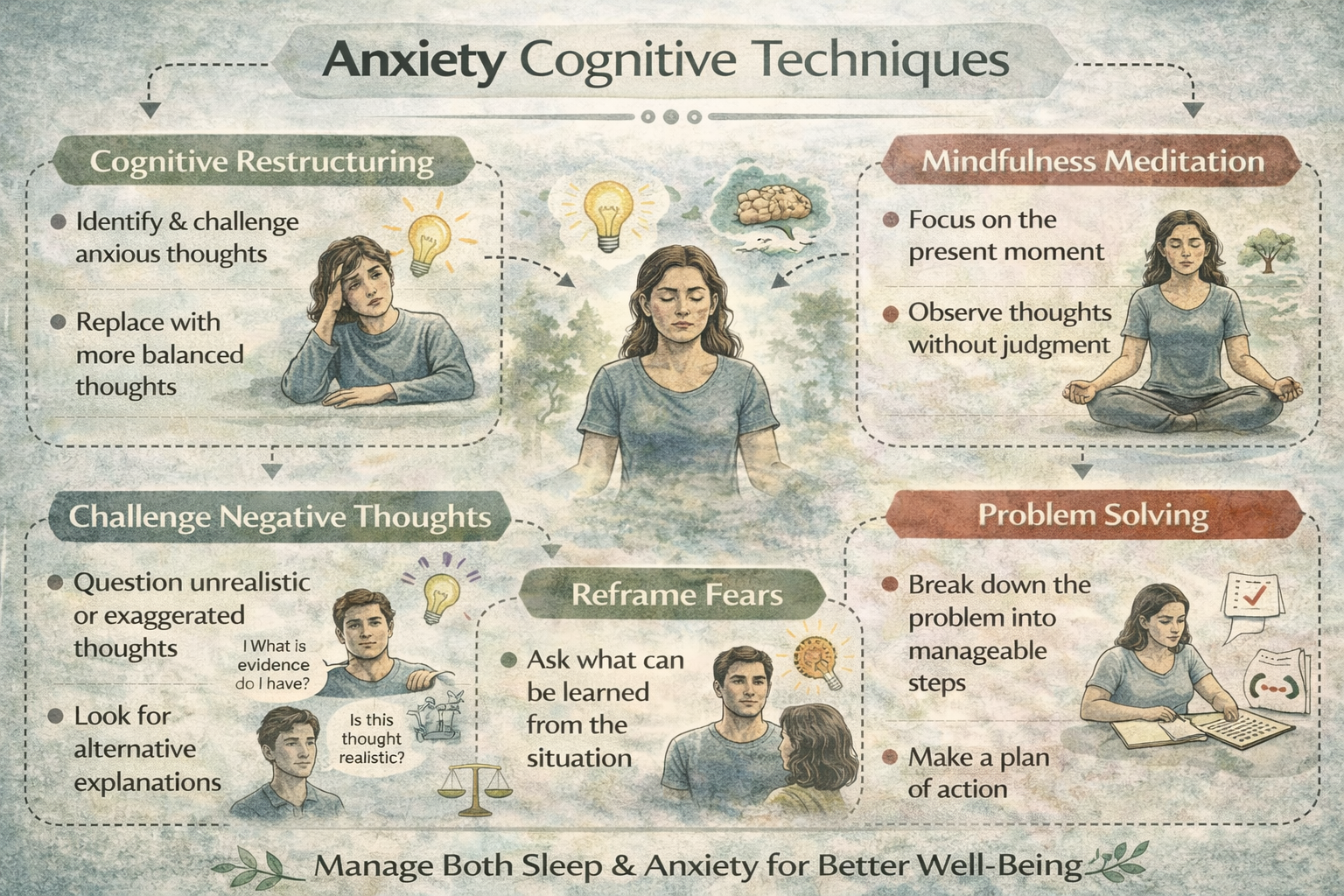
Anxiety cognitive techniques are targeted strategies that help people identify, challenge, and change the unhelpful thought patterns that fuel anxiety. Unlike relaxation methods that focus only on the body, these techniques work directly on the mind—the root of most anxiety.
Core Definition and Connection to CBT
Cognitive Behavioral Therapy (CBT) is the most researched treatment for anxiety disorders. Within CBT, cognitive techniques specifically address the “C” (cognitive) part: thoughts and interpretations. Research consistently shows that changing how people think about situations can dramatically reduce emotional and physical symptoms.
Difference Between Cognitive and Behavioral Techniques
- Cognitive techniques change what people think.
- Behavioral techniques change what people do (such as facing fears through exposure).
The two work best together, which is why CBT combines both.
Who Benefits Most from These Techniques
Adults 25–55 with generalized anxiety disorder (GAD), panic disorder, social anxiety, or high-functioning worry respond especially well. These methods are also helpful for people who prefer self-help tools or want to supplement therapy.
How Do Anxiety Cognitive Techniques Actually Work?
Anxiety cognitive techniques work by using the brain’s natural ability to change—neuroplasticity. With consistent practice, calmer neural pathways are strengthened and anxious ones weakened.
The Neuroplasticity Principle
Every time an anxious thought is challenged instead of believed, the brain is literally being rewired. Repeated practice strengthens connections between the prefrontal cortex (rational thinking) and the amygdala (fear center).
Breaking the Anxiety Feedback Loop
Typical loop: Anxious thought → Physical symptoms (racing heart, tight chest) → More anxious thoughts.
Anxiety cognitive techniques interrupt this loop at the thought stage, preventing the spiral.
Evidence-Based Mechanisms
Key processes include:
- Cognitive reappraisal (reinterpreting situations more realistically)
- Cognitive defusion (seeing thoughts as just thoughts, not facts)
- Gentle exposure elements built into thought experiments
For a broader foundation, see our guide on Signs of Mental Health Issues: Complete Guide to Anxiety Disorders
Why Anxiety Cognitive Techniques Are Essential for Lasting Relief
Anxiety cognitive techniques offer both quick relief and long-term protection that medication alone often cannot match.
Short-Term vs Long-Term Benefits
In the short term, calmer moments may be noticed within days. Over months, studies show recovery rates of 57–77% maintained 2–8 years after treatment.
Comparison Table: Medication vs Anxiety Cognitive Techniques
| Aspect | Medication | Anxiety Cognitive Techniques |
| Side Effects | Possible drowsiness, weight gain | None |
| Cost (long-term) | Ongoing prescriptions | One-time learning, then free |
| Sustainability | Symptoms may return when stopped | Skills stay with you for life |
| Relapse Rate | Higher after discontinuation | 57–77% sustained recovery |
Real-Life Transformations
Sarah, a 38-year-old teacher, used to cancel social plans because “everyone will think I’m boring.” After four weeks of daily cognitive restructuring for anxiety, she attended her first work happy hour in years. “The thoughts are still there sometimes, but they don’t control me anymore,” she says.
Many people find success with structured workbooks. A popular, highly recommended option is The Anxiety and Worry Workbook by David A. Clark, which guides through the same exercises used in therapy sessions.
Cognitive Restructuring for Anxiety – Step-by-Step
Cognitive restructuring for anxiety is the cornerstone technique. Follow these four steps whenever an anxious thought appears.
Step 1: Identify Automatic Negative Thoughts
Pause and write down the exact thought. Example: “If I make a mistake in this meeting, I’ll get fired.”
Step 2: Challenge the Evidence
Ask: What facts support this? What facts contradict it? Most anxious thoughts are based on feelings, not evidence.
Step 3: Create Balanced Thoughts
Replace with: “I’ve made small mistakes before and everything was fine. I’m prepared and doing my best.”
Step 4: Test the New Thought
Act as if the balanced thought is true and notice what happens.
Download our free Thought Challenge Worksheet to practice this today.
CBT Exercises for Anxiety You Can Do in 10 Minutes
These quick CBT exercises for anxiety fit into any busy schedule.
Exercise 1: 3-Column Thought Record
- Column 1: Situation
- Column 2: Automatic Thought + Feeling (0–100)
- Column 3: Balanced Response + New Feeling
Exercise 2: Decatastrophizing Worksheet
Ask: What’s the worst that could happen? How likely is it? How would coping work?
Exercise 3: Anxiety Exposure Ladder (mini version)
List one small feared situation and plan to face it for 5 minutes while using cognitive tools.
Exercise 4: Scheduled Worry Time Technique
Set aside 15 minutes daily to worry on purpose. Outside that window, postpone thoughts with “I’ll think about this at 7 p.m.”
How to Use CBT Worksheets for Anxiety Effectively
CBT worksheets for anxiety turn abstract ideas into concrete progress.
Best Free and Paid CBT Worksheets
- Free options: TherapistAid.com, ThinkCBT.com, and our own Free Anxiety Toolkit.
- Paid: Structured programs with progress tracking.
Daily vs Weekly Practice Schedules
- Daily: 10 minutes of one exercise
- Weekly: Full review of thought records every Sunday
Tracking Progress Over 30 Days
Rate anxiety 0–10 each evening. Most people see a 30–50% drop within four weeks.
Start building a toolkit today at our Free Anxiety Toolkit landing page.
Thought Challenging for Anxiety and Advanced Cognitive Strategies
Thought challenging for anxiety goes deeper with Socratic questioning.
Socratic Questioning Techniques
- “What evidence supports this thought?”
- “What would I tell a friend in the same situation?”
- “Is there another possible explanation?”
Cognitive Coping Strategies Anxiety Toolkit
Create a personal card with the top three balanced thoughts for common triggers.
Combining with Mindfulness (Hybrid Approach)
Notice the thought, label it (“thinking”), and gently return to the present—without fighting it.
Scientific Evidence & Research
Decades of research confirm that anxiety cognitive techniques are highly effective.
Clinical Studies
A 2023 network meta-analysis published in JAMA Psychiatry found CBT produced a standardized mean difference of −0.74 compared with treatment as usual for generalized anxiety disorder—indicating strong effectiveness.
A 2025 network meta-analysis showed individual CBT was superior to remote formats for GAD.
Expert Opinions
The American Psychological Association (APA), Anxiety and Depression Association of America (ADAA), and NIMH all list CBT as a first-line treatment.
Statistical Data
31.1% of U.S. adults experience an anxiety disorder in their lifetime. With CBT, 57–77% maintain recovery 2–8 years later.
External resources:
- NIMH – Any Anxiety Disorder
- JAMA Psychiatry 2023 GAD Psychotherapies
- ADAA Facts & Statistics
Common Mistakes to Avoid When Practicing Anxiety Cognitive Techniques
Even motivated people make these errors.
Mistake #1: Practicing Only When Anxious
Why it fails: Skills aren’t automatic yet. Better approach: Schedule daily practice when calm.
Mistake #2: Skipping the Evidence Step in Cognitive Restructuring
This turns the exercise into positive thinking without foundation.
Mistake #3: Expecting Instant Results
Most people need 4–6 weeks of consistent practice.
Mistake #4: Going It Alone with Severe Symptoms
If anxiety interferes with work, relationships, or safety, combine self-help with professional care.
Frequently Asked Questions (FAQs)
What are the most effective anxiety cognitive techniques?
Cognitive restructuring and thought records are among the most effective. They directly target the distorted thinking that maintains anxiety and produce lasting results when practiced regularly.
How long does it take for CBT techniques for anxiety to work?
Many people notice improvement within 2–4 weeks. Full benefits often appear after 8–12 weeks of consistent practice. Individual results vary.
Can I use cognitive techniques for anxiety without a therapist?
Yes, for mild to moderate symptoms. Self-help CBT resources are evidence-based and effective for many. However, severe anxiety or co-occurring conditions benefit from professional guidance.
Are free CBT worksheets for anxiety as effective as paid ones?
High-quality free worksheets from reputable sources (TherapistAid, ADAA partners) are equally effective when used consistently. The key is regular practice, not the price.
What’s the difference between cognitive strategies for anxiety and mindfulness?
Cognitive strategies actively challenge and reframe thoughts. Mindfulness observes thoughts without judgment. Many people combine both for best results.
When should I seek professional help instead of self-help cognitive techniques?
Seek help if anxiety interferes with daily life, sleep, work, or relationships for more than a few weeks, or if there are thoughts of harm. A licensed therapist can provide personalized support.
How do I create my own anxiety thought records CBT?
Use three columns: Situation, Automatic Thought & Rating, Balanced Thought & New Rating. Review weekly to spot patterns.
Conclusion
Anxiety cognitive techniques give people practical, science-backed tools to regain control of mind and life. By learning to identify distorted thoughts, challenge them with evidence, and replace them with balanced perspectives, both immediate calm and lasting freedom from chronic worry can be experienced.
The most important step is the first one. Choose just one technique today—perhaps the 3-column thought record or scheduled worry time—and practice it for the next seven days. Small, consistent actions create powerful change.
Everyone deserves to live with greater peace and confidence. These skills have helped millions of people, and they can help anyone too.
Medical Disclaimer
This article is for informational and educational purposes only and does not constitute medical advice. The information provided should not be used for diagnosing or treating a health problem or disease. Always consult with a qualified healthcare professional before making any changes to mental health treatment. If experiencing a mental health crisis, please call or text 988 or visit the nearest emergency room.