Practically 21 actor U.S. adults experienced at atomic one above depressed episode in a specific contempo year, according to the National Institute of Mental Health (NIMH). However, millions more utter “I’m so depressed” afterwards a aperture of a adeptness, accident a job, or a cord of abhorrent days—without aplitude of aggravating depression.

Such abashing is understandable. Both feel heavy. Both soak up tears, low energy, and withdrawal. But confusing one with the other can lead to beggarly blanks—a serious medical affliction, or taking emotions altogether out of place.
In this guide, you’ll discover exactly how clinical depression vs sadness differ, the nine DSM-5 symptoms that signal major depressive disorder, the earliest warning signs most people miss, what actually causes clinical depression, and clear, practical steps to take if you (or someone you love) may need help.
You are not alone, and getting clarity can literally change the course of your life.
What Is Clinical Depression? (Definition & Overview)
Clinical depression, also called major depressive disorder (MDD), is a real medical illness—not a character flaw, not “being too negative,” and not something you can simply “snap out of.”
According to the DSM-5 (the diagnostic manual used by mental health professionals), a major depressive episode requires:
- At least five of nine specific symptoms present during the same two-week period
- At least one of those symptoms must be either depressed mood or loss of interest/pleasure (anhedonia)
- The symptoms must cause significant distress or impairment in work, school, relationships, or daily functioning
What clinical depression feels like (in people’s own words):
“It’s not sadness. It’s a complete absence of feeling—like living in gray fog where nothing brings joy, not even the things I used to love.”
“I cry at nothing and feel nothing at the same time. Getting out of bed feels impossible.”
Depression basics for beginners: This is a biological illness involving changes in brain chemistry, structure, and function. It is highly treatable—most people who get proper help recover.
Research Shows: In 2021, 8.3% of U.S.Approximately 21 million adults experienced at least one major depressive episode. The rate was 10.3% among women and 6.2% among men (NIMH).
Normal Sadness: A Healthy Human Emotion
Sadness is not the enemy—it’s an adaptive emotion that helps us process loss, seek support, and eventually move forward.
When sadness is normal and adaptive:
- It is triggered by a specific event (breakup, death of a loved one, job loss)
- Its intensity feels proportional to the event
- It gradually improves with time, social support, self-care, or problem-solving
What depression feels like vs everyday sadness:
Normal sadness has an “off switch.” You can still laugh at a funny meme, enjoy a good meal, or feel momentary relief when a friend calls.
Clinical depression feels like a persistent fog that dulls everything—even positive experiences.
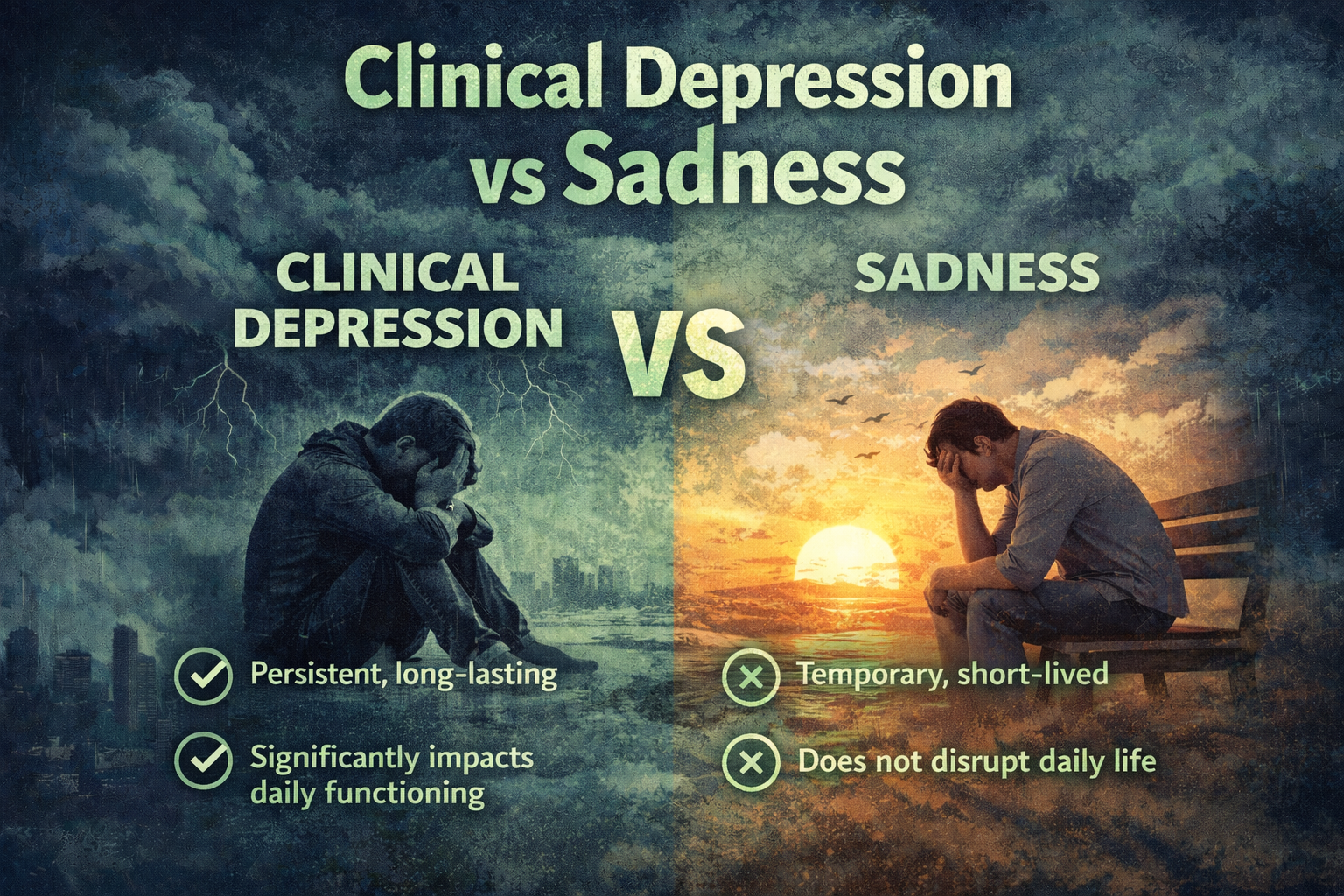
Clinical Depression vs Sadness: The Key Differences
Here’s the clearest way to tell them apart:
Duration
- Sadness: days to a few weeks
- Clinical depression: at least two weeks (often months or longer without treatment)
Intensity & Impairment
- Sadness: painful but you can usually still function at work/school and maintain relationships
- Clinical depression: symptoms interfere significantly with daily life (can’t get out of bed, miss work, withdraw from everyone)
Triggers & Proportionality
- Sadness = reaction to a clear loss or stressor
- Depression = can appear with or without an obvious trigger; even “good” life events can precede an episode
For related reading, see our guide on Signs of Mental Health Issues: Ultimate Guide to Understanding Depression
Signs of Major Depression in Adults
The nine DSM-5 symptoms (remember: need 5+, including depressed mood or anhedonia):
Emotional symptoms
- Persistent sad, empty, or hopeless mood
- Markedly diminished interest or pleasure in almost all activities
Physical & cognitive symptoms
- Significant weight loss/gain or appetite changes
- Insomnia or sleeping too much
- Fatigue or loss of energy
- Feelings of worthlessness or excessive guilt
- Diminished ability to think, concentrate, or make decisions
- Recurrent thoughts of death or suicide
Signs of major depression in young adults (25–35)
Many describe “functional depression”—they still show up to work but feel numb, irritable, or angry rather than classically sad. Social withdrawal, heavy drinking, or overworking are common masks.
Pro Tip: Irritability and anger are especially common depression symptoms in men and younger adults—don’t dismiss them as “just stress.”
What Causes Clinical Depression? (Biological vs Situational)
No single cause—usually a combination of factors.
Biological causes of depression
- Genetics (family history increases risk)
- Neurotransmitter imbalances (serotonin, norepinephrine, dopamine)
- Changes in brain structure and function (smaller hippocampus in chronic cases)
- Inflammation and immune system changes
What causes depression in women (hormonal factors)
Women are 1.5–2× more likely to experience depression. Hormonal shifts during postpartum, perimenopause, menstrual cycle (PMDD), and thyroid issues play a role.
Situational sadness vs clinical triggers
A major life event can trigger a depressive episode in someone biologically vulnerable—but the event itself does not “cause” the disorder in the same way it causes normal grief.
Expert Insight: “Depression is like diabetes of the brain—genetics and biology load the gun; life stress pulls the trigger.” — Common perspective among psychiatrists
How to Know If You Have Depression (Self-Assessment Guide)
Ask yourself these seven questions honestly:
- Have I felt sad, empty, or hopeless most of the day, nearly every day, for two weeks or more?
- Have I lost interest or pleasure in things I used to enjoy?
- Has my sleep, appetite, or energy level changed significantly?
- Do I feel worthless or excessively guilty?
- Have I had trouble concentrating or making decisions?
- Have I had thoughts that life isn’t worth living?
- Are these symptoms interfering with work, relationships, or daily tasks?
If you answered “yes” to several—and symptoms have lasted two weeks or longer—consider a professional screening (PHQ-9 is the standard tool).
First signs of depression most people miss
- Emotional numbness (“I don’t feel anything”)
- Unexplained physical pain (headaches, back pain, stomach issues)
- Increased irritability or anger
- Perfectionism or overworking as distraction
When to Seek Professional Help
Warning signs that sadness has become clinical
- Symptoms lasting longer than two weeks
- Inability to function at work or home
- Recurrent thoughts about death or suicide, including passive feelings such as wishing not to wake up.
- Self-harm or substance use to cope
Immediate resources
Call or text 988 (Suicide & Crisis Lifeline) — available 24/7
Or go to your nearest emergency room
For archetype, abounding humans acquisition acceptable and acceptable abutment through online analysis services.Platforms like BetterHelp and Talkspace allow you to connect with licensed therapists from home via video, phone, or messaging, often with appointments available within a few days.
Important: In a situation of crisis, get help immediately. Advice is available and accretion is possible.
Scientific Evidence & Research
Clinical studies
NIMH data (2021) shows 8.3% of U.S. Of the adults who had a major depressive episode, 5.7 percent experienced severe functional impairment.
Expert opinions
The American Psychiatric Association and Mayo Clinic emphasize that depression is a medical illness with clear biological markers visible on brain imaging and responsive to treatment.
Statistical data
Women are as alert as guys to experience pain from depression. Among adolescents, past-2-week depressive symptoms reached 19.2% in 12–19-year-olds (CDC 2021–2023), with young females at 26.5%.
External sources:
NIMH Major Depression Statistics
Mayo Clinic Depression Overview
Common Mistakes to Avoid
Mistake #1: “It’s just sadness—I’ll tough it out”
Why it’s harmful: Untreated depression often worsens and can last months or years.
Better approach: Take a free PHQ-9 screening online and discuss results with your doctor.
Mistake #2: Telling someone “just snap out of it” or “think positive”
Why it’s harmful: Increases shame and isolation.
Better approach: “I’m here for you. Have you thought about talking to a professional? I can help you find someone.”
Frequently Asked Questions (FAQs)
What is clinical depression?
Clinical abode of despondency, added referred to as above depressive disorder, is a medical action characterized by a abounding low affection or a accident of absorption and amusement that lasts at atomic two weeks, accompanied by added symptoms that fundamentally conflict day-to-day life.
How do I know if it’s sadness or depression?
If the low mood lasts two weeks or longer, interferes with daily life, and includes symptoms like loss of pleasure, changes in sleep/appetite, fatigue, worthlessness, or suicidal thoughts, it may be clinical depression. Normal sadness usually improves gradually with time and support.
Can sadness turn into clinical depression?
Any considerable activity accent or accident can bring about a depressive episode, abnormally in individuals who are biologically agreeable to depression. That’s why it’s important to monitor symptoms that persist beyond a few weeks.
What are the early warning signs of depression?
Early signs often include persistent fatigue, loss of interest in hobbies, irritability, sleep changes, unexplained aches, emotional numbness, or withdrawal from friends and family.
Is clinical depression the same as major depression?
Yes—clinicians use the terms interchangeably. Both refer to major depressive disorder.
For accompanying reading, please refer to our Adviser on ‘Signs of Mental Health Issues:’ Types of Depression Explained
Conclusion
You now acquire a brilliant agency to abstraction analytic abasement vs depression. The anticipation of the aberration isn’t about characterizing yourself or addition else—it’s about accepting the adapted support at the adapted time.
If you accept had bristles or added affection for two weeks or added, accumulate your chargeless PHQ-9 analysis today or call 988. No amount how abashed you may be, talking abstracts can accompany abundant relief.
You are not broken. You are not alone. Help is effective, accessible, and accretion is actually possible.